Can a Contractor Charge Late Fees? (2026): 1.5% a Month on a Homeowner's Unpaid Invoice
When a contractor can charge a homeowner a late fee or interest, what 1.5% a month comes to on a $6,000 invoice, the places that pay interest with no clause, and the states where 18% a year can be too high.
The assumptions
This model assumes
- A contractor billing the owner of a home, not a business
- An undisputed invoice for finished work
- General information, not legal advice; the rules differ by state
Late fees, step by step
Contractors say late fee for four different things. The law treats each one differently, so start by naming the one you mean.
| Charge | Comes from |
|---|---|
| Contract interestA rate on the unpaid balance, such as 1.5% a month. Tested under interest and usury law. | Your signed contract |
| Flat late feeA fixed sum, such as $50. Tested as liquidated damages: it has to be a fair estimate of your loss, not a penalty. | Your signed contract |
| Statutory interestOwed with no clause at all, in the few places that give it to a contractor paid late by a homeowner. | State law |
| Legal interestThe low default rate a court can add when nothing else applies. | State law |
For the first two, the homeowner has to have agreed to the term before the work, in the contract they signed. Don't count on a line printed on the invoice after the job. The agreement has to come first.
A remodeler finishes a job and sends the $6,000 final invoice. Nobody disputes the work. Sixty days after the due date it is still unpaid. The contract says 1.5% a month on past-due balances.
Counted by the day instead, 18% a year for 60 days on a 365 day year is $177.53. Your contract should say which way you count.
1.5% a month is 18% a year. Remember that number, because several states set their ceilings as a yearly rate.
If the contract says nothing, you can't charge 1.5% a month in most states. What is left is legal interest: a low rate set by statute, usually collected only if you sue and win.
| State | 60 days |
|---|---|
| Arizona, 10%A.R.S. 44-1201. Step 4 has the 1.5% a month statute. | $98.63 |
| California, 10%Civil Code 3289, after a breach of contract. | $98.63 |
| North Carolina, 8%G.S. 24-1. | $78.90 |
| Pennsylvania, 6%41 P.S. 202. | $59.18 |
| Michigan, 5%MCL 438.31. | $49.32 |
| Texas, 6%Finance Code 302.002. Starts on the 30th day after the amount is due, so only 30 days count. Step 4 has the 1.5% a month statute. | $29.59 |
That is $30 to $99, against $180 with a clause. The clause is worth having. It also has to be one your state allows, which is the rest of this guide.
A few places give a contractor interest on a late owner payment by statute, and the statute reaches a remodel on one home. Most state prompt payment acts do not: they cover commercial jobs, or contractors paying subs.
District of Columbia
Rate1.5% for each month or part of a month.
Clock7 days after a payment date in the contract, or 15 days after the owner gets your payment request.
FeesA contractor who wins a suit for the interest gets attorney fees.
Texas
Rate1.5% each month.
ClockStarts the day after the 35th day from when the owner received your written payment request.
HousesA written contract on a single-family house can give the owner until before the 61st day.
FeesA court may award attorney fees. It does not have to.
Louisiana, new in 2026
RateA penalty of 1.5% of the unpaid amount per month.
Clock35 days after the owner receives a written payment request.
ChangeAct 822 took effect August 1, 2026. It added the owner's duty to pay and removed the old exclusion for residential work. The act does not say whether it reaches contracts signed before that date.
FeesThe side that wins gets attorney fees. That cuts both ways: lose the suit and you pay the homeowner's lawyer.
Florida
RateThe state's judgment rate plus 12 points: 19.87% a year for the quarter that began October 1, 2026. It resets each quarter.
ClockFrom the 14th day after payment is due under the contract.
NeedsA written contract on a job where you have construction lien rights, a written request for payment and the lien paperwork the lien law calls for. An oral contract gets nothing from this section.
FeesThe section has no attorney fee rule.
Arizona
Rate1.5% a month or fraction of a month.
CatchOn an owner-occupied home, remodels included, the prompt pay rules apply only if the statute's notice is on the front page of each billing or estimate.
Without it10% a year, or whatever rate you agreed in writing.
FeesThe successful party gets attorney fees.
New Jersey
RatePrime plus 1%.
Clock30 calendar days after the billing date. A bill is deemed approved 20 days after the owner receives it, unless the owner objects in writing with the amount held back and the reason.
FeesThe side that wins gets attorney fees.
California has a 2% a month penalty, but only for a progress payment or retention an owner wrongfully withholds. Its appeals courts have held that a last payment due at completion is neither one. An overdue draw or money actually held back keeps the penalty even if it is on the final invoice.
Under these statutes the clock does not start on your invoice date or your due date. It starts when the statute's own deadline passes. Take the same $6,000 in Texas, where the owner received the written request 60 days ago.
| Where | Statutory interest |
|---|---|
| DCDeadline was day 15. 45 days late is two months, because part of a month counts. | $180 |
| Arizona, with noticeDue about day 21. 39 days late is a month and a fraction. | $180 |
| FloridaIf payment was due on receipt: 46 days at 19.87% a year. | About $150 |
| Texas, Louisiana25 days late. The statutes don't say how to count part of a month. | Under $90 |
Two things follow. Send a written payment request and keep proof of the day the owner got it, because that date starts the clock. And don't bill $180 in Texas or Louisiana just because the invoice is 60 days old.
A clause is not the end of it. Some states cap interest below 18% a year, and two cap the late charge on home improvement installment contracts at $5. The caps are written for loans and for agreements to wait for payment. Courts in several of these states have not applied them to a true late charge. Still, these are the states where a lawyer writes the clause.
| State | The limit |
|---|---|
| ArkansasThe state constitution caps interest on loans or contracts. Over the cap, the contract is void as to principal and interest. | 17% a year |
| IllinoisIn written contracts, on money in any manner due and owing, with listed exceptions. 815 ILCS 205/4. | 9% a year |
| Michigan7% a year if agreed in writing. On a home improvement installment contract, one late charge per installment: the lesser of 5% or $5. | 7%, and $5 |
| Pennsylvania6% on the loan or use of money up to $50,000. Same $5 cap on a home improvement installment contract. | 6%, and $5 |
| MinnesotaOn the loan or forbearance of money. Minn. Stat. 334.01. | 8% a year |
| New YorkOn a loan or forbearance. Banking Law 14-a. | 16% a year |
What courts have said. In New York, an appeals court in a contractor's collection case said a late payment charge is not a forbearance. A Minnesota appeals court dealt with a usury challenge to a 1.5% a month late charge on an overdue account. In Pennsylvania, a court enforced 18% a year on the final balance of a home construction contract. Michigan's attorney general and courts treat late payment charges as separate from interest. No Illinois ruling on a homeowner invoice was found, so treat its 9% as live.
Arkansas shows the other risk. In a 2022 home foundation repair case, the late fee did not make the contract usurious, but the court refused to enforce the fee because it was unconscionable.
All of this depends on the charge being a real late charge. You keep the right to collect in full at once, and you act on it. If you agree to let the customer pay later in exchange for the charge, that is the kind of deal the caps are written for.
Maryland goes the other way and says yes. In a consumer contract a late fee of up to 1.5% a month of the past-due payment is allowed, if the contract discloses it and you wait at least 15 days after the bill date.
In Pennsylvania, keep attorney fees out of it. A home improvement contract with a clause awarding the contractor attorney fees and costs is voidable by the owner.
A flat late fee and a payment plan each bring a different rule.
A flat fee, such as $50
The testIt has to be a reasonable estimate of what the late payment costs you. A sum set to punish is a penalty and courts don't enforce penalties.
CaliforniaIn a consumer contract for services, a liquidated damages term is void unless your actual damage would be impracticable or extremely difficult to fix.
Don't stackA flat fee plus monthly interest for the same delay is the easiest version to attack.
Letting a customer pay over time
Late chargeUnder the federal lending rules, a charge for an actual, unexpected late payment is not a finance charge.
The lineIf you routinely let customers pay late and just bill the charge instead of collecting, it can become a finance charge.
CreditorYou become a creditor under those rules if you offer consumers a finance charge or a written plan of more than four installments more than 25 times a year.
Billing draws only for work already completed, with no obligation on the customer to keep paying, is not credit under those rules. A six-payment plan for a balance the customer can't pay is.
You can't add a late charge after the fact. These are the things that have to exist before the invoice is overdue.
In the signed contract
The termThe rate or fee, what it is charged on, the day it starts, and whether you count full months or days. Have a lawyer in your state write it.
Due datesWhen each payment is due. A statute or a clause can't run from a date nobody set.
On every invoice
Due dateThe date this payment is due, matching the contract.
ArizonaThe prompt pay notice on the front page of each billing or estimate, if you want the statute to apply on an owner-occupied home.
When it goes late
Written requestSend a written payment request and keep proof of when the owner received it.
StatementShow the unpaid balance, the days late and how you figured the charge.
Act on itFollow up. A late charge you bill for months without collecting starts to look like financing.
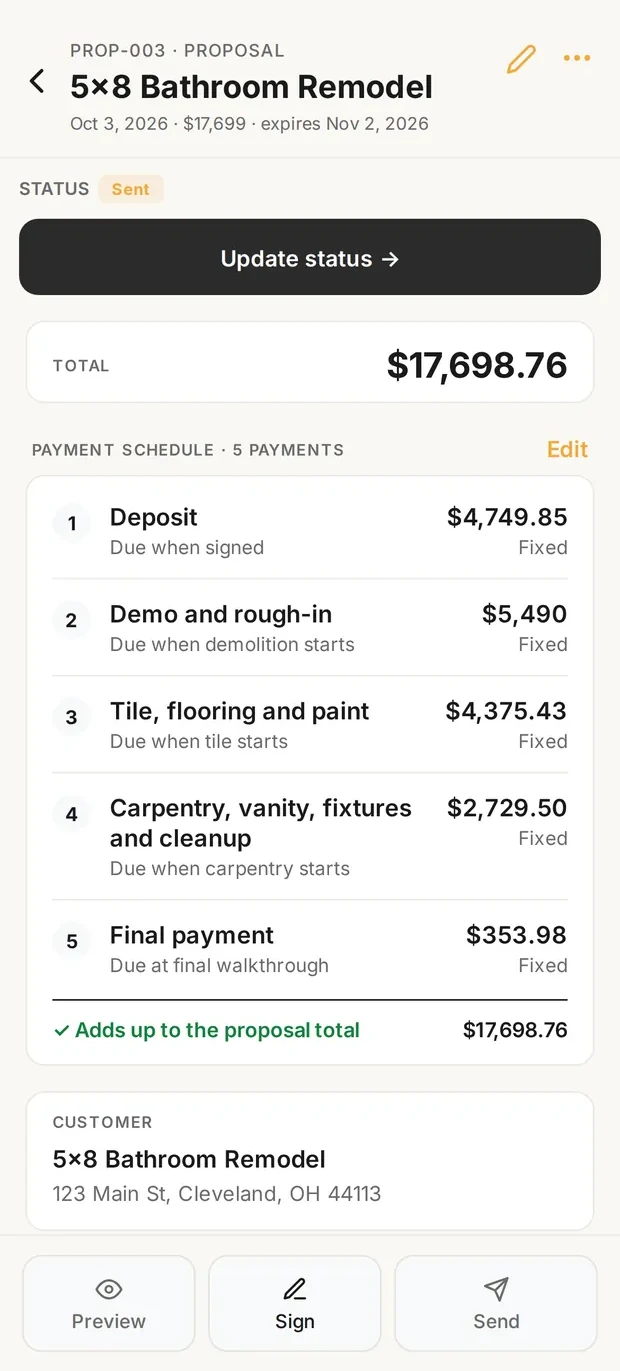
What's billed and when
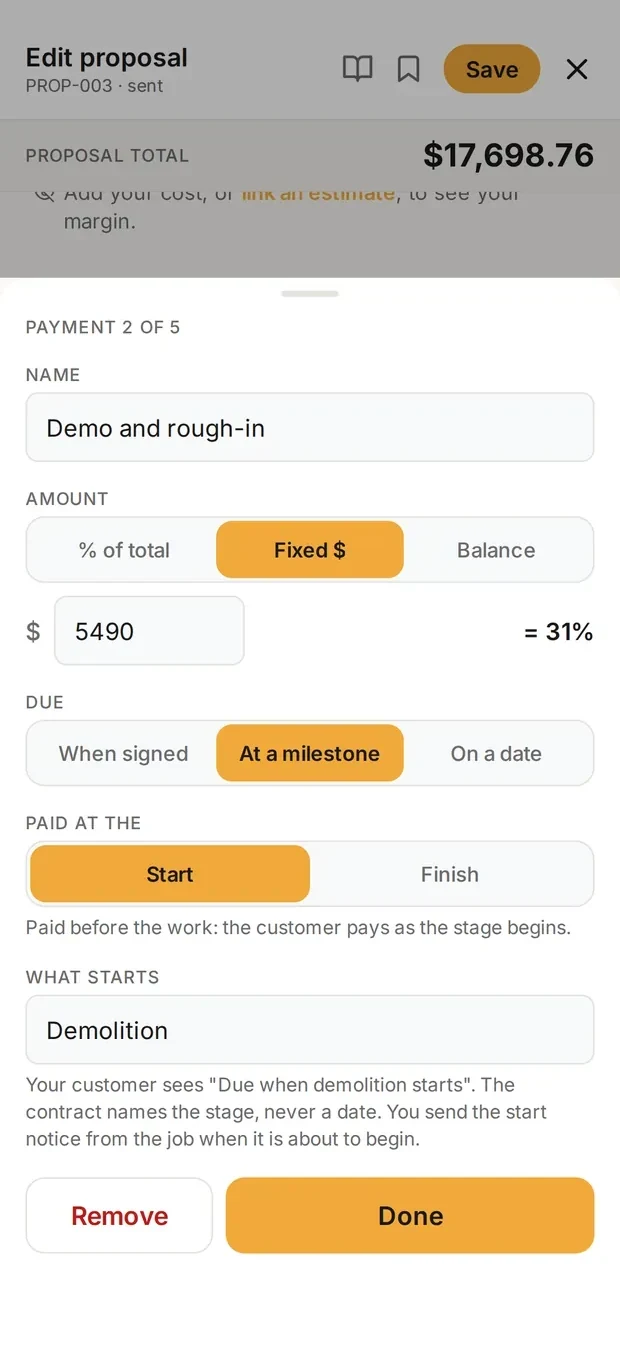
When each payment is due
In Clamp, the invoices a job bills from with their due dates, and where a payment's due date is set. Demo data.
What it means
Put a due date on every invoice
Every Clamp invoice carries a due date, and payments on a job can be due when signed, at a milestone or on a date. You record each payment against its invoice, so you know the day one went past due and what is still owed. Clamp does not write your late fee term and does not add late fees or interest to an invoice.
Late fees don't get you paid; they give the customer a reason to pay sooner and pay you something for waiting. The lien deadline keeps running while an invoice sits. If a balance is 60 days old, check your state's deadline to record a lien before you spend another month sending statements.
Questions
Can a contractor charge a late fee if it is not in the contract?
Not a fee or rate of your own choosing. Without an agreed term you have your state's legal interest rate, which a court can add, and in DC, Texas, Louisiana, Florida and New Jersey the statutory interest those laws give a contractor on a late owner payment.
Is 1.5% a month a legal late fee?
In many states, yes, when it is agreed in writing. Arizona lets parties agree to any rate in writing, and Maryland expressly allows 1.5% a month in consumer contracts. It is 18% a year, which is over the yearly interest caps in Arkansas, Illinois, Michigan, Minnesota, New York and Pennsylvania. Courts in several of those states have treated a true late charge as something other than interest on a loan, but not all, so get the clause written by a lawyer there.
How much interest can I charge on an overdue invoice?
It depends on your state and on what the homeowner signed. With no clause the legal rate runs from about 5% to 10% a year in the states read. With a clause, some states allow any agreed rate and others cap it.
When does interest start on a late invoice?
Under a contract clause, on the date the contract says. Under a prompt payment statute, when the statute's deadline passes: 35 days after the owner receives a written payment request in Texas and Louisiana, and 15 days after the request or 7 days after a contract payment date in DC.
Can I charge a flat late fee and interest too?
It is the riskiest version. A flat fee has to be a fair estimate of your loss from the late payment. Adding monthly interest for the same delay makes it look like a penalty, and in California a flat late fee in a consumer service contract is void unless your actual damage would be impracticable or extremely difficult to fix.
Sources & provenance
- Texas Property Code 28.002, prompt payment by owner to contractor Texas Legislature (official source)
- Texas Property Code 28.004, interest on overdue payment Texas Legislature (official source)
- Texas Property Code 28.006, no waiver Texas Legislature (official source)
- Texas Property Code 28.003, good faith dispute Texas Legislature (official source)
- Texas Property Code 28.005, action to enforce payment Texas Legislature (official source)
- Louisiana Revised Statutes 9:2784, prompt payment Louisiana State Legislature (official source)
- House Bill 638 (2026 Regular Session), enrolled, Act 822 Louisiana State Legislature (official source)
- Resume digest for Act 822 of the 2026 Regular Session Louisiana State Legislature (official source)
- New Jersey Statutes 2A:30A-1 and 2A:30A-2, prompt payment of construction contracts State of New Jersey, read on Justia (research)
- D.C. Code Title 27A, chapter 1, prompt payment in private construction Council of the District of Columbia (official source)
- Florida Statutes 715.12, Construction Contract Prompt Payment Law Florida Senate (official source)
- Judgment interest rates Florida Department of Financial Services (official source)
- Arizona Revised Statutes 32-1182, progress and final payments by owner Arizona State Legislature (official source)
- Arizona Revised Statutes 32-1188, applicability to owner-occupied dwellings Arizona State Legislature (official source)
- Arizona Revised Statutes 44-1201, rate of interest Arizona State Legislature (official source)
- California Civil Code 8800, progress payment State of California, read on public.law (research)
- California Civil Code 3289, rate of interest after breach State of California, read on public.law (research)
- California Civil Code 1671, liquidated damages State of California, read on public.law (research)
- Texas Finance Code 302.002, accrual of interest when no rate is specified Texas Legislature (official source)
- North Carolina General Statutes 24-1, legal rate North Carolina General Assembly (official source)
- Act 6 of 1974 (41 P.S. 201, 202), maximum and legal rates of interest Pennsylvania General Assembly (official source)
- Michigan Compiled Laws 438.31, legal rate of interest Michigan Legislature (official source)
- Michigan Home Improvement Finance Act (MCL 445.1209) Michigan Legislature (official source)
- Pennsylvania Home Improvement Finance Act, 73 P.S. 500-209 Commonwealth of Pennsylvania, read on FindLaw (research)
- Pennsylvania Home Improvement Consumer Protection Act, 73 P.S. 517.7 Commonwealth of Pennsylvania, read on FindLaw (research)
- Arkansas Constitution, Amendment 89 State of Arkansas, read on Justia (research)
- Illinois Interest Act, 815 ILCS 205/4 Illinois General Assembly (official source)
- Minnesota Statutes 334.01, rate of interest Minnesota Office of the Revisor of Statutes (official source)
- New York Banking Law 14-a, rate of interest New York State Senate (official source)
- Maryland Commercial Law 14-1315, late fees State of Maryland, read on FindLaw (research)
- Arizona Revised Statutes 33-1002, definitions Arizona State Legislature (official source)
- Protection Industries Corp. v. Kaskel, 262 A.D.2d 61 (1st Dept. 1999) New York Appellate Division, read on FindLaw (research)
- Dye v. Precision Foundation Specialties, 2022 Ark. App. 220 Arkansas Court of Appeals (official source)
- Pittsburgh Construction Co. v. Griffith, 2003 PA Super 374 Pennsylvania Superior Court, read on Justia (research)
- Widmark v. Northrup King Co., 530 N.W.2d 588 (Minn. Ct. App. 1995) Minnesota Court of Appeals, read on Justia (research)
- Michigan Attorney General Opinion No. 6716 Michigan Department of Attorney General (official source)
- Yassin v. Solis, 184 Cal.App.4th 524 (2010) California Court of Appeal, read on Justia (research)
- Murray's Iron Works, Inc. v. Boyce, 158 Cal.App.4th 1279 (2008) California Court of Appeal, read on FindLaw (research)
- Regulation Z, 12 CFR 1026.2, definitions and official interpretations Consumer Financial Protection Bureau (official source)
- Regulation Z, 12 CFR 1026.4, finance charge, official interpretations Consumer Financial Protection Bureau (official source)