How to Track Painting Labor Hours Against Your Estimate
Your estimate is priced by the square foot. Your timecard is in hours. Turn the estimate into an hour budget first, then the comparison tells you something you can use on the next bid.
The assumptions
This model assumes
- One occupied bedroom repaint, walls only: 425 square feet of previously painted wall, two coats, light patching and normal protection included, no ceiling or trim
- The estimate assumes 85 square feet an hour, the two-coat rate the Painting Contractors Association measured on the same kind of wall
- 6 confirmed labor hours on the job, and no change order. The overrun is illustrative
- A loaded labor cost of $40 an hour and the Established 1.50x markup, so the wall labor sells for $300
- Your own rate comes from your own jobs. The PCA figure is one painter, timed once
The model, step by step
A painting estimate usually starts from measurements, not hours: square feet of wall, linear feet of trim, a count of doors. To compare it with a timecard, divide each quantity by the production rate you assumed for it.
The Painting Contractors Association defines a production rate as "sqft/hr, lnft/hr, or hrs/item". Before you divide, know what your rate covers. A rate per coat needs the area multiplied by the number of coats. A rate that leaves out prep needs prep hours added on their own line.
| Source | What the rate covers | Rate |
|---|---|---|
| Craftsman 2026 estimator | Textured drywall, first coat, rolling only | 400 to 675 sq ft/hr |
| Painting Contractors Association | Previously painted walls, two coats, one painter timed | 85 sq ft/hr |
If your quote prices the walls at $300, that is a selling price. It carries overhead and profit on top of the labor. Dividing it by your loaded labor cost does not give the hours you priced. It gives a bigger number, and a bigger budget hides an overrun.
Clamp estimates price labor at cost and add markup separately, so a painting labor line divided by the loaded rate of the role doing the work is an honest hour budget. Use the same role rate when you log the hours, or the two sides will not match.
The shortcut that hides the overrun
| Wall labor price, 425 sq ft | $300 |
| Divided by a $40 loaded cost | 7.5 hours |
| Actual hours | 6.0 |
| Reads as | 1.5 hours under budget, when it was 1.0 hour over |
Divide a labor cost by a labor cost: $200 of labor at cost ÷ $40 an hour = 5.0 hours. Or divide quantity by production rate.
With the budget in hours, the comparison is subtraction. Run it against the approved scope: if the homeowner added a ceiling by change order, the budget includes the ceiling hours.
The achieved rate is the number to keep. "One hour over" describes one job. "About 71 square feet an hour in an occupied room" is something you can price the next one with.
Here the furniture had to be moved and put back twice because the family was living in the room. That is a real cause, and it points at a fix: price occupied rooms at their own rate instead of raising every rate. Painting overruns tend to come from a short list.
| Cause | Example | Next time |
|---|---|---|
| Occupied room | Furniture moved and restored twice | A separate rate for occupied rooms |
| Extra coat | Dark color going light, or porous patches | Coats and primer written into the estimate |
| Color changed after signing | Homeowner picks a much darker color | Change order |
| Prep beyond what you saw | Cracks and nail pops behind furniture | State the included prep; more is a change order if excluded |
| High walls | Stairwell or vaulted ceiling | Its own line and rate |
| Trim and doors | More casing and doors than counted | Price by linear foot and by each, not by wall area |
| Cut-in ran slow | Nothing changed; the rate was optimistic | Record it; it is an estimating variance |
A solo painter does not need a timer for prime, cut and roll. Log the job's hours and tag the exceptions: prep, paint, trim, rework. A crew of two to four gets more from logging by phase, because 72 hours on a job says nothing about whether prep or trim ran long. Phase is usually more useful than room, unless you price room by room.
Then change the rate only after it repeats. The Painting Contractors Association says to time a crew several times, because "a single run-through won't suffice", and Craftsman tells estimators to keep records of crew productivity.
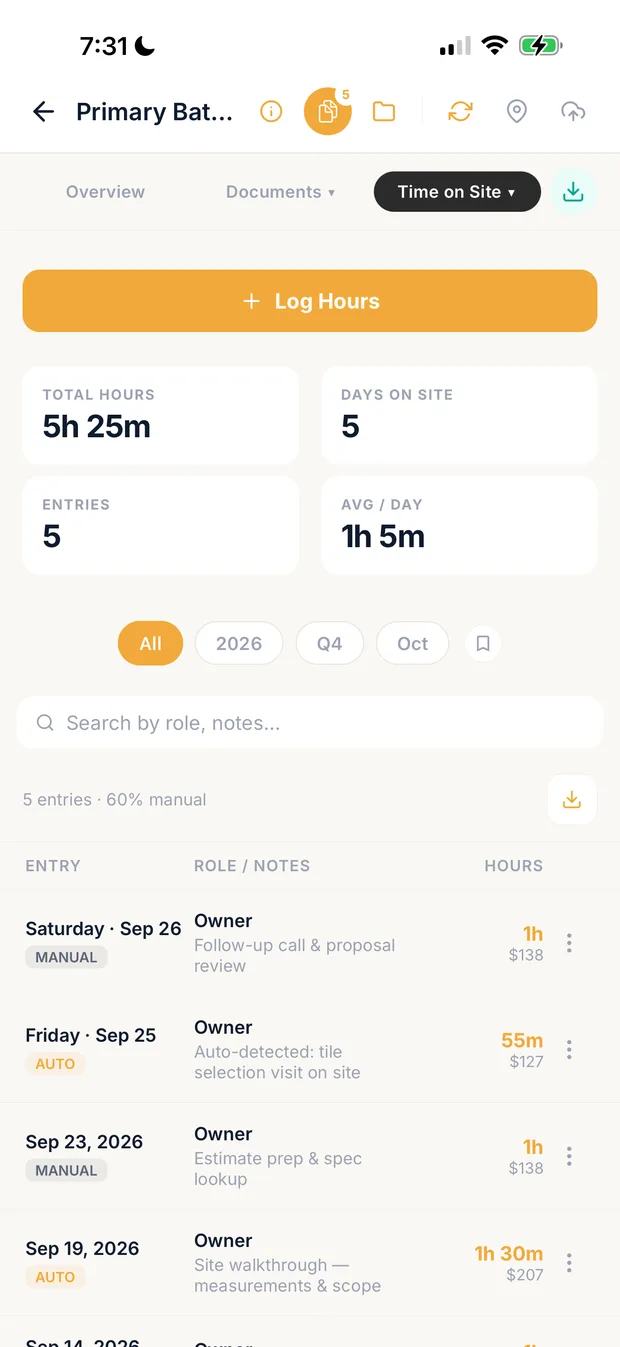
Hours on the job
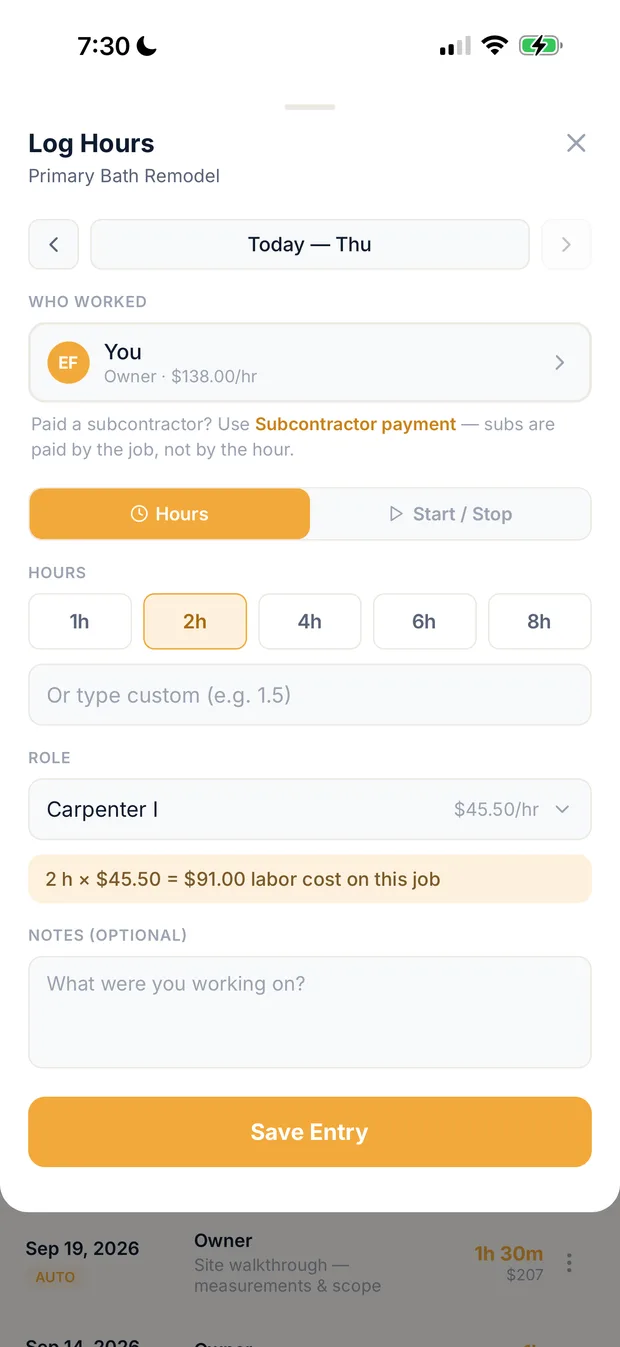
Log hours by role
Sample data. Hours are logged on the job by person and role, and each hour is costed at that role's rate.
Clamp's Job costs card compares labor in dollars: budget from the linked estimate, spent from logged hours at each role's rate. When both use the same rate, dollars over divided by that rate is hours over: $240 spent against a $200 budget is $40, or 1.0 hour at $40. Clamp does not show budgeted hours or an achieved production rate yet, so write the hour budget on the job before it starts.
What it means
Log the hours where the job is
Clamp logs hours on the job by person and role, costs them at that role's rate, and compares labor against the linked estimate on the Job costs card.
An hour budget turns a painting estimate into something your timecard can check. Build it from quantity and production rate, compare it on the approved scope, and keep the achieved rate. After a few jobs, the rate on your next estimate is your own.
Questions
What is a good production rate for interior painting?
There is no single number, because it depends on what the rate covers. Craftsman's 2026 estimator lists 400 to 675 square feet per manhour for the first rolled coat on textured drywall, rolling only. The Painting Contractors Association timed a painter at 85 square feet an hour for two coats on previously painted walls. Use published rates to start, then replace them with your own.
Is an extra coat a change order?
Only if the scope changed after signing, such as the homeowner picking a much darker color. If you knew about the color change when you estimated, the extra coat belongs in the estimate, and running over is an estimating variance. Write the coat count and primer into the estimate so the difference is clear.
Do drying times count as labor hours?
Not by themselves. Waiting for a coat to dry adds days to the schedule, not hours to the timecard, unless the crew stays on site with nothing else to do. If that happens often, it is a scheduling problem to fix, not a production rate to change.
Can I compare hours if I price painting per room?
Yes, as long as you wrote down the hours each room price assumed. A room price with no hour assumption behind it can only be compared in dollars. Record the hours on your next few room prices and you will have a budget to compare against.
Sources & provenance
- Top Painting Companies Don't Guess on Pricing Painting Contractors Association (research)
- 2026 National Painting Cost Estimator (preview) Craftsman Book Company (book)
- Transparent (Poor Hiding) Sherwin-Williams (official source)
- Contractor Time Tracking: Compare Estimated Hours With Actual Job Hours Clamp Research