Conditional vs Unconditional Lien Waivers (2026): Which to Sign, and When
Sign conditional before the check clears and unconditional after. The four waiver types, a $48,000 kitchen worked draw by draw, the states that set their own form, and what your waiver doesn't cover.
The assumptions
This model assumes
- A remodeler hired directly by the homeowner
- Paid by check or bank transfer, in draws
- General information, not legal advice; lien law varies by state
Lien waivers, step by step
A lien waiver gives up your right to put a lien on the property for work you were paid for. Every waiver answers two questions. Is it for a progress payment or the final payment? Does it depend on the money arriving, or not? That makes four kinds, and California's Civil Code prints a form for each one.
| Waiver | Binds you |
|---|---|
| Conditional, progressFor a draw you have billed and not yet been paid | Check clears |
| Unconditional, progressFor a draw already in your bank | Signed and delivered |
| Conditional, finalFor the final payment, before you have it | Last check clears |
| Unconditional, finalFor a job paid in full | Signed and delivered |
Conditional and unconditional is one question. Progress and final is another. A conditional waiver is not the same thing as a progress waiver, and an unconditional waiver is not the same thing as a final one.
Sign a conditional waiver when you hand over paper to get a check. Sign an unconditional waiver only after the money is in your account. California's unconditional forms print the reason on their face: the form is "enforceable against you if you sign it, even if you have not been paid."
The owner asks for a waiver with your invoice
SignConditional. It does nothing until the bank pays the check.
WhyIf the check never comes or bounces, your lien right is where it was.
The check has cleared
SignUnconditional, for the amount that cleared.
WhyThe owner needs proof the draw is settled. Make the through date match what the payment covered, because the form releases everything through that date.
The owner wants unconditional first
SayYou sign unconditional when funds clear, and offer the conditional form today.
TexasNo one may require an unconditional waiver before you have received good funds.
A remodeler bills a $48,000 kitchen in three draws of $16,000. Draw 1 is paid and cleared. At draw 2 the owner says: sign the waiver and I'll hand you the check.
| When | Sign |
|---|---|
| Draw 2, with the invoiceProgress form, $16,000, through the last day billed | Conditional |
| Draw 2 check clearsProgress form, only if the owner asks for it | Unconditional |
| Final, with the invoiceFinal form, $16,000; list disputed extras with a dollar amount | Conditional |
| Final check clearsFinal form. The job is closed | Unconditional |
Signed the conditional form and the draw 2 check bounces? Nothing was waived. You still have a lien right for that $16,000 of work.
Signed the unconditional form instead? In California you gave up the lien right for work through that date, paid or not. You can still sue on the contract, but the property no longer secures the debt.
A progress waiver covers work through one date. Write the last day your invoice covers, not the day you sign. Work after that date is still protected.
Not waived by a California progress form
RetentionMoney held back until the end is not covered.
Unpaid extrasExtra work you have not been paid for is not covered.
Contract rightsYour right to be paid for work the payment does not cover stays.
Watch for
Signed change ordersIn California, work under a change order signed before the waiver date is covered unless you list it as an exception.
Earlier drawsThe conditional progress form has a line for earlier draws you waived conditionally and still haven't been paid for. List each by date and amount.
Other statesArizona and Florida forms use a date too. Nevada's use the invoice or pay application number, and Texas forms the attached pay request.
In some states the waiver has to follow the statute's form or it doesn't count. If the owner, a lender or a title company hands you another form in one of those states, ask for the statutory one. For a remodeler hired by the homeowner, the rules are not all the same.
| State | The form |
|---|---|
| ArizonaA.R.S. 33-1008. No notary. | Four forms, required |
| CaliforniaCivil Code 8132 to 8138. No notary. | Four forms, required |
| NevadaNRS 108.2457. Void if the check fails to clear. | Four forms, required |
| TexasProperty Code 53.284. No notary for contracts from January 1, 2022. | Four forms, required |
| MichiganMCL 570.1115, in the statute's format. | Four forms, required |
| GeorgiaO.C.G.A. 44-14-366. Deemed paid after 90 days. | Two forms, required |
| MississippiCode 85-7-419. Deemed paid after 60 days. Notary block. | Two forms, required |
| Florida713.20. You can't be made to sign a different one. | Two forms, optional |
| Utah38-1a-802. Only good if you are paid. | Two forms |
| MassachusettsChapter 254, section 32. | One partial form |
| Wyoming29-10-101. Notary block. | One partial form |
| Missouri429.016 leaves out owner-occupied remodels. | Not for remodels |
Georgia and Mississippi work on a clock. Once you sign, you are treated as paid after 90 days in Georgia or 60 in Mississippi, unless you file an Affidavit of Nonpayment in the county where the property is before the clock runs out, and send the owner a copy. Georgia gives you seven days after filing to send it, by registered or certified mail or statutory overnight delivery. Mississippi also accepts a claim of lien filed in that time. If a Georgia or Mississippi check is late, calendar that date.
In Florida the forms are optional, and a waiver in another form can still be enforced. But no one may require you to sign a waiver different from the statute's.
Some contracts ask you to waive lien rights up front, before you have done anything. In the states below, the statutes read for this guide don't let that term stand. The wording differs. Some bar any waiver in advance of the work. Others bar a waiver traded for being awarded the job. Arizona and California get there another way: a waiver counts only on the statutory form, and a contract can't waive anyone else's lien rights.
Up-front waivers don't stand
States readArizona, California, Florida, Georgia, Illinois, Massachusetts, Michigan, Mississippi, Missouri, Nevada, New York, North Carolina, Tennessee and Utah.
Florida's words"A right to claim a lien may not be waived in advance."
Texas and Pennsylvania are different on houses
TexasAdvance waivers are void in general. But a waiver written into the original contract for a single-family house, townhouse or duplex, made before work starts, can stand.
PennsylvaniaOn residential property a contractor may waive the right to file a lien claim by a signed writing.
SoIn these two states, read the contract for a lien waiver before you sign it.
Each sub and supplier has its own lien right. Your waiver releases yours, not theirs. California's contractor board tells homeowners that a contractor's release "does not guarantee that other claimants, like subcontractors and suppliers, are paid." That is why owners and lenders ask for waivers from your subs too.
With each sub's bill
CollectA conditional waiver for the amount you are about to pay.
After you payAn unconditional waiver once their check clears. Keep both with the job.
Other tools
Joint checksThe owner writes the check to you and the supplier together. California's board suggests it to homeowners.
MichiganOn a residential job, an owner can't rely on a sub's waiver that did not come straight from the sub without checking it with them first. The rule applies where the sub filed a notice of furnishing or was excused from one.
Waiver or release
WaiverGives up the right to file a lien, at payment time.
ReleaseRemoves a lien that is already recorded.
The whole rule turns on one fact: has this payment cleared? Keep that answer where you bill. Before you sign anything unconditional, check the draw is marked paid and the bank agrees.
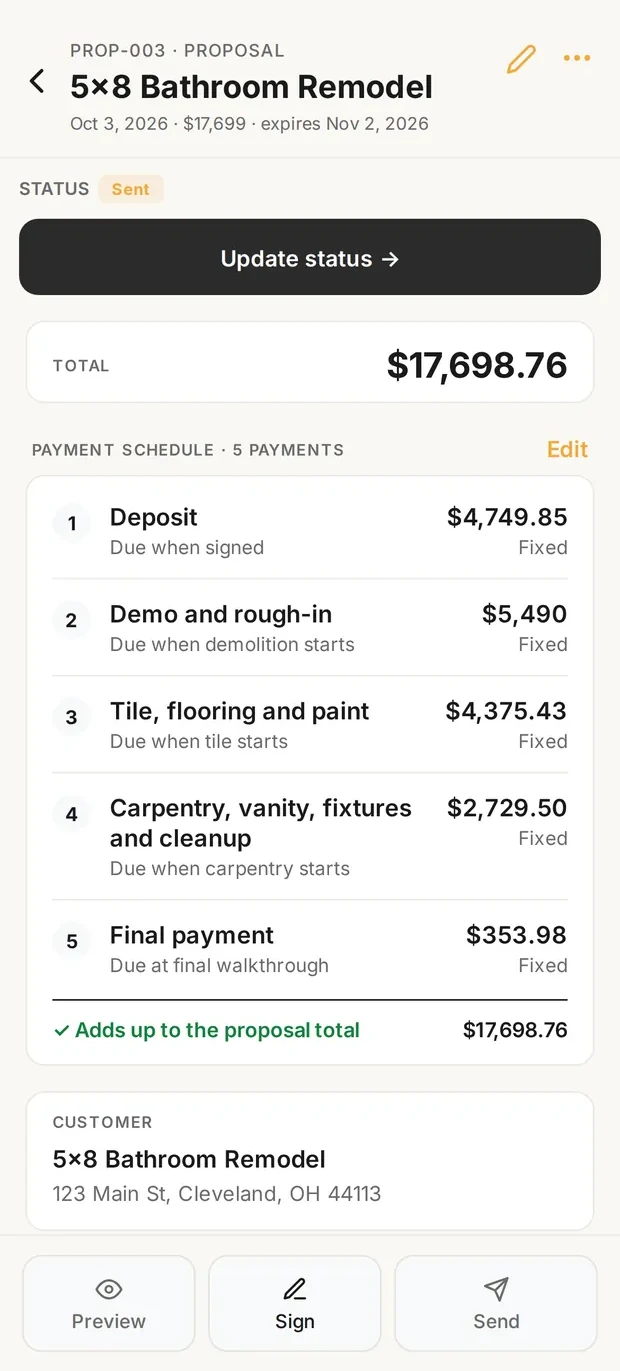
Each draw, by milestone
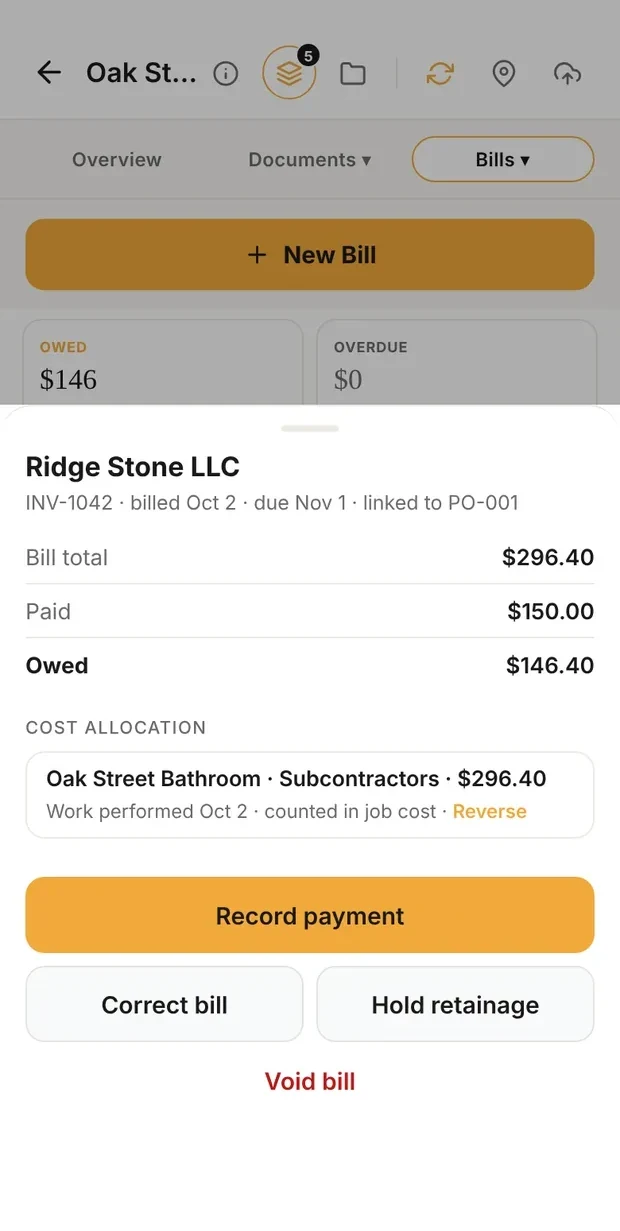
Each sub's bill and payment
In Clamp, the payment schedule a job bills from, and a sub's bill with what's paid and owed. Demo data.
What it means
Know which draw has cleared
Clamp bills a job by milestone and you record each payment against its invoice, so the answer to "has this draw cleared?" is on the job before you sign an unconditional waiver. Each sub's bills and payments are there too, and the default final walkthrough checklist has a line for lien waivers. Clamp doesn't create lien waivers or process payments.
A waiver does not pause your lien deadline. If a check bounces, the clock to record a lien is still running. Before your next draw, find out whether your state sets the form. If it does, print the conditional progress form and send it with the invoice. If the owner's form says unconditional and you haven't been paid, ask to swap it.
Questions
What is the difference between a conditional and unconditional lien waiver?
A conditional waiver only takes effect once the payment it names is actually paid by the bank. An unconditional waiver can bind you once you sign it and hand it over, whether or not you were paid. California's unconditional forms say so in a printed notice. Nevada and Utah void a waiver when the check given for it fails to clear.
Should I sign a lien waiver before I get paid?
Sign a conditional one. It lets the owner release the check and waives nothing until the check clears. Don't sign an unconditional waiver until the money is in your account. In Texas no one may require an unconditional waiver before you have good funds.
Do lien waivers need to be notarized?
Not in most of the states read for this guide. Arizona, California, Michigan and Nevada forms have no notary. Texas dropped notarization for waivers under original contracts made on or after January 1, 2022; the date of the contract controls, not the date you sign the waiver. The Mississippi and Wyoming statutory forms include a notary block, and Georgia's Affidavit of Nonpayment is sworn before a notary.
What is a final unconditional lien waiver?
It says you have been paid in full and gives up all lien rights on the job when you sign. In California the only thing it can leave out is a disputed claim for extras that you list with a dollar amount. Sign it after the final check clears.
Is a lien waiver the same as a lien release?
No. A waiver gives up the right to file a lien and is traded at payment time. A release removes a lien that has already been recorded against the property.
Sources & provenance
- California Civil Code 8132, conditional waiver and release on progress payment State of California, read on Justia (research)
- California Civil Code 8134, unconditional waiver and release on progress payment State of California, read on Justia (research)
- California Civil Code 8136, conditional waiver and release on final payment State of California, read on Justia (research)
- California Civil Code 8138, unconditional waiver and release on final payment State of California, read on FindLaw (research)
- California Civil Code 8122, waiver of another claimant's rights by contract State of California, read on Justia (research)
- California Civil Code 8126, statements purporting to waive a lien State of California, read on Justia (research)
- Conditional and Unconditional Waiver and Release Forms California Contractors State License Board (official source)
- How to Prevent a Mechanics Lien California Contractors State License Board (official source)
- Arizona Revised Statutes 33-1008, waiver of lien Arizona State Legislature (official source)
- Florida Statutes 713.20, waiver or release of liens Florida Senate (official source)
- O.C.G.A. 44-14-366, waiver of lien or bond rights State of Georgia, read on FindLaw (research)
- Senate Bill 315 (2020), signed text Office of the Governor of Georgia (official source)
- Michigan Compiled Laws 570.1115, waiver of construction lien Michigan Legislature (official source)
- Mississippi Code 85-7-419, waiver of lien or claim State of Mississippi, read on FindLaw (research)
- Mississippi Code 85-7-433, forms State of Mississippi, read on FindLaw (research)
- Revised Statutes of Missouri 429.016 Missouri Revisor of Statutes (official source)
- Revised Statutes of Missouri 429.005 Missouri Revisor of Statutes (official source)
- Nevada Revised Statutes chapter 108 (108.2453, 108.2457) Nevada Legislature (official source)
- Texas Property Code 53.284, forms for waiver and release State of Texas, read on public.law (research)
- Texas Property Code 53.282, conditions for waiver State of Texas, read on public.law (research)
- Texas Property Code 53.283, unconditional waiver and release State of Texas, read on Justia (research)
- House Bill 2237 (87th Legislature, 2021), enrolled text Texas Legislature Online (official source)
- Utah Code 38-1a-802, waiver or limitation of a lien right Utah State Legislature (official source)
- Utah Code 38-1a-105, no waiver of rights Utah State Legislature (official source)
- Massachusetts General Laws chapter 254, section 32 Massachusetts Legislature (official source)
- Wyoming Statutes 29-10-101, notice and waiver forms State of Wyoming, read on FindLaw (research)
- New York Lien Law section 34 New York State Senate (official source)
- North Carolina General Statutes 44A-12 North Carolina General Assembly (official source)
- Illinois Mechanics Lien Act, 770 ILCS 60/1 Illinois General Assembly (official source)
- Act 52 of 2006, amending the Mechanics' Lien Law of 1963, section 401 Pennsylvania General Assembly (official source)
- Tennessee Code 66-11-124 State of Tennessee, read on Justia (research)