How to Close Out a Remodeling Job: Punch List, Final Payment, Warranty, and Handoff
A job isn't finished because the last tool leaves. What closeout includes, sample wording from the final walkthrough to the referral ask, the final balance on a published bathroom, lien waivers in plain terms, and the rule that complete is defined in the contract.
The assumptions
This model assumes
- A residential remodeler, solo or with a small crew and trade subs
- The contract and payment schedule are the published 5x8 bathroom, version 3, as scheduled in the invoice guide
- One year on workmanship is the owner's practice, not a standard
- Sample language is a drafting example, not legal advice; lien and warranty law vary by state
The model, step by step
Contract completion, the punch list, the final payment, permit closeout and the start of the warranty are related events. They aren't automatically the same event.
| Event or record | What it is for |
|---|---|
| The contract's definition of complete | Says when the work is complete, how the punch list is handled, and when the final payment is due. Everything below follows from it. |
| The final walkthrough | One deliberate visit to compare the finished work with the contract and signed changes. |
| The punch list | The remaining contract items, written down and agreed. It separates unfinished work from later warranty claims and new requests. |
| The final inspection or permit closeout | What the building department requires, when a permit was pulled. It runs on its own timeline. |
| The final invoice | The last bill, reconciled to the contract, the signed changes and the payments already made. |
| Lien waivers or releases | A record that specified lien or payment rights are released, conditionally or unconditionally, using the form and timing your state requires. |
| The handoff | The warranty terms, care and maintenance, manuals, selections and paint colors, given to the customer. |
| The warranty period | What you'll come back to fix after completion, for how long, under the written terms. |
| Closing out a trade | Each sub finishing their part on the jobsite. See how to coordinate a remodeling jobsite. |
| Closed in Clamp | Your internal record that you marked the job Closed. It isn't proof that the contract is complete, that you've been paid, that permits are closed, or that the warranty has started. |
Sorted from always to only if listed.
| Item | When | Why |
|---|---|---|
| A final walkthrough with the customer | Always | One point where you both compare the work with the contract. |
| A written punch list | Always | Separates unfinished contract work from later warranty and new-work requests. |
| Customer sign-off on the list | Always | Records what both sides agreed remained, and when it was done. |
| A final invoice that reconciles | Always | The final balance ties to the contract plus signed changes less payments. It is never a new, unexplained number. |
| Final payment status | Always | Reconcile what is due, and record whether it was paid or remains disputed. Financial closeout isn't complete while an amount is unresolved. |
| A job cost review | Always, internally | Compares estimated and actual cost before the next similar estimate. |
| Warranty terms | Usually, and already in the signed contract | The handoff reminds the customer what applies. It never invents new terms. |
| Care and maintenance information | Usually | Finishes and products often have care requirements. |
| Product manuals and manufacturer warranties | Usually, when products were installed | The customer needs them for the products, separate from your warranty. |
| Selections and paint colors | Usually | For touch-ups, repairs and the next job at the same house. |
| Final photos | Usually | A record of the finished work. |
| The review and referral ask | Usually | Once the customer is happy. |
| The final inspection or certificate of occupancy | When the permit requires it | Depends on the jurisdiction and the work. |
| Lien waivers or releases | When your state's law or your contract requires them | The right form and timing are set by state law. |
| A check-in before the warranty ends | Only if it's your policy | A service habit, not a requirement. |
| Maintenance visits | Only if sold or promised | Don't create an obligation the contract never included. |
The lines below are this guide's examples to adapt, not a script or legal advice. Have your contract's completion, punch list, payment and warranty terms reviewed in your state.
Not "fix trim" or "paint issue". Each item names the place and the fix, so both of you can tell when it's done.
Michael C. Stone, a builder and remodeler with more than six decades in the industry and the author of Markup & Profit: A Contractor's Guide, Revisited, puts the punch list in the contract: one list, put together jointly, tied to the original contract and signed change orders, signed off as items are done. After completion, later issues move to the warranty.
The final invoice is never where undocumented extras appear for the first time. Under this guide's change-order rule, unsigned extra work doesn't first show up on the final invoice.
Don't promise a different term at closeout than the signed contract gives.
In Profitable Sales: A Contractor's Guide, Stone has the salesperson visit shortly after completion to see how the job turned out, confirm the customer is satisfied, learn what could have gone better, and ask for a referral. He suggests asking about one person rather than "who do you know?".
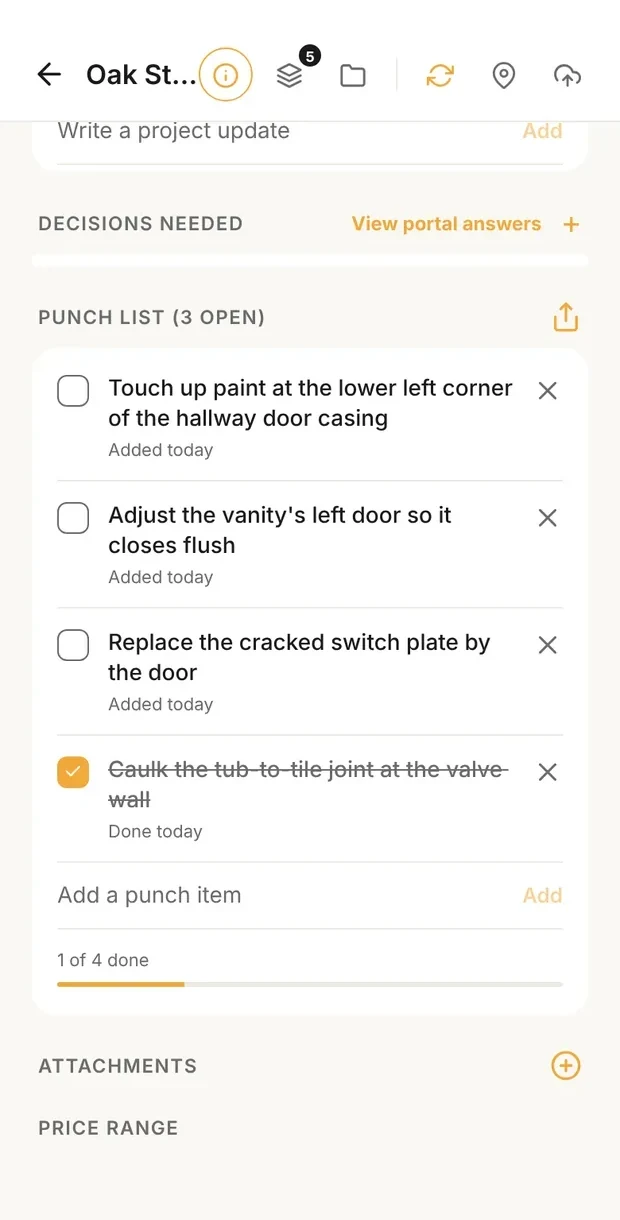
The punch list
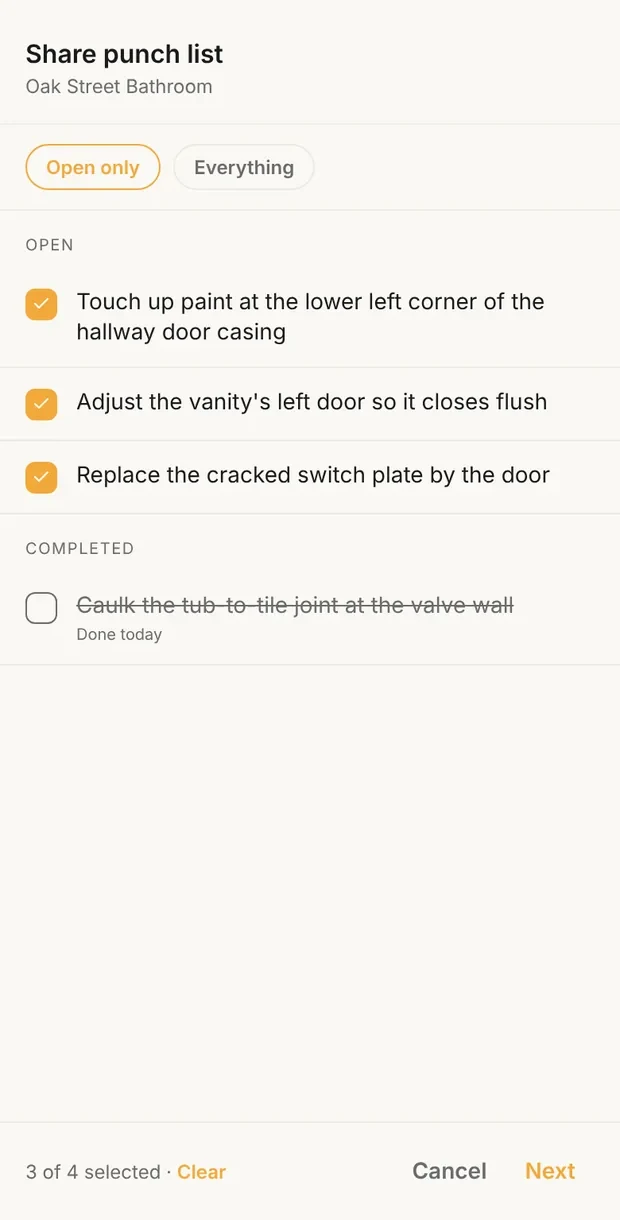
Sharing it for sign-off
The Oak Street job's punch list in Clamp, and sharing it: open items only or everything, as a text or as a PDF with Contractor and Homeowner sign-off lines. Demo data on the published 5x8 bathroom.
Answer with the contract and the signed punch list, not a feeling. "The cabinet door is on the punch list, and we'll adjust it. When the final payment is due is set by the completion and payment terms we signed. If those terms allow an amount to be held for an open item, we'll write down that amount for that item. Otherwise we follow the payment terms as written."
This case teaches more than a customer who keeps adding items, because it separates completion, punch work, money and the contract. Don't tell the customer they're legally required to pay with an item open. That depends on the contract and your state's law. A small final payment limits how much is still outstanding at closeout. That's why the payment schedule is designed before construction starts: see the invoice guide.
The final balance on the published 5x8 bathroom, using the payment schedule from the invoice guide.
| Line | 5x8 bathroom |
|---|---|
| Original signed contract | $17,698.76 |
| Plus signed change orders | None |
| Less signed credits | None |
| Adjusted contract total | $17,698.76 |
| Less payments received (deposit $4,749.85 and three stage payments: $5,490.00, $4,375.43, $2,729.50) | $17,344.78 |
| Final balance due | $353.98 |
Cross-check: the payments received plus the final balance equal the adjusted contract total. It should also equal the final payment in the signed schedule, plus any change billed to the final payment. Here the schedule's final payment is $353.98, so it ties. If it doesn't, find out why before you send it.
The job cost review. Compare estimated with actual cost, by category, before you close the books on the job:
In Estimating Construction Profitably, chapter 12, Stone has you job-cost every completed job, comparing actual against estimated labor, materials, subcontracts and other costs, ideally section by section. With a mature estimating system, Emmanuel Forge's Minimum Pricing course aims to bring actual job cost within about 2% of the estimate, either way. That is his experience-based target, earned by repeating a scope, not a benchmark. The method, with a worked example, is in How to Job Cost a Remodeling Job.
Complete is defined in the contract.
Write down, before the job starts:
Then the walkthrough, the punch list, "while you're here", the final payment and the first callback all have an answer you agreed to in advance. Without it, the last week of the job is a negotiation.
This is the owner's practice. It doesn't replace your state's law: have the completion, payment and warranty terms reviewed in your state.
Decide these before the contract is signed.
| Decision | Options | This guide's practice |
|---|---|---|
| What counts as complete | Every punch item done; the contract's definition, with a defined punch list | The contract's definition. A defined punch list is part of a complete job, not a reason the job isn't complete. |
| Money held for punch items | Hold the value of open items; no new holdback | No new holdback. The final payment is already small. If the contract allows withholding for an open item, write down a specific amount for that item. |
| The warranty term | A term you set and have reviewed; no written term | One year on workmanship, as the owner's practice. Write what it covers, what it excludes, when it starts and how to report a claim, and have it reviewed for your state. |
| Before the warranty ends | A second walkthrough; a check-in; nothing | An optional check-in, not a second inspection. |
| When to ask for a review and a referral | At the walkthrough; after the final payment, once the customer is happy | After closeout and the final payment, once you've confirmed they're happy. Ask for one person, not "anyone". |
| Something reported after sign-off | Treat it all as punch work; sort it | Sort it: unfinished contract work, a warranty claim, damage or upkeep, or new work. New work starts at the first call. |
The FTC notes that builders' warranties, which can come with a new home or a remodel, vary in what they cover and for how long. One year is this guide's practice, not a standard. State law may also create implied warranty rights that differ from your written warranty, and may limit how those rights can be disclaimed.
What customers say at closeout, and what to say back.
| The customer says | What to say back |
|---|---|
| "I'm not paying until every last thing is done." | "Let's use the completion and payment terms in our contract and the punch list we signed. Every remaining contract item is on it, and we'll follow those terms." |
| "I found three more things after we signed the list." | "Let's sort them. A warranty issue we'll look at under the warranty. New work we'll price separately. If one is truly unfinished contract work, we'll add it." |
| "We'll pay after the inspector comes." | "Let's check the contract. The final inspection and the final payment are separate unless our agreement ties them together." |
| "While you're here, can you just fix this too?" | "Happy to look. First let's decide whether it's punch, warranty or new work, so we record it right." |
| "Why do you need a lien waiver?" | "It documents which payment-related lien rights are being released, and whether that release is conditional on payment. The form depends on state law, so we use the one required here." |
| Mistake | What to do instead |
|---|---|
| No definition of complete in the contract | Define complete, the punch list, the final payment trigger and the move to warranty before the job starts. |
| A punch list that never ends | One walkthrough, one signed list. Sort anything reported later as unfinished contract work, warranty, damage or maintenance, or new work. |
| Vague punch items | Name the place and the fix. |
| A final invoice that doesn't reconcile | Show the contract, plus signed changes, less credits, less payments. |
| Extras appearing for the first time on the final invoice | If it wasn't signed, it isn't billed there. Use a change order before the work. |
| A generic lien release from the internet | Use your state's form where it provides or requires one. |
| Asking a sub for an unconditional waiver before they're paid | An unconditional waiver says payment was received. Match the waiver to the payment. |
| Treating Closed in your software as completion | Your app's status is your record. Completion, payment, permit closeout and the warranty start are their own events. |
| No recorded warranty start | Record the date the written terms start it from. |
| Warranty terms given out loud at the handoff | Put them in the signed contract and hand the customer a copy. |
| Skipping the job cost review | Review every job before you price the next similar one. |
| Asking for a referral before checking they're happy | Confirm they're satisfied, then ask. |
| "Know anyone who needs work?" | Ask about one person who'd be a good fit. |
What it means
Closeout in Clamp
The punch list lives on the job: add items, check them off, and each records when it was done. Share punch list sends the open items or everything as a text or a PDF with your letterhead and Contractor and Homeowner sign-off lines. The payment schedule's last row is the final payment, due at the final walkthrough by default, and signed change orders count in the contract total. You can record each payment, and add your own payment link that the customer portal shows as Pay invoice. When every invoice is paid, Clamp asks whether to close the job; if money is still open, it tells you before you close. Closing records the date, the portal shows the project as completed, and the job comes up for a final job cost review. The Referral and Repeat Customer lead sources mark where your next jobs come from. Clamp doesn't make lien waivers, track warranty claims or send review requests.
Score your Leads system in the contractor business self-assessment, where question 19 asks whether you have a system for referrals and repeat business, and see how to set a payment schedule and invoice a remodeling job for sizing the final payment before the job starts.
Sources & provenance
- Markup & Profit: A Contractor's Guide, Revisited Michael C. Stone (book)
- Estimating Construction Profitably Michael C. Stone (book)
- Profitable Sales: A Contractor's Guide Michael C. Stone (book)
- Warranties for New Homes Federal Trade Commission (official source)
- California Civil Code sections 8132, 8134, 8136 and 8138 California Legislature (official source)
- Arizona Revised Statutes section 33-1008 Arizona Legislature (official source)
- Texas Property Code chapter 53, including section 53.281 Texas Legislature (official source)
- Nevada Revised Statutes section 108.2457 Nevada Legislature (official source)
- 5×8 Bathroom Remodel Cost and Labor (2026 Baseline) Clamp Research
- How to Set a Payment Schedule and Invoice a Remodeling Job Clamp Research