What Is a Good Close Rate for a Contractor? Measure Yours Against Your Plan
There is no close rate that is right for every contractor. Work out the rate your plan requires, then measure yours so you can trust it: count only qualified leads, count a win only at the signed contract, and leave out leads that have not decided.
The assumptions
This model assumes
- The solo business from What a Solo Contractor Has to Charge to Make $100,000 and How Many Leads Does a Contractor Need?: eight projects a year
- A qualified lead scores four or five on the five criteria in How to Qualify a Contractor Lead in Seven Minutes
- The win is a signed construction contract
- The counts in the worked examples and on the screens illustrate the arithmetic. They are not results from any contractor.
The model, step by step
There are two common ways to calculate a close rate, and they answer different questions. Jobs ÷ all inquiries mixes marketing and selling together, so a bad month of calls and a bad month of sales look the same. Jobs ÷ qualified leads isolates the sales conversion part of the funnel more cleanly.
This page uses the qualified-lead rate. It is the same rate the formula in How Many Leads Does a Contractor Need? asks for. The share of inquiries that qualify is a separate ratio, tracked on its own.
A construction job is won when the construction contract is signed. A verbal yes is neither a win nor a loss until that happens, or until the lead is clearly lost.
If your process sells a paid planning step first, there are two sales, and each one gets its own rate: qualified lead to paid planning agreement, then paid planning agreement to signed construction contract.
Do not combine the two rates. The first tells you whether qualified leads accept your process. The second tells you whether planning clients go on to build. This page's main close rate runs from qualified lead to signed construction contract. When to Charge for the Estimate, and How Much covers the planning step.
An open lead belongs in pipeline reporting, not in the close-rate denominator yet.
| Qualified leads | Count |
|---|---|
| Won | 8 |
| Lost | 16 |
| Still deciding | 6 |
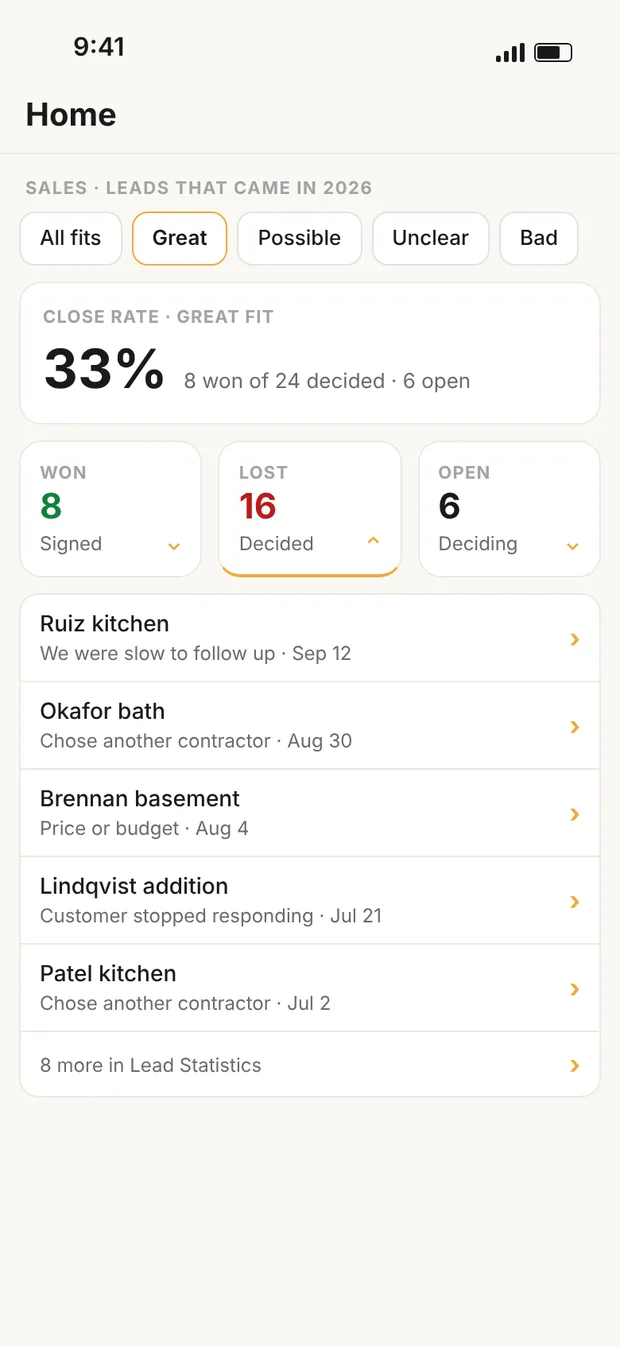
33% of decided
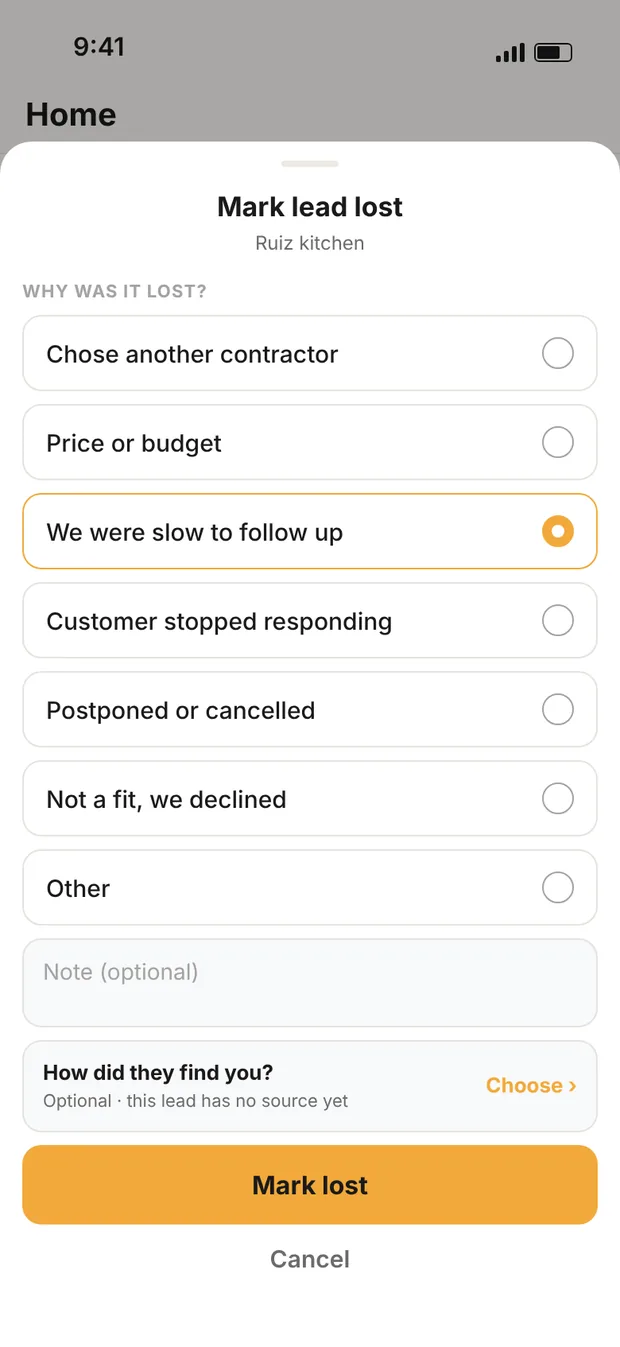
Lost, and why
The same illustration in Clamp: the close rate counts decided leads and shows the open ones beside it, and marking a lead lost records why. Illustrative data, not results.
If the six open leads are counted as losses, the same pipeline shows 26.7%.
The 6.7-point gap is not a change in how well you sell. It is pipeline timing. Remodeling decisions can take months, so the error is largest when the pipeline is fullest, and it shrinks as those leads decide.
Your main close rate stays limited to fours and fives. Separately, track outcomes for each grade band (zero to one, two to three, four to five) to see whether your grading separates stronger opportunities from weaker ones.
Regrade a lead when you learn something new about the project, the budget or the people, such as after a site visit. Do not regrade it because of how it ended. A grade changed after the outcome makes your grading look better at predicting buyers than it was.
The grading method in How to Qualify a Contractor Lead in Seven Minutes comes from a course whose position is that a lead totaling zero will be very hard to close. Your own outcomes by grade are how you test whether the grading is useful in your business. They are evidence about your process, not proof that the grade caused the outcome.
At eight jobs a year, the numbers are small.
| Decided qualified leads in the period | One job moves the rate by |
|---|---|
| 24, about a year | 4.2 points |
| 6, about a quarter | 16.7 points |
Use a rolling 12 months for the headline rate, and group leads by when they came in. For each group, divide the wins by the leads that have decided, and keep the number still open beside it. A recent group is incomplete until its leads decide, so read it as early, not as final.
A lead nobody followed up on does not stay open forever. When it dies, it is decided: it is lost. Record why, because a lead lost to a slow response is something you can fix, and it looks very different from one lost on price.
Use the number of qualified leads your lead system produces now, not the number you hope for.
| Qualified leads a year | Close rate required |
|---|---|
| 18 | 44.4% |
| 24 | 33.3% |
| 32 | 25.0% |
If your measured rate is below the required rate, the business has to change one or more of three things. Generate more qualified leads, as How Many Leads Does a Contractor Need? works through. Convert more of the qualified leads you already have. Or need fewer jobs by raising the average sold-project size. Larger projects also take more production hours, and they can change how many qualified leads you see, how long they take to decide and how many you close. If you change project size materially, rerun the lead plan rather than assuming the old lead volume and close rate still apply.
A falling rate is a reason to ask questions, not a diagnosis. Did it drop in one grade group, or in all of them? Did it drop before paid planning or after it? Did the share of fours and fives change? Did the average project size or budget range change? Did leads start taking longer to decide?
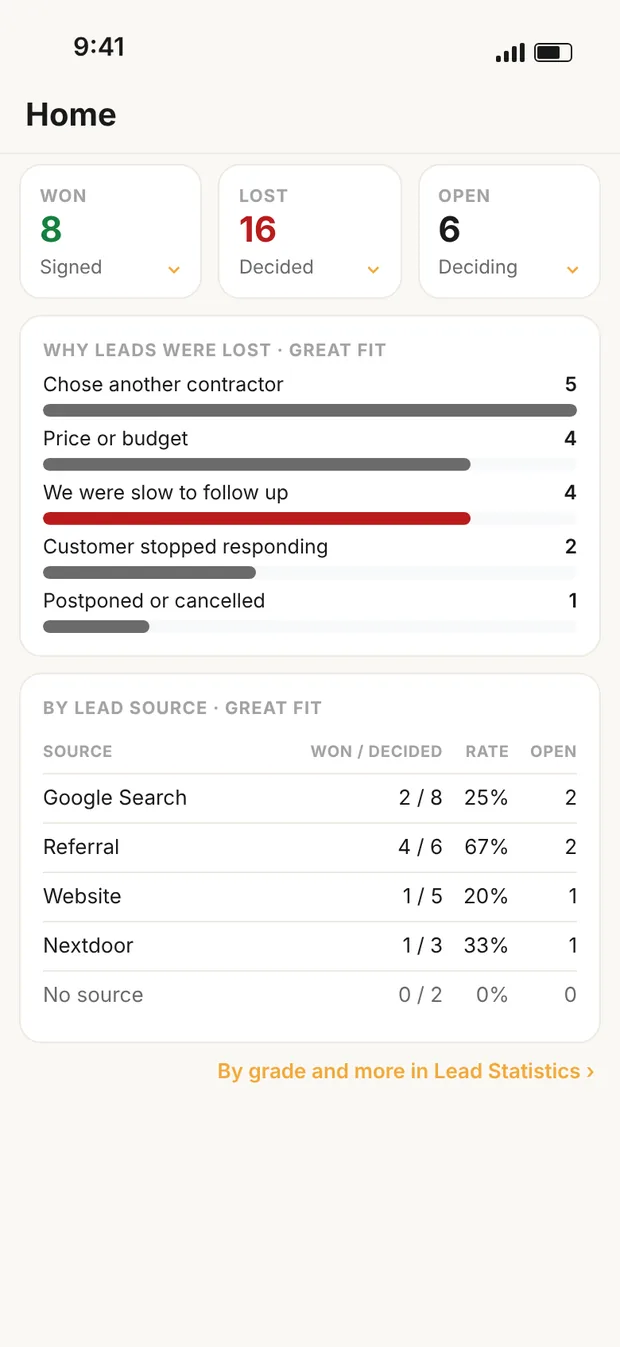
Why, and from where
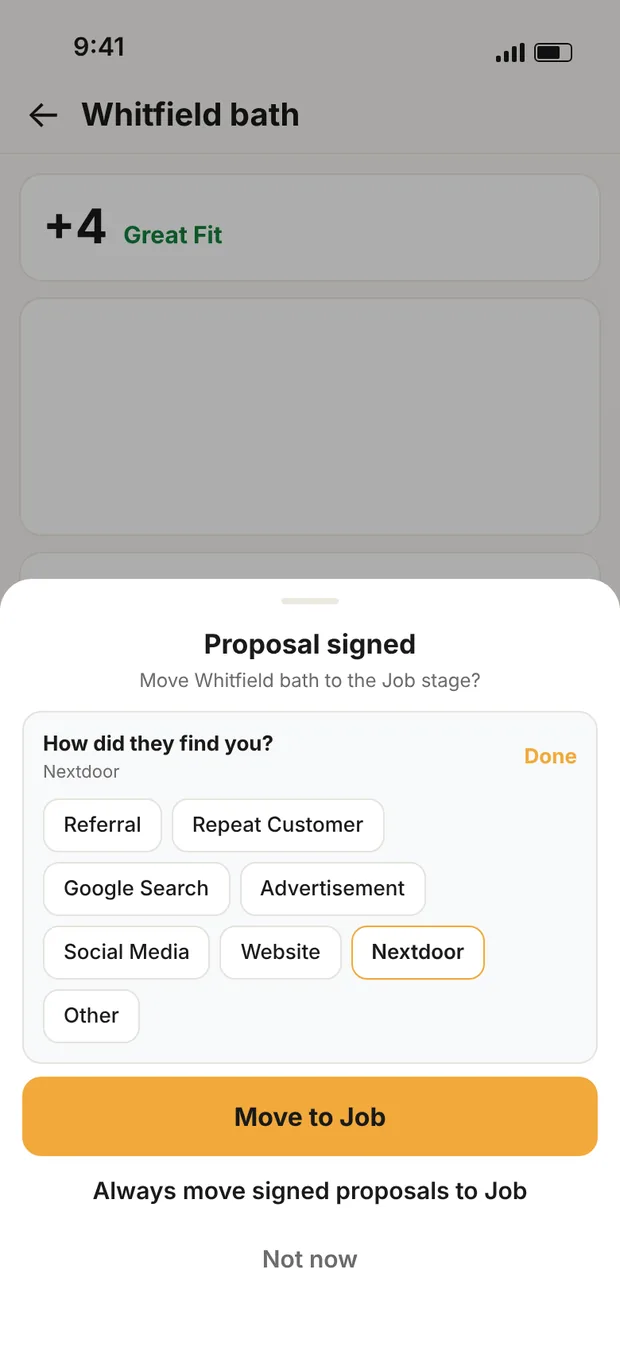
Source on every win
Why leads were lost and close rate by source, next to the Move to Job sheet asking for a missing source. Illustrative data, not results.
Recording why each lead was lost, and where each one came from, is what lets you answer those questions from your own pipeline. Asking for the source on wins and losses alike keeps the comparison honest: if only wins get a source, every source looks better than it is.
A lower close rate is not, by itself, evidence that your price is too high. Should a Contractor Lower the Price to Win a Job? shows what cutting the price costs.
What it means
Your own close rate
Clamp's Home screen shows your close rate as won of decided leads, with the open leads beside it, for the period you pick and by lead fit. Marking a lead lost asks why, including when you were slow to follow up, and close rate by lead source shows where your wins come from.
Score your Sales system in the contractor business self-assessment, and work out how many leads you need in How Many Leads Does a Contractor Need?.