How to Write a Contractor Design Agreement: What to Include and How to Price It
A design agreement is a paid contract for the planning phase of a remodel. What it includes, how to write each section, how to price the fee, who owns the drawings, and whether the fee is credited later.
The assumptions
This model assumes
- A residential remodel that needs planning before it can be priced
- Whether and when to charge for planning is settled; see When to Charge for the Estimate, and How Much
- The owner's practice: no credit, and the drawings remain the contractor's
- Sample language is a drafting example, not legal advice. Have your final form reviewed in your state.
- The $132.80 rate and the $40,000 average project are published Clamp model figures; the 18 planning hours are an illustration
The model, step by step
Four documents get confused, and they do different jobs.
| Document | What it is for |
|---|---|
| Estimate | Prices work you can already describe |
| Feasibility study | Answers whether the project can be built, here and for this budget, before design starts |
| Design agreement | Pays for the work of defining the project: drawings, specifications and a buildable price |
| Construction contract | Authorizes and prices the construction itself |
A feasibility study comes first when the questions are about the site or the money rather than the design: existing plans that need a budget check, setbacks, variances, code problems, environmental issues, or whether the customer can afford what they want. Michael C. Stone, a builder and remodeler with more than six decades in the industry and the author of Profitable Sales, the book this guide draws on most, treats it as a separate paid stage. Plenty of jobs skip it and go straight to design.
A design agreement is not the construction contract and does not authorize construction. Signing one commits the customer to planning, and nothing more.
Every design agreement needs five things, and most need several more.
| Item | Include |
|---|---|
| The parties and the project address | Always |
| The planning scope, listed specifically | Always |
| The fee and payment terms | Always |
| A timeframe | Always |
| Scope limits and exclusions | Always |
| Plans or drawings | Usually |
| Written specifications, where construction pricing depends on them | Usually |
| A firm construction price | Usually |
| A draft construction contract | Usually |
| A preliminary schedule | Usually |
| Site documentation and existing-condition measurements | Depending on the project |
| Product and finish selections, and allowances | Depending on the project |
| Documents needed to apply for a permit, never a promise of approval | Depending on the project |
| Engineering, surveying, an architect's stamp, variance work, permit and agency fees, testing | Only if listed; otherwise excluded |
Stone describes the agreement as one or two pages that identify the parties, the work, the price and the timeframe, and limit the scope. Short is fine. Vague is not.
The language below is a drafting example, not legal advice. Have a lawyer in your state review your final form.
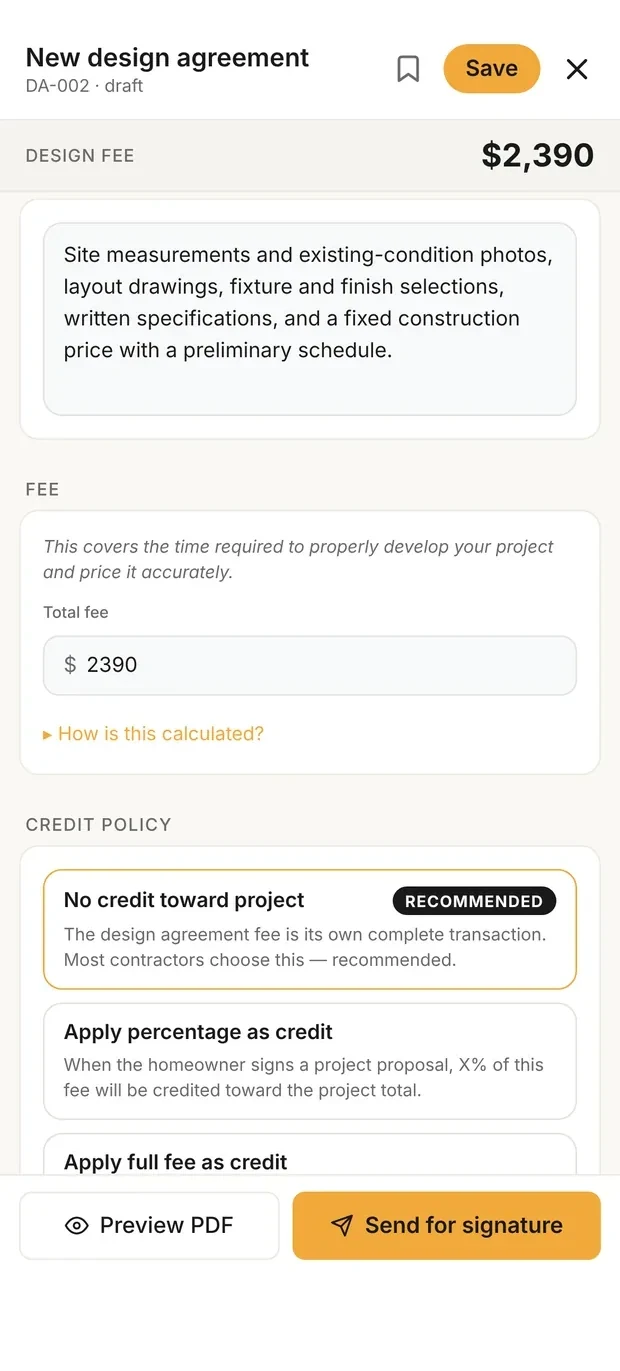
Scope, fee, credit
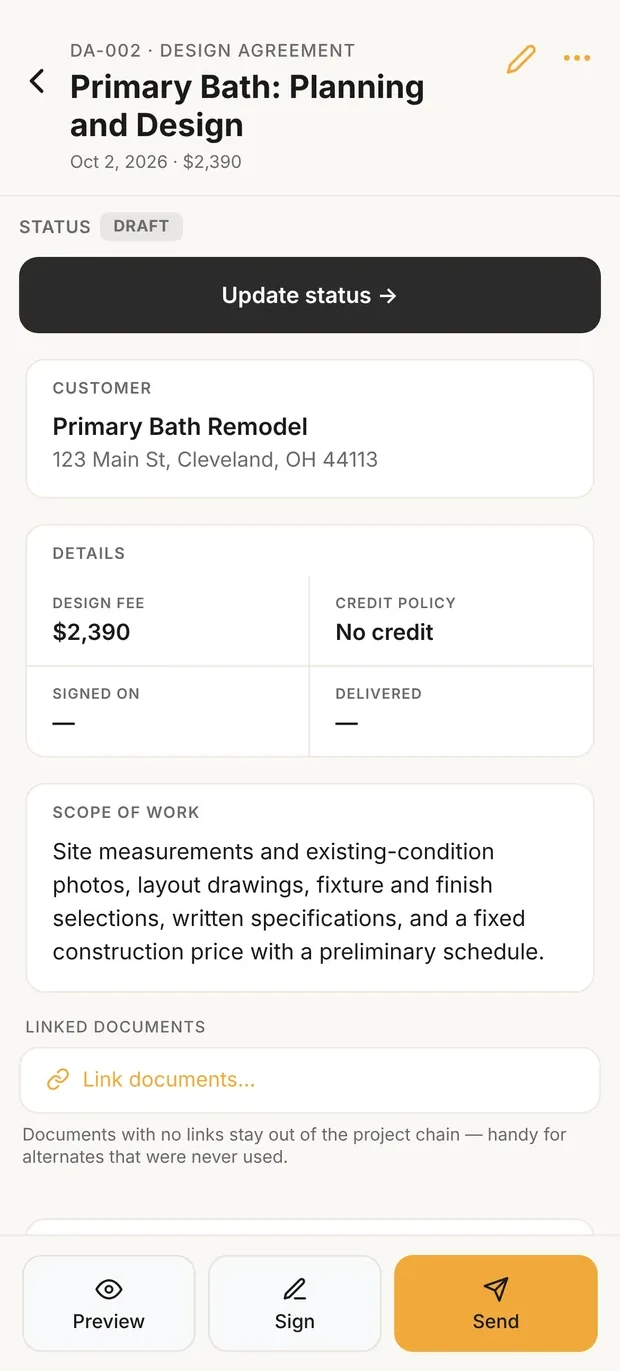
The saved agreement
A design agreement in Clamp: the deliverable, the fee and the credit policy on the form, then the saved agreement. Demo lead; the $2,390 fee is the worked example in step 4.
There are three ways to set the number, and each fits a different product. The paid-estimating guide sets out the ladder from a free fit conversation to a full design package. The design agreement is near the top of it.
Hourly is planning hours times a rate that covers your labor, overhead and profit. Flat is a fixed fee for a defined package, usually built from the hourly estimate. Percentage is a share of the expected construction price: Stone puts a design agreement at 4 to 8% of the total sales price in Profitable Sales. That is his method, not a survey of what contractors charge.
| Input | Value |
|---|---|
| Planning hours (illustration) | 18 |
| Hourly rate, from the solo contractor hourly model | $132.80 |
| Fee | $2,390 |
The $132.80 rate comes from that published solo-business model. It is not a recommended design rate for every contractor.
As a cross-check against the percentage method, on the published $40,000 average project from What a Solo Contractor Has to Charge, 4 to 8% is $1,600 to $3,200. The hourly fee lands at 6.0%. That is a sanity check, not a rule. Use your own hours, your own rate and your own average project.
Stone also recommends one practice worth knowing: when subcontractors or suppliers are asked to do design work beyond a normal quote, they should be paid too. If you are being paid for planning, so are they.
Say it in the agreement, not in a conversation after the customer asks.
The practice this guide uses, following Stone, is that the contractor keeps ownership of the plans and specifications and gives no right for another builder to use them. That is the clause in step 3. It is the cleanest answer to "can I take your drawings to someone else?", because the customer agreed to it before you drew anything.
Copyright, architectural licensing and state law can all affect how ownership and use rights work, so have the final clause reviewed in your state.
When the customer goes ahead with construction, the fee can either come off the construction price or stand on its own.
| Policy | What it says to the customer | What it does to you |
|---|---|---|
| No credit | Planning is a product with its own value | Paid once, whether or not you build |
| Full credit | Planning is a down payment on the job | The fee becomes part of the construction price |
| Partial credit | Some of each | The split is yours to set |
Stone shows both approaches. His worked example credits the fee, and he notes that many contractors treat design as a separate service and do not. This guide recommends no credit, because the planning work has real labor and real value of its own. If the construction price is calculated independently and the design fee is then credited without being built into that price, the credit reduces the money available for overhead and profit. What a discount really costs shows how fast that adds up.
Older practice used a different tool: one design fee if you build the job, and 1.75 to 2 times that if the customer takes the plans elsewhere. Stone recommended it to stop contractors being used as low-cost designers. A clear ownership clause, in step 5, addresses the same concern from a different direction: it defines who may use the work product, instead of changing the fee depending on who builds the project.
Whichever you choose, write it down before any work starts.
The planning deliverables become the basis of the construction proposal. The final scope, specifications, selections and price are carried into the proposal or attached to it as needed.
With no credit, the proposal is priced on its own, at your normal markup, with no planning fee to subtract. If the customer does not go ahead, the planning relationship ends under the agreement's terms: the fee for completed work was earned, and the drawings stay yours.
Most objections are answered by something the agreement already says.
| The customer says | What to say back |
|---|---|
| "Other contractors estimate for free." | A fit or budget conversation is free. Plans, specifications and a buildable price are work, and this agreement pays for it. |
| "Why pay before I know the price?" | The planning phase is what produces a price you can hold. Without enough planning, the number rests on an incomplete scope and carries more uncertainty. |
| "Just send me a quote." | Explain the process: define the project first, then price it, under a paid agreement. |
| "What if I don't build with you?" | The agreement already says: the fee pays for the planning services, and the plans and specifications remain ours, for our use on this project. |
| "Can I take your drawings to someone else?" | Answer from the ownership clause, which they have already signed. |
| "I already have plans." | Offer a feasibility study instead: whether those plans can be built, here, for this budget. |
| Mistake | Instead |
|---|---|
| Vague deliverables | List them specifically |
| No timeframe | State one |
| Planning, estimating or specifications before being paid | Sign the agreement first |
| No ownership and use clause | Put it in writing |
| A credit policy decided after the fact | Decide before any work starts |
| Unlimited revisions or meetings | Set a number |
| Treating a feasibility question as design | Offer a feasibility study |
| Expecting subs and suppliers to design for free | Pay them for design work |
| Mixing a design agreement with a letter of intent | Keep them separate contracts |
| No terms for delays when outside design or engineering needs correcting | Cover them in the schedule clause |
| Pricing the planning phase without its outside costs | Include engineering, drafting and specialty design in the fee, or authorize them separately |
What it means
Design agreements in Clamp
A design agreement in Clamp is its own document, separate from the proposal, and your customer signs it in the portal. The scope can be a written description or line items, the fee can be shown as flat, a percentage or hours times a rate, and the credit policy defaults to none.
Settle whether and when to charge first in When to Charge for the Estimate, and How Much, and score your Offers system in the contractor business self-assessment.
Sources & provenance
- Profitable Sales: A Contractor's Guide Michael C. Stone (book)
- Estimating Construction Profitably Michael C. Stone (book)
- The Hourly Rate a Solo Contractor Needs to Make $100,000 Clamp Research
- What a Solo Contractor Has to Charge to Make $100,000 Clamp Research