Lead Water Line Replacement Cost (2026): Trench vs Pull, Who Pays and the 2027 Rule for Contractors
What replacing a lead or galvanized water service costs a contractor in 2026: trench versus pull, what utilities pay, the 45-day rule from 2027, checking the pipe, sizing the new line, crew safety, and a 1920s house priced line by line.
The assumptions
This model assumes
- 60 ft private side, curb stop to a basement meter
- New 1 in copper with a pressure-reducing valve and pressure test
- Job cost before markup: labor, materials, subs and rentals, no tax, no permits
- Prices from Clamp's catalog on November 22, 2026
The model, step by step
Under the federal Lead and Copper Rule Improvements, published October 30, 2024, water systems must fully replace every lead service line under their control within 10 years, starting November 1, 2027. Many utilities already run replacement programs, and some replace the owner's side for free. A private job can charge the owner for work the utility would do at no cost. Before you price it, look the address up in the utility's service line inventory and ask what its program pays.
What utilities pay (one utility each)
Denver WaterReplaces customer-owned lead lines at no direct cost to the customer.
Milwaukee Water WorksThe owner pays the lesser of the actual or the average cost, and can spread it over 15 years on the tax bill, with interest.
DC WaterPublishes a private-side cost of about $7,200 (2024). Since October 2026, its assistance program covers the full private side for enrolled homeowners.
From November 1, 2027, if an owner replaces only their own side, the water system must replace its side within 45 days. If it can't, it must tell the state and finish within 180 days. Water systems may not do a partial replacement, swapping one side and leaving lead on the other, except during an emergency repair or other planned work on the street; work done only to replace lead doesn't count. So a private-side job starts a clock on the utility. Tell the utility before you dig, and write in the scope which side you replace.
Who does what after the swap
The water systemGives the household a filter, six months of cartridges and flushing instructions, and offers a water test 3 to 6 months later.
Your crewReplaces the pipe it was hired for, flushes the house plumbing, and leaves the utility's paperwork to the utility.
Priced through Clamp's catalog on November 22, 2026, for a 60 ft private-side service (curb stop to a basement meter) with new 1 in copper, a pressure-reducing valve and a pressure test. Every Clamp price in this guide is job cost before markup: what the dig, pipe and subs cost you before overhead and profit. A lead or galvanized line adds the removal and recycling of the old pipe and a house flush. Ballpark price ranges add your markup to that.
| Job | Clamp job cost |
|---|---|
| Copper or unknown, trenchNo lead removal or flush | $3,549 |
| Lead, open trenchLawn reseeded over the trench | $4,573 |
| Lead, pulled, 3 pitsLawn reseeded at the pits | $9,515 |
| Lead, 100 ft, trenchLawn reseeded over the trench | $6,055 |
| Lead, 100 ft, pulledLawn reseeded at the pits | $13,345 |
An open trench digs the whole run. A pull or slit follows the old pipe: a cable through the old line drags it out with the new pipe behind it, or splits it in the ground. The Lead Service Line Replacement Collaborative calls pulling or slitting the preferred technique, but it still works from pits. Saint Paul's utility digs 3 to 4 per house. In Clamp's catalog a pulled 60 ft line runs about $4,942 more than a trench through lawn, because the pits and the pulling sub cost more than a mini excavator day.
When the pull pays
Through lawnThe trench is cheaper. Seed and straw over the trench is a small line.
Under a drive or walkThe trench pays to saw, remove and replace concrete or asphalt. The pull digs around it.
Mature trees, steps, stoneWhat a trench would tear up and what restoring it costs is what the pull saves.
EPA's quick check at the meter: scratch the pipe with a key or coin. Lead is soft and shiny silver where scratched, and a magnet won't stick to it. EPA's own slides note that the test can't spot lead-lined iron pipe, and the street side may differ from what you see in the basement. When the utility's inventory says unknown, a test pit at the curb settles it. Clamp prices one at $750.
Where to look
Utility inventoryClasses each line as lead, galvanized requiring replacement, non-lead or unknown, for both sides of the curb.
At the meterThe scratch and magnet check on the pipe entering the house.
Galvanized pipeCounts for replacement if it is or ever was downstream of lead, or sits downstream of an unknown line. Replacing lead but leaving that galvanized leaves the job unfinished.
The model codes set a 3/4 in minimum water service and size it by the house's fixture demand, the street pressure, the meter and the length of the run. Sizing turns on the whole house's demand, not one room. Low pressure, a long run, irrigation or a large tub filler are what tend to push a service to 1 in. Clamp prices 1 in copper, so you aren't short if the plumber or utility sizes up.
What to check
Street pressureGet the static pressure from the utility or a gauge on a hose bibb. Low pressure is the usual reason to go to 1 in.
MeterAWWA ratings put a 5/8 in meter's safe maximum at 20 gpm and a 1 in meter's at 50 gpm. The utility sets the meter and its fee.
Above 80 psiThe code calls for a pressure-reducing valve. Clamp includes one by default.
OSHA's construction lead standard, 1926.62, covers removing materials that contain lead. NIOSH found lead on the hands, gloves and trucks of water department crews that cut and handled lead pipe, even when air samples stayed under the limits. Decontamination is where the exposure travels home, so it belongs in the job.
On the job
CuttingKeep cut pieces and debris contained, and bag the old pipe.
HandlingGloves, hand washing before eating, and a clean truck cab.
After the swapFlush the house plumbing the way the utility's procedure says and clean the faucet aerators. Clamp prices the flush as its own line.
A 1920s house has a lead line from the curb stop to a basement meter, 60 ft away. The run crosses a 5 ft sidewalk and the edge of an asphalt driveway, and the rest is lawn. The utility's inventory shows its side already replaced. The new service is 1 in copper by open trench, with a new curb stop and box, a new meter setter, the old lead removed and recycled, and the house flushed after. Clamp prices it at $6,578 job cost before markup. Pulled with 3 pits instead it's $11,015, so the pull makes sense only if the trench would tear up more than about $4,437 worth of landscape or hardscape.
| Line | Job cost |
|---|---|
| New curb stop and box1 ea | $850 |
| 1 in copper service pipe60 lf | $825 |
| Lay and connect pipe60 lf | $819 |
| Old lead line out, recycled1 ea | $650 |
| Meter setter and tie-in1 ea | $650 |
| Mini excavator, 1 day1 day | $550 |
| Trench, 60 ft60 lf | $480 |
| Pressure-reducing valve, install1 ea | $375 |
| Sidewalk, 25 sq ft25 sf | $313 |
| Pressure-reducing valve1 ea | $285 |
| House flush after1 ea | $275 |
| Driveway patch, 30 sq ft30 sf | $225 |
| Pressure test1 ea | $215 |
| Lawn seed and straw, 120 sq ft120 sf | $66 |
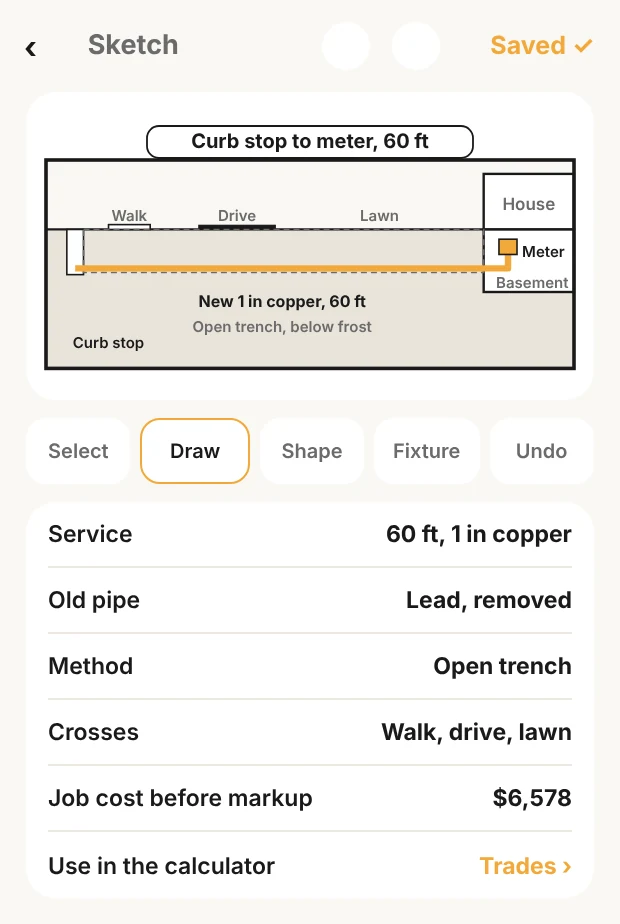
The run
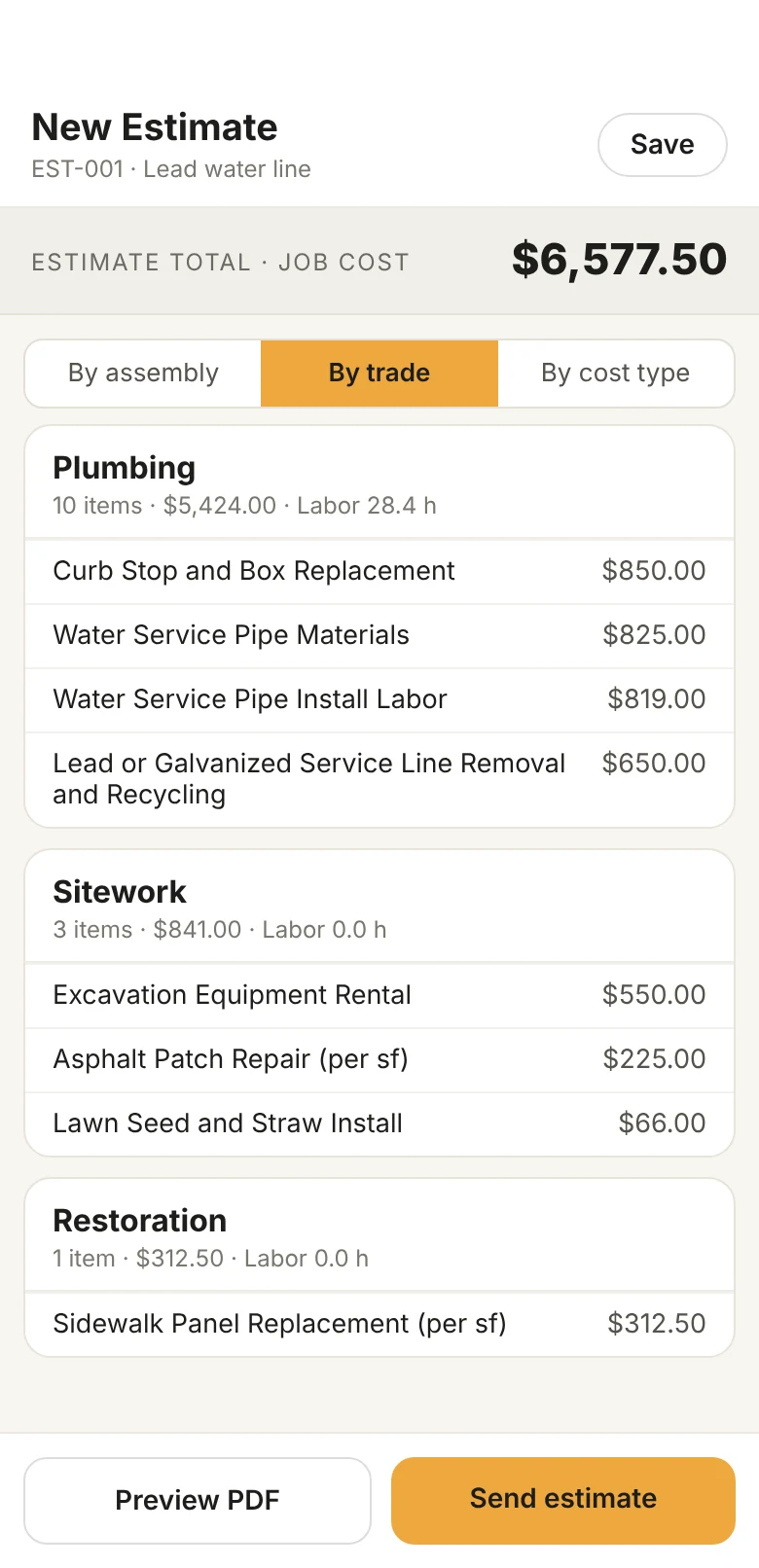
Every line priced
Left: the service line in section, drawn for this guide in the style of Quick Clamp's sketch pad, with typed labels (the pad doesn't draw pipes or pits). Right: the estimate by trade, $6,578 at job cost. Illustrations of the Clamp app with demo data.
What it means
Every line of the dig, priced
Clamp reads the length, the old pipe, the method, the valves and what the run crosses from the words, and prices the trench or pull, the pipe, the lead removal, the flush and each surface on its own line.
The surface decides the method, and the utility decides who pays.
Questions
How much does it cost to replace a lead water service line?
In Clamp's catalog a 60 ft private-side lead line replaced with 1 in copper by open trench runs $4,573 in job cost before markup, and $9,515 pulled with three pits. DC Water puts its private-side cost at about $7,200 (2024) with restoration, and its full replacement at about $21,000.
Who pays to replace a lead service line?
The federal rule doesn't set who pays for the owner's side; each utility's plan and local law decide. Denver Water replaces customer-owned lead lines at no direct cost, while Milwaukee charges the owner the lesser of the actual or average cost, which can be paid over 15 years on the tax bill. Check the utility's program before paying privately.
When do lead service lines have to be replaced?
Under the Lead and Copper Rule Improvements published October 30, 2024, water systems must start on November 1, 2027 and fully replace the lead and galvanized requiring replacement lines under their control within 10 years. The rule is being challenged in federal court.
How do I tell if my water line is lead?
EPA's quick check: scratch the service pipe at the meter with a key or coin. Lead is shiny silver where scratched and a magnet won't stick to it. The test can't find lead-lined iron pipe, so check the utility's service line inventory too.
Do I need a bigger water line for a new bathroom?
Not necessarily. The codes set a 3/4 in minimum and size the service by fixture demand, street pressure, the meter and the length of the run. Low pressure, a long run or irrigation are what usually push a service to 1 in.
Sources & provenance
- Clamp's catalog, priced by script Clamp (research)
- 40 CFR 141.84, service line inventory and replacement requirements Legal Information Institute, Cornell Law School (official source)
- National Primary Drinking Water Regulations for Lead and Copper: Improvements (LCRI) Federal Register (EPA) (official source)
- 40 CFR 141.84(h), filters and flushing after replacement eCFR (official source)
- American Water Works Association et al. v. EPA (Lead and Copper Rule Improvements) NRDC (research)
- DWSRF Lead Service Line Replacement Playbook EPA (official source)
- EPA announces $2.9 billion for states to reduce lead in drinking water EPA (official source)
- Lead Reduction Program Denver Water (official source)
- Lead service line replacement: owner request Milwaukee Water Works (official source)
- Lead Free DC: understanding cost DC Water (official source)
- Customer Initiated Private Side Lead Replacement DC Water (official source)
- Understanding replacement techniques Lead Service Line Replacement Collaborative (research)
- Lead service line replacement process Saint Paul Regional Water Services (official source)
- Lead service line replacement costs and strategies for reducing them Safe Water Engineering for NRDC (Betanzo and Speight) (research)
- Cost to install or replace a water main line HomeAdvisor (research)
- Protect Your Tap: a quick check for lead EPA (official source)
- Identifying lead service lines EPA (official source)
- 2012 International Plumbing Code, chapter 6 International Code Council (official source)
- IRC 2021 P2903.7, size of water service pipe Jaspector (paraphrase of IRC 2021) (research)
- AWWA meter sizing table Austin Water (official source)
- 1926.62 Lead OSHA (official source)
- Lead exposure among water department workers NIOSH (official source)