Masonry Cost (2026): Brick, Stone Veneer, Block and Repointing Prices for Contractors
What residential masonry costs a contractor in 2026: brick, thin brick and stone veneer, block and retaining walls, chimney work, and repointing brick or fieldstone in Portland or lime mortar, with the ties, flashing and mortar rules that a price per square foot hides.
The assumptions
This model assumes
- A 210 sq ft wall for the veneer rows: a 30 ft ranch front, 8 ft tall, two windows
- Repointing: 100 sq ft of brick; 832 sq ft of fieldstone basement wall
- Job cost before markup: labor, materials and subs, no markup, permits or tax
- Prices from Clamp's catalog on November 25, 2026
The model, step by step
Priced through Clamp's catalog on November 25, 2026. Every Clamp price in this guide is job cost before markup: labor, materials and subs before your overhead and profit. The veneer rows are one 210 sq ft wall, the size of a ranch front with two windows, so the price per square foot carries a small job's setup.
| Finish | Per sq ft | Job cost |
|---|---|---|
| Brick veneerFull-size brick, ties, flashing, weeps, lintels | $23.74 | $4,986 |
| Thin brickAdhered over lath and scratch coat | $31.60 | $6,635 |
| Manufactured stoneAdhered, WRB and weep screed | $32.10 | $6,742 |
| Natural thin stoneSame install, dearer stone | $42.83 | $8,994 |
Anchored brick hangs on ties across an air space, with flashing and weeps to let water out. Each of those is a line on the bid, and a price per square foot that leaves them out isn't the same job.
What a brick veneer price must carry
TiesOne for each 2.67 sq ft at most, 32 in across by 24 in up, plus extra ties around openings.
Air spaceA nominal 1 in between the brick and the sheathing.
Flashing and weepsFlashing at the base and over every opening, weeps at most 33 in apart (the brick industry says 24).
LintelsA steel angle over each opening with 4 in of bearing at each end.
StagingScaffold once the wall climbs past what the crew can reach from the ground, and the moves as the wall goes up.
Adhered stone and thin brick go on a water-resistive barrier, lath and a scratch coat, with a weep screed at the bottom. The labor is the same for manufactured and natural thin stone; the stone sets the difference. In Clamp's catalog the same 210 sq ft runs $6,742 in manufactured stone and $8,994 in natural thin stone.
Smaller masonry jobs price as a few lines each. A short segmental block retaining wall is labor and block; taller walls bring footings, drainage, reinforcement and often an engineer.
| Job | Job cost |
|---|---|
| Stone wainscot, 40 ft3.5 ft high, with sill caps | $5,568 |
| Block retaining wall80 sq ft segmental block, no engineering | $3,696 |
| Chimney crown8 sq ft, torn off and poured | $1,132 |
| Chimney removal28 ft, two floors, patched | $6,461 |
Chimney work
CrownA sloped cap with a drip edge, cast with a bond break from the flue liner.
Height3 ft above where it leaves the roof and 2 ft above anything within 10 ft.
RebuildTaking the top down to sound brick and relaying it is priced by the foot of height.
RemovalDown through the roof and floors, with the openings framed and patched.
Repointing means raking out failed mortar and packing in new. On old soft brick or stone, the new mortar has to be softer than the units, or the face of the brick takes the movement and spalls. Fieldstone joints are wide and deep, so they take about six times the mortar of brick joints per square foot, raked by hand.
| Wall | Area | Job cost |
|---|---|---|
| Brick, PortlandType N or O | 100 sq ft | $1,594 |
| Old brick, limePre-1900 mortar, curing visits | 100 sq ft | $1,994 |
| Fieldstone, PortlandHand-raked rubble joints | 832 sq ft | $14,694 |
| Fieldstone, NHL limeLime mortar and curing | 832 sq ft | $25,718 |
The brick industry's advice is the weakest mortar that does the job. A stronger mortar isn't safer: on old brick it's the wrong one.
Mortar, by the job
Type NGeneral above-grade work and most veneer.
Type SLoad-bearing and reinforced walls, and an alternate below grade (the brick industry lists Type M first there); the usual setting bed for adhered stone.
Type OLow-strength, for interior and repointing soft old brick.
Lime (NHL or putty)Old soft brick and stone, where the mortar must be softer than the units.
Masonry has its own limits. Cold-weather rules start below 40 F and step up through lower temperature bands, and lime mortar needs days of misting and frost protection. Clean with the gentlest method that works: a test patch first, low-pressure water, and no unbuffered acid on brick.
A 30 ft ranch front, 8 ft tall, with two 3 x 5 ft windows, gets new brick veneer: 210 sq ft net, about 1,489 brick, 79 field ties plus extra at the windows, two lintels and flashing at the base and heads. In Clamp's catalog it's $4,986 in job cost, about 62 labor hours. Separately, a fieldstone basement, 128 ft of wall at 6.5 ft, is repointed: $14,694 in Portland-lime mortar and $25,718 in NHL lime, where the lime mortar for the wide rubble joints is about half of the lime job's cost.
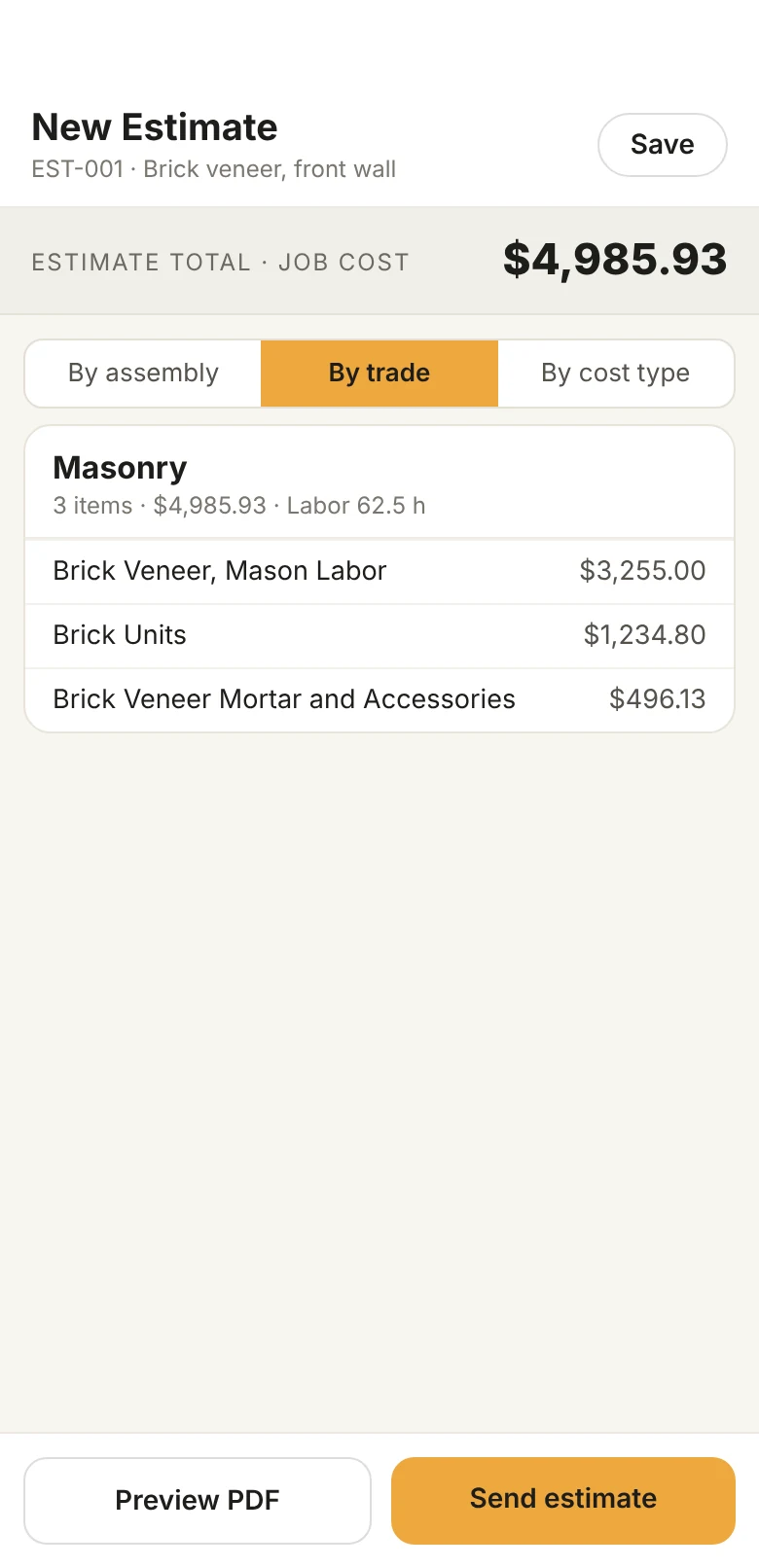
Every line priced
The brick wall in the estimate by trade, $4,986 at job cost. Illustration of the Clamp app with demo data.
What it means
Every course, priced from the wall
Clamp reads the wall area, the material and the work, and prices the laying, the brick or stone, the ties, flashing and lintels, or the raking, mortar and curing for a repoint, with labor hours on each line.
A square-foot price is only as good as the list of what's in it.
Questions
How much does masonry cost per square foot?
In Clamp's catalog, a 210 sq ft wall runs about $23.74 per sq ft in full-size brick veneer, $32.10 in manufactured stone and $42.83 in natural thin stone, in job cost before markup, with ties, flashing and lintels in the brick price. National cost pages quote $12 to $18 installed for brick without saying what's included.
How many wall ties does brick veneer need?
Under the IRC, one tie for each 2.67 sq ft of wall at most, spaced no more than 32 in across and 24 in up, plus extra ties around openings. A 210 sq ft wall needs at least 79.
What is the difference between tuckpointing and repointing?
Repointing is raking out failed mortar and replacing it. The National Park Service uses tuckpointing for a decorative raised joint, while many contractors use it to mean repointing. Say which one the bid covers.
Should I use lime mortar or Portland mortar for repointing?
Use mortar that is softer than the brick or stone and no stronger than the original. On old soft brick and stone that usually means lime or a Type O or K mix; the Brick Industry Association recommends N, O or K for repointing.
Can you put stone veneer over brick?
No, not over brick veneer. The manufactured stone industry's installation guide says adhered stone can't be installed over existing anchored masonry veneer, so the brick comes off first. On a solid masonry wall, lath and a scratch coat go on where the surface won't bond.
Sources & provenance
- Clamp's catalog, priced by script Clamp (research)
- 2021 Seattle Residential Code (IRC 2021 with amendments), chapter 7 City of Seattle (official source)
- 2021 Seattle Residential Code (IRC 2021 with amendments), chapter 10 City of Seattle (official source)
- Technical Note 28: Anchored brick veneer, wood frame construction Brick Industry Association (research)
- Technical Note 8B: Mortar for brickwork, selection and quality assurance Brick Industry Association (research)
- Repointing brick masonry Brick Industry Association (research)
- Preservation Brief 2: Repointing mortar joints in historic masonry buildings US National Park Service (official source)
- Installation guide for adhered concrete masonry veneer, 5th edition Masonry Veneer Manufacturers Association (research)
- Cost vs. Value 2025 Journal of Light Construction (Zonda) (research)
- We don't have a manpower problem, we have a production problem Masonry Magazine (research)
- Repointing or tuckpointing cost HomeGuide (research)
- Brick veneer cost HomeGuide (research)
- Technical brief: cold weather masonry construction International Masonry Institute (research)
- Technical Note 20: Cleaning brickwork Brick Industry Association (research)
- Troubleshooting brick veneer Journal of Light Construction (research)
- NHL 3.5 cut sheet LimeWorks.us (research)
- Retaining wall cost HomeGuide (research)