Electrical Panel Upgrade and EV Charger Cost (2026): 200 Amp Service, Subpanels, Level 2 Chargers, With Labor Hours
What a contractor's cost is in 2026 to swap a panel, upgrade to 200 or 400 amps, add a subpanel, and install a Level 2 charger: the code that comes with a new service, the load calculation that can avoid one, wire and GFCI rules, load management and what's left of the credits, with labor hours.
The assumptions
This model assumes
- Overhead service, panel in the same spot unless stated
- Utility charges on its side of the meter excluded
- Job cost before markup: labor and materials, no markup or tax
- Prices from Clamp's catalog on November 4, 2026
The model, step by step
Priced through Clamp's catalog on November 4, 2026, with labor hours. Every price in this guide is job cost before markup: what the labor and materials cost you, before your markup, overhead and profit. Ballpark price ranges add your markup to that. A panel swap keeps the meter and riser; a service upgrade replaces the meter equipment and riser too. Both include grounding and bonding. Every service job includes the permit, a surge protector, an outdoor emergency disconnect and a load calculation; utility disconnect and reconnect fees are not included.
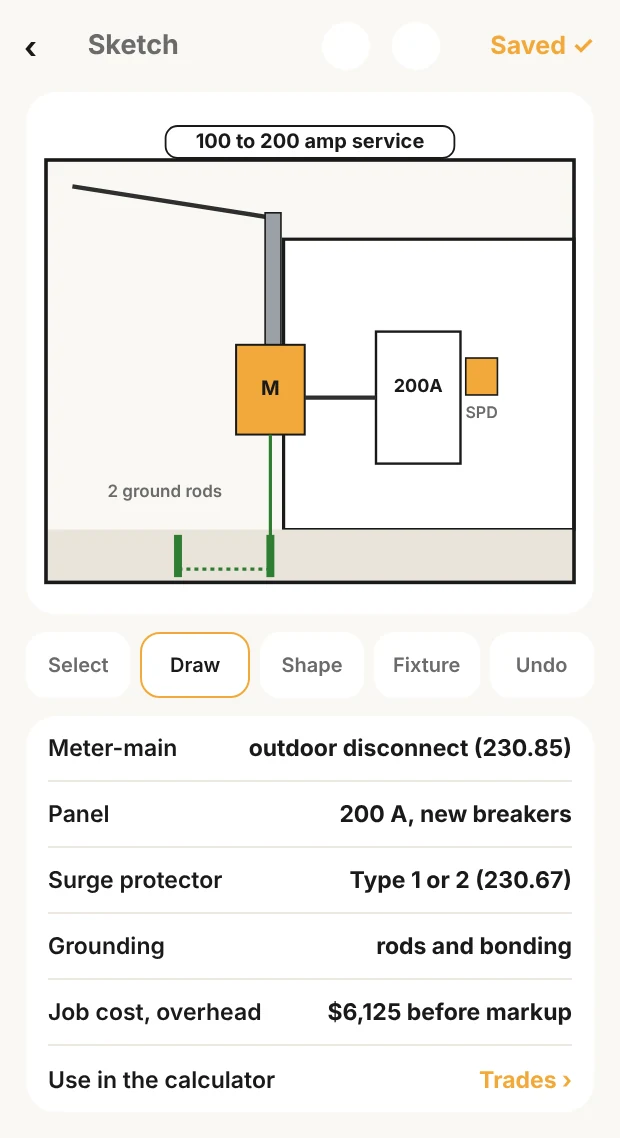
The service
Drawn for this guide in the style of Quick Clamp's sketch pad: the overhead service from the drop to a meter-main with the outdoor disconnect, the 200 A panel with a surge protector, and two ground rods. Demo data.
| Job | Job cost | Hours |
|---|---|---|
| Panel swap, 200 AMeter stays, outdoor disconnect added | $4,450 | 19 |
| 100 to 200 A, overheadMeter-main, riser, grounding, SPD | $6,125 | 27 |
| 100 to 200 A, new dropService drop replaced | $8,025 | 27 |
| 100 to 200 A, panel movedPanel relocated | $7,875 | 39 |
| 200 to 400 ALarger panel, more panel labor | $8,418 | 39 |
| 60 A subpanel, garage30 ft feeder | $1,960 | 10 |
| 100 A subpanel, basement40 ft feeder | $2,328 | 11 |
| 100 A subpanel, detached80 ft feeder | $3,181 | 16 |
Replacing the service equipment pulls in code the old panel never had. Clamp prices both on every service upgrade by default.
On the service upgrade
Surge protector (230.67)A Type 1 or Type 2 SPD when dwelling service equipment is replaced: $465 with its breaker and labor.
Outdoor emergency disconnect (230.85)Where adopted, one- and two-family dwellings get an outdoor emergency disconnect whenever service equipment is replaced: Clamp carries a meter-main or disconnect at $250.
AFCI on extended circuits210.12(E) in the 2023 NEC covers 120 V, 15 and 20 A circuits that are extended or modified; it doesn't reach a 240 V EV circuit.
Utility sideThe utility sets the meter, and its fees and schedule sit outside your price; who owns the drop or lateral varies by utility.
Before you quote a new service, run the numbers. NEC 220.83 lets you add loads to an existing dwelling from nameplate ratings with demand factors; 220.87 uses a year of utility demand data (or a 30-day recording) plus 25%. A managed EV load can be counted at the limit an energy management system enforces (625.42).
The options
220.83Nameplate loads and demand factors. Needs the floor area and every appliance and HVAC rating.
220.87Measured maximum demand, the highest 15-minute average, times 125%, then the new load.
Local limitsClark County, Nevada limits 220.87 to other than one- and two-family dwellings from January 11, 2026.
2026 NECThe load calculations move to Article 120; check the section numbers your jurisdiction uses.
CostClamp carries a load calculation on every service job: $185 and 1.5 hours.
A Level 2 charger runs on its own circuit, sized at 125% of the charging current: 40 A charging on a 50 A circuit, 48 A on a 60 A circuit. Clamp prices the charger, the circuit, the run and the permit, with labor that grows with the run.
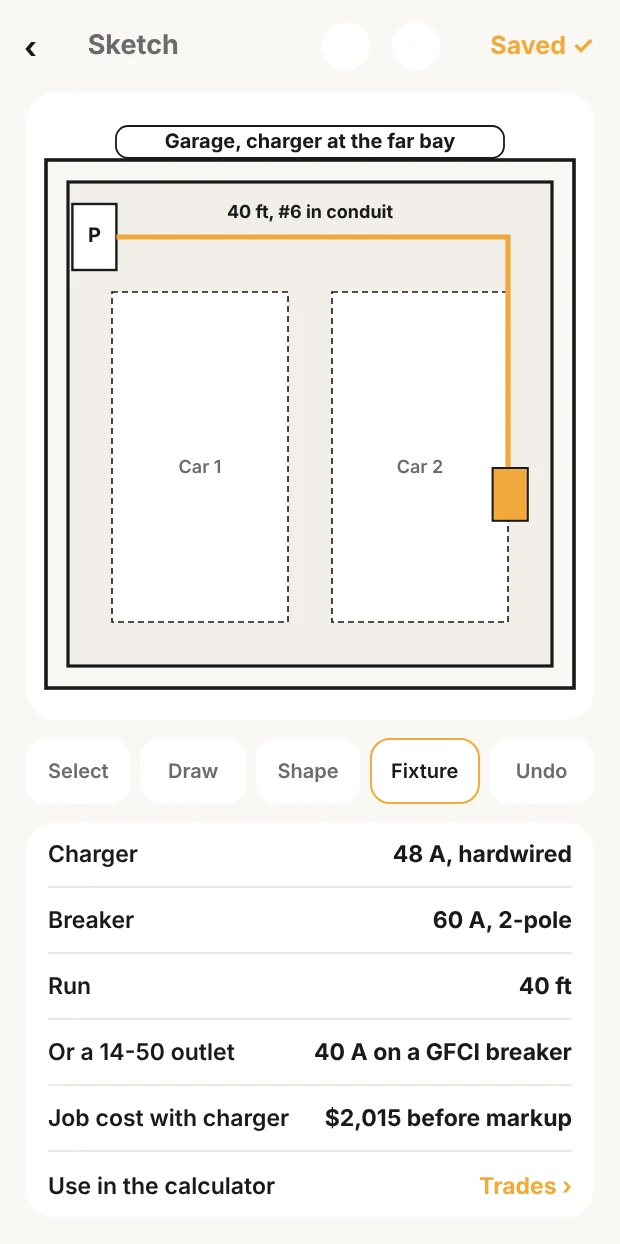
The garage run
Drawn for this guide in the style of Quick Clamp's sketch pad: a two-car garage with a 40 ft run from the panel to a 48 A charger at the far bay. Demo data.
| Install | Job cost | Hours |
|---|---|---|
| 14-50 outlet, 25 ft40 A charging, GFCI breaker | $1,292 | 6 |
| Circuit only, 40 A, 25 ftCustomer's charger | $1,130 | 6 |
| 48 A charger, 25 ftHardwired, 60 A, charger included | $1,790 | 6 |
| 48 A charger, 50 ft#6 THWN-2 in conduit | $2,166 | 7 |
| 48 A charger, 100 ftLong run | $2,918 | 10 |
| 48 A, 50 ft, outside wallWeatherproof, exterior run | $2,807 | 12 |
| 48 A, 40 ft, load managedEV energy management device | $2,955 | 10 |
Two choices drive the material: the connection and the conductor.
What changes the line items
14-50 receptacleCaps charging at 40 A, and EV receptacles need GFCI protection (625.54): a 2-pole GFCI breaker. ChargePoint warns a GFCI breaker can nuisance-trip its Home Flex and says to hardwire where code requires one.
Hardwired, 48 ATesla calls for a 60 A 2-pole breaker and, with a 75 C-rated breaker, at least #6 copper THWN-2 (90 C) for full output.
NM-B is 55 ASouthwire limits 6 AWG NM-B to its 60 C ampacity, 55 A, short of a 60 A circuit, so run #6 THWN-2 in conduit. Clamp prices #6 THWN-2 and conduit over 50 A.
Long runsCheck voltage drop as well as ampacity on long runs; the per-foot adder in Clamp is labor, conduit and wire, not trenching.
An EV energy management device watches the service and holds the charger to what's left. Clamp prices the device and three hours to install and configure it: $2,955 for a 48 A charger at 40 ft, managed.
Published device prices
Emporia ProCharger and Vue monitor package, $599 at launch in April 2025, with load management.
Wallbox Power Meter$299.99 for dynamic balancing with a compatible Wallbox charger.
Code625.42 lets a listed energy management system under 750.30 set the EV load, or an EVSE with restricted-access adjustable settings be rated at its setting.
The federal charger credit (30C) ended for property placed in service after June 30, 2026, and the home improvement credit (25C), which covered panels, ended after 2025. A charger or panel installed now gets no federal credit.
What's left
HEARUp to $4,000 for an electrical panel where the state runs the program, by income.
UtilitiesCheck the customer's utility for charger and panel rebates before you quote.
PermitsMountain View, California: $500 for a residential EV charger permit, inspections included. Clamp carries $225 for a charger and $375 for a service.
A 1960s house on 100 amp overhead service is adding a 48 A charger, a heat pump and an induction range. Option A upgrades to 200 A with a new meter-main, panel, grounding and surge protector, then runs the charger 40 ft on a 60 A circuit: $7,915 job cost before markup, 34 person-hours. Option B keeps 100 A, runs a load calculation and manages the charger: $3,140 job cost before markup, if the calculation shows the heat pump and range fit.
| Line | Job cost | Hours |
|---|---|---|
| Set the 200 A panel, move the circuits1 ea | $1,600 | 16.0 |
| Install the meter and riser1 ea | $1,050 | 8.0 |
| 200 A panel1 ea | $950 | |
| EV circuit, 40 ft1 ea | $806 | 6.7 |
| Riser and service entrance cable1 ea | $625 | |
| Ground rods and bonding1 ea | $625 | |
| 48 A charger1 ea | $550 | |
| Permit1 ea | $375 | |
| Meter-main with outdoor disconnect1 ea | $250 | |
| #6 THWN-2 conductors46 lf | $242 | |
| Surge protector1 ea | $215 | |
| Load calculation1 ea | $185 | 1.5 |
| Install the surge protector1 ea | $165 | 1.3 |
| Conduit40 lf | $130 | |
| Surge breaker1 ea | $85 | |
| 60 A breaker1 ea | $63 |
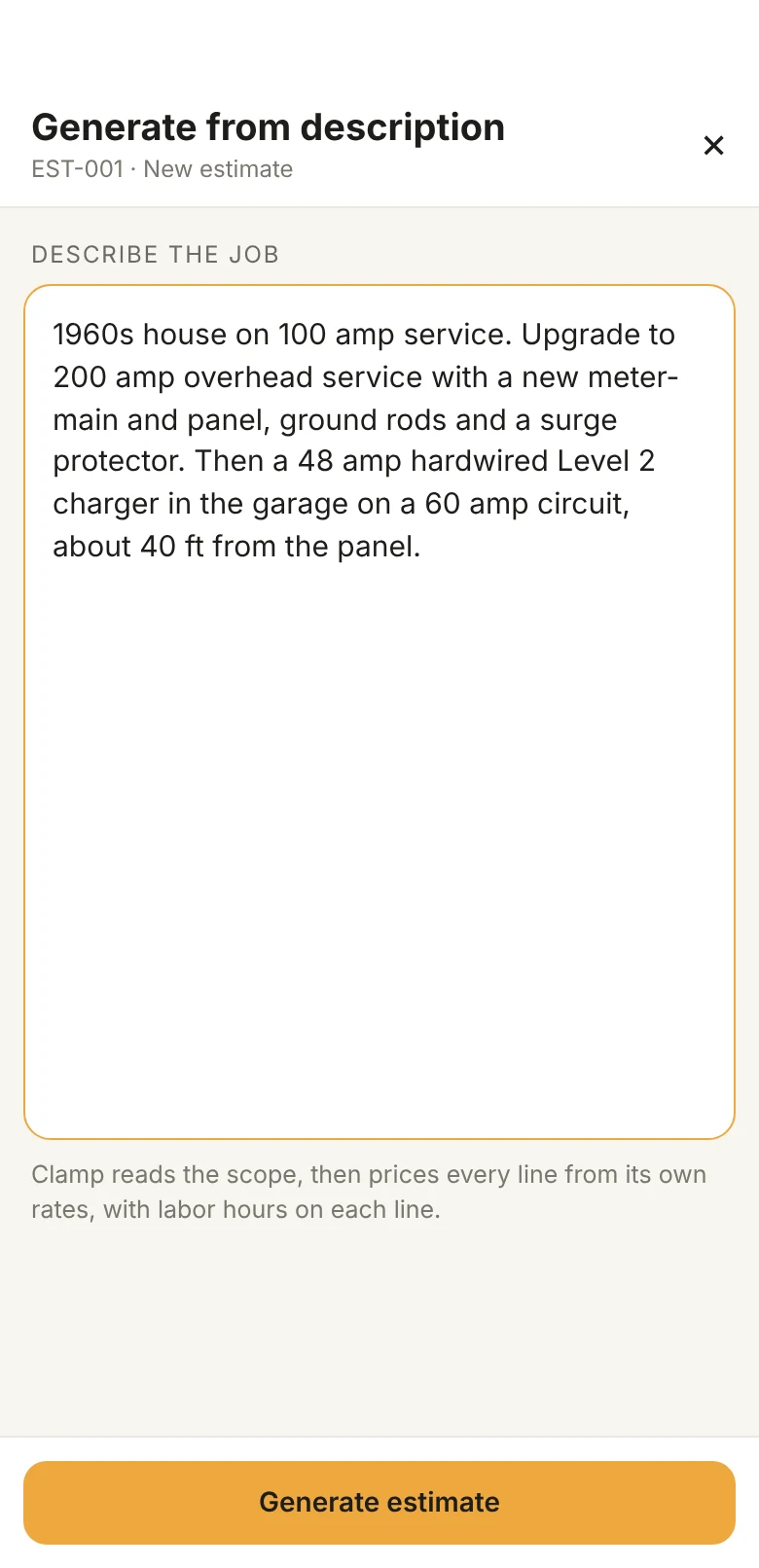
The job
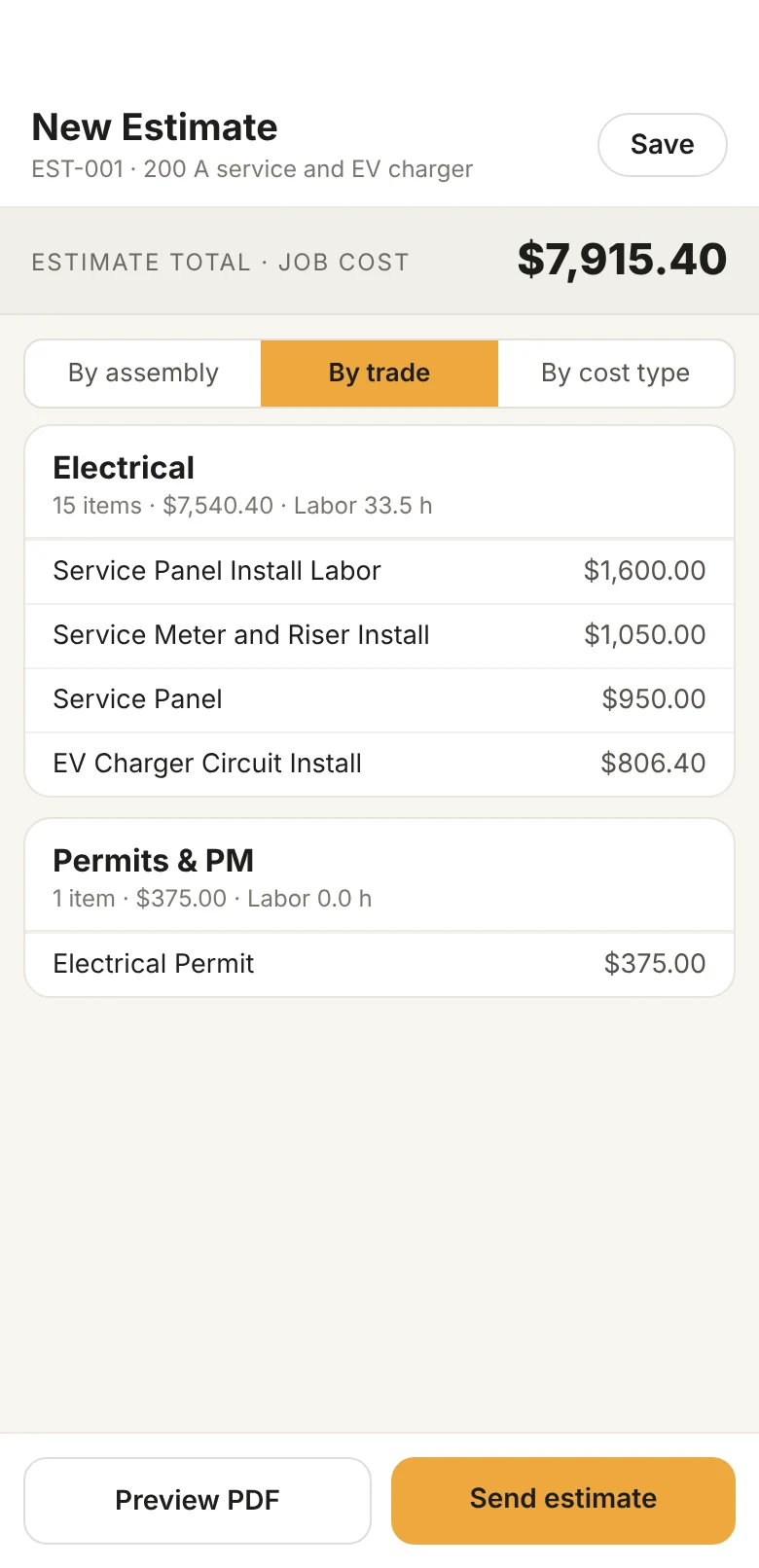
Every line priced
The job in Clamp, and the estimate it prices: $7,915 at job cost, by trade. Illustration of the Clamp app.
What it means
Every service and charger, line by line
Clamp reads the amps, overhead or underground, the meter, the panel location, and the charger's amps, connection and run from the words, and prices the panel, meter-main, grounding, surge protector, circuit and permit, with labor hours on each line.
The load calculation decides the job; the run and the wire decide the charger.
Questions
How much does a 200 amp panel upgrade cost?
In Clamp's catalog, upgrading 100 A overhead service to 200 A is $6,125 in job cost before markup, about 27 person-hours, with the meter-main, riser, grounding, surge protector, load calculation and permit. A panel swap on the same service is $4,450. The ballpark price range for the upgrade is $7,963 to $12,250.
How much does it cost to install a Level 2 EV charger?
Clamp's catalog prices a 48 A hardwired charger at $1,790 at 25 ft and $2,166 at 50 ft in job cost before markup, charger included; a 14-50 outlet for the customer's charger is $1,292. Qmerit puts installs at $749 to $2,500, about $1,700 on average.
Do I need a panel upgrade for an EV charger?
Not always. A load calculation under NEC 220.83 or 220.87 shows whether the service has room, and an EV energy management system (625.42) can hold the charger to the spare capacity. If other new loads push the house over, the service has to grow.
How much should an electrician charge for a panel upgrade?
Price it from job cost: on Clamp's numbers a 100 to 200 A overhead upgrade is $6,125 job cost before markup, so a ballpark price range of $7,963 to $12,250, plus any utility charges.
Is there a tax credit for EV chargers in 2026?
Not for chargers placed in service after June 30, 2026: the IRS says the 30C credit ended then. Before that it paid 30% up to $1,000 for a home charger in an eligible census tract.
Sources & provenance
- Clamp's catalog, priced by script Clamp (research)
- FAQs for modification of sections 25C, 25D, 25E, 30C, 30D, 45L, 45W and 179D under Public Law 119-21 IRS (official source)
- Alternative fuel vehicle refueling property credit IRS (official source)
- Low-power electrification, the NEC and building energy codes Lawrence Berkeley National Laboratory / DOE (research)
- The apprentice's guide to Article 625 EC&M (research)
- How do 2023 NEC changes affect EVSE load calculations and adjustable settings? ExpertCE (research)
- NEC code requirements for surge protection Leviton (research)
- Wall Connector installation: circuit breaker and wire Tesla (research)
- Romex SIMpull Type NM-B Southwire (research)
- ChargePoint Home Flex installation guide ChargePoint (research)
- Understanding your EV home charging station costs Qmerit (research)
- How much does EV charger installation cost? EnergySage (research)
- 2023 NEC amendments Clark County, Nevada (official source)
- 2026 NEC adoption review minutes Minnesota Department of Labor and Industry (official source)
- Home Energy Rebates customer guide US Department of Energy (official source)
- Emporia launches Pro Level 2 EV charger Emporia (research)
- Electric panel upgrade tax credit ENERGY STAR (official source)
- Power Meter Wallbox (research)
- Electric vehicle charger permit City of Mountain View (official source)
- Electrical panel upgrade cost guide Inch Calculator (research)