Shower Waterproofing Systems Compared by Cost and Labor Hours: Foam Board, Kerdi, RedGard and the Old Way
Nine wall systems and five pans priced for a 3x5 shower, with the hours behind the dollars.
Name the system
Priced as its own line
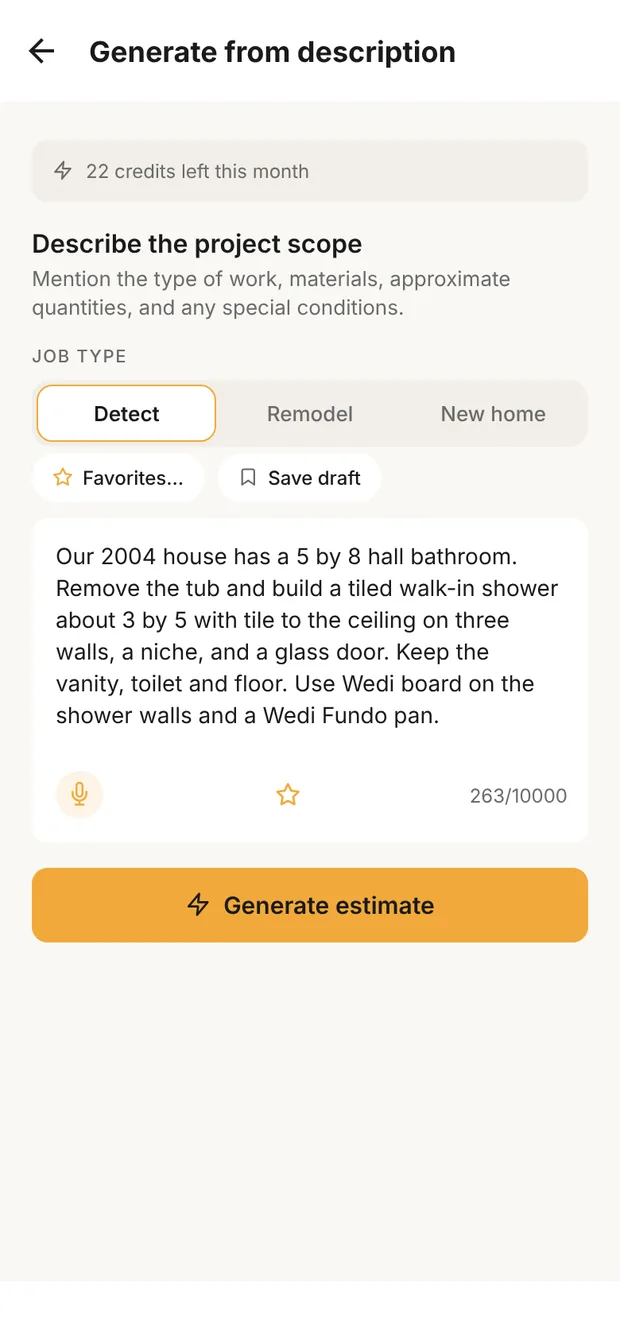
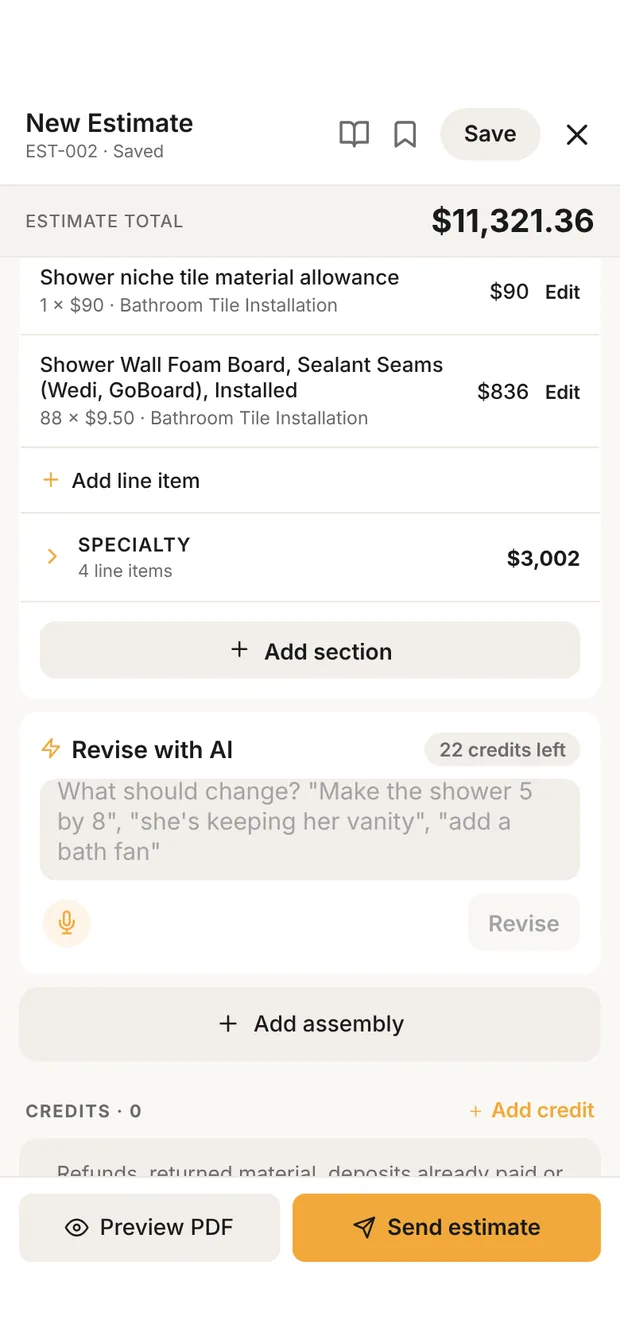
A tub-to-shower conversion described with Wedi board and a Wedi pan. Clamp prices the shower walls as their own line, 88 sf at $9.50, and switches the line when another system is named. The total is the whole job. Sample data.
The example
The 3x5 example assumes
- Three tiled walls, (5 + 3 + 3) x 8 = 88 sf, with an open 5 ft front
- No ceiling tile, niche, bench or window
- Plumb, ready framing; no demolition, leveling or plumbing moves
- Clamp catalog rates, direct job cost at the median market; a membrane over a board is the board line plus the membrane line ($6.75/sf)
- Hours are board and waterproofing hours per shower for a crew that has done the system before
- Substrate and waterproofing only: no tile, tile setting, overhead, profit, tax or permits
The systems, step by step
Most line items on a shower estimate move with material price. Waterproofing is different. The boards and membranes in common use land within a few dollars a square foot of each other, but the number of operations is not the same. One system is: hang board, tape and mud the joints, roll two coats, wait for each to dry. Another is: hang board, seal the joints and screw heads, tile tomorrow. On an 88 sf shower that difference is hours, and hours are what a small crew runs out of.
Two decisions sit inside the line. The board carries the tile: cement board, fiber cement, approved gypsum, coated glass-mat gypsum, foam board, or a floated mortar wall. The water management keeps water out of the wall: a liquid membrane on the face, a sheet membrane on the face, a board whose face is already waterproof, or a barrier behind the board that drains to the pan.
Every stack runs from the studs out and ends with mortar and tile.
Cement board + liquid membrane (RedGard, Hydro Ban)
StackCement board, joints treated, liquid membrane in the specified coats, modified mortar, tile.
FitsThe familiar remodel specification and a fair generic baseline.
CostLow board cost, moderate membrane cost, the most operations.
Fiber cement + liquid
StackFiber-cement board, prescribed joint preparation, liquid membrane, mortar, tile.
FitsSame role as cement board. Standard fiber cement is not the waterproof variant.
CostAbout the baseline.
Cement board + sheet membrane (Kerdi over cement board)
StackCement board, bonding mortar, sheet membrane with sealed overlaps, bands and penetrations, mortar, tile.
FitsWhere the customer or specifier wants a cementitious board under a surface membrane.
CostA full extra membrane operation. The most hours of the surface systems.
Approved gypsum + sheet membrane (Kerdi over drywall)
StackApproved gypsum board, prescribed mortar, sheet membrane with bands and seals, mortar, tile.
FitsPermitted for the sheet systems whose installation guides name gypsum, per those guides. Check that your inspector accepts it.
CostBoard cost drops; membrane cost and hours stay.
Foam board, sealant seams (Wedi, GoBoard)
StackFoam board and fasteners, sealant on every joint, fastener and penetration, mortar, tile.
FitsFast remodel installation. One trip for board and waterproofing.
CostHigh board cost, little membrane cost, the fewest hours.
Foam board, banded seams (Kerdi-Board)
StackFoam panel, banding, fastener patches and corners set in mortar, mortar, tile.
FitsA system specification that is easy to cut and handle.
CostHigh board cost, modest band cost, fewer hours than board plus membrane.
Coated glass-mat gypsum (DensShield)
StackCoated board, joints, edges and penetrations treated as prescribed, mortar, tile.
FitsA production alternative with an integrated surface barrier, per the manufacturer's installation guide. Not ordinary drywall.
CostLow board cost and no full-field membrane. Keep the joint and penetration labor.
Plastic behind cement board (the old way)
StackA lapped barrier draining to the tub flange or pan liner, cement board, joints, mortar, tile.
FitsThe established method, usually paired with a traditional liner pan.
CostLowest membrane cost. Board hours unchanged.
Floated mortar walls
StackMoisture barrier and lath, reinforced mortar float, a bonded membrane, mortar, tile.
FitsSpecialist crews, out-of-plumb walls, premium flatness.
CostThe most skilled labor and the highest installed cost by a wide margin.
Clamp's installed price for each wall system on the 3x5 shower, with the hours behind it.
| Wall system | 88 sf | vs. base | Hoursboard / waterproofing |
|---|---|---|---|
| Cement board + liquid (RedGard)$4.25 + $6.75 = $11.00/sf | $968 | base | 6 / 3 |
| Fiber cement + liquid$5.75 + $6.75 = $12.50/sf | $1,100 | +$132 | 6 / 3 |
| Cement board + Kerdi sheet$4.25 + $6.75 = $11.00/sf | $968 | $0 | 6 / 4 |
| Kerdi over drywall$3.10 + $6.75 = $9.85/sf | $867 | −$101 | 3.5 / 4 |
| Foam board, sealant seams (Wedi, GoBoard)$9.50/sf | $836 | −$132 | 3.5 / 1.5 |
| Foam board, banded seams (Kerdi-Board)$11.50/sf | $1,012 | +$44 | 3.5 / 2.5 |
| Coated glass-mat gypsum (DensShield)$5.25/sf | $462 | −$506 | 4 / 1.5 |
| Cement board + plastic behind$4.25 + $1.55 = $5.80/sf | $510 | −$458 | 6 / 0.75 |
| Floated mortar + Kerdi$18.50 + $6.75 = $25.25/sf | $2,222 | +$1,254 | 13 / 4 |
The installed figures are what a tile sub charges the contractor for the finished wall, materials and labor together, before any markup. Liquid and sheet membranes over cement board price the same here, $968; the sheet takes about an hour longer.
The pan is a separate decision from the walls, and so is the drain. A linear drain is not a pan type. Curbless is not a waterproofing product.
| Pan | Installed | Hours |
|---|---|---|
| Foam tray (Wedi)$675.00 materials + $632.50 labor | $1,307.50 | 3.9 |
| Foam tray kit (Kerdi)$650.00 materials + $661.25 labor | $1,311.25 | 4.0 |
| Mortar bed with a bonded membrane$475.00 materials + $977.50 labor | $1,452.50 | 6.0 |
| Hot mop$500.00 materials + $977.50 labor | $1,477.50 | 6.0 |
| Traditional liner and mud bed$265.00 materials + $1,265.00 labor | $1,530.00 | 7.7 |
A flood test is a separate $250 line on every tiled pan. The liner pan is the cheapest materials and the most labor: two mortar operations and more visits. The bonded-membrane bed is one mortar operation plus a membrane. The tray is neither, when the floor is flat and the drain is where the tray wants it. The Wedi tray saves $145.00 against the bonded bed and $222.50 against the liner, installed.
The figures above are a clean 3x5. Five things move them.
Small kits and waste
A foam board is sold by the panel and a sheet membrane by the roll. A shower that needs a little more than a kit or a roll costs a second kit or a second roll. Price the purchase unit, not the net square feet.
Crew familiarity
The hours assume the crew has done the system before. A first install of any system runs long, and a crew that is fast with cement board and a roller can beat the foam board hours on its first foam shower.
Leveling and drain relocation
The tray assumes a flat, level floor and a drain in the right place. Leveling the floor or moving the drain eats the labor saving, often all of it. Clamp's published 3x5 shower builds price a drain move at $745 before any framing repair.
Niches and benches
The example has none. Each niche adds corners and transitions in every system; each bench adds a slope and full waterproofing. Count them separately and price each.
Curbless
A curbless shower is not a curb deleted. It is a recessed or raised structure, a slope, floor transitions and a designed extent of waterproofing into the bathroom floor. Price the structure first.
Four neighbors of the shower line that get priced on their own terms.
Steam is its own class
An ordinary shower approval does not carry to steam. A steam shower needs a low-permeance, steam-rated assembly on walls and ceiling, with the ceiling sloped and every penetration sealed. Some steam details call for a second vapor retarder and some prohibit one, per the makers' steam installation guides, so validate the whole assembly.
The bathroom floor
Over a wood subfloor, the default is an uncoupling membrane, $2.45 materials and $1.90 labor per sf in Clamp's catalog. Over a sound slab, tile bonds direct. Waterproofing the floor outside the shower is a design decision, not a bathroom default.
Heated floors
Price electric heat by heated area, not room area; cable does not go under a fixed vanity or toilet. A combined heat-and-uncoupling membrane runs $17.00 per heated sf installed in Clamp's catalog ($11.50 materials, $5.50 labor), with the plain mat on the rest of the floor. The circuit and the thermostat are their own lines.
Backsplashes and fireplaces
A kitchen backsplash or a dry accent wall is tile over sound drywall: no cement board, no membrane. A fireplace surround follows the fireplace listing and clearances, not shower rules, and foam board is not a substitute for a specified noncombustible backing.
The ones that cost money on a shower bid, and what to do instead.
Liquid membrane over drywall in a shower
Liquid membrane makers do not list gypsum board for the wet area, per their installation guides. The gypsum approval belongs to specific sheet systems. Use an approved board, or a sheet system that permits gypsum.
A second full-field membrane on top of foam board
The board is the membrane, per the foam board makers' installation guides. Price and do the seam, fastener and penetration treatment the system calls for, and nothing else.
Treating greenboard or purple board as waterproof
Moisture resistance and mold resistance are not waterproofing. Either board is a shower substrate only inside a sheet-membrane assembly that names it.
Missing the tub flange connection
Where the board stops above the flange, the membrane or barrier must still lap or bond to it. Detail it, and price the detail.
A liner laid on a flat subfloor
A traditional liner needs a pre-slope beneath it so water reaches the weep holes. No pre-slope, no drainage.
Pricing curbless as a curb deleted
Price the recess or raised floor, the slope, the transitions and the waterproofing extent.
Double-counting a kit
A shower kit may already include wall membrane, curb, drain flange, corners and seals. Read the box before adding the lines.
Pricing from a color
"The pink stuff" may be RedGard, another coating, or purple drywall. Ask for the brand or a photo before selecting a system.
Counting cure and flood-test time as crew hours
A flood test and a drying membrane are a trip, not a shift. Price the mobilization, not the wait.
What it means for your bid
Shower waterproofing in Clamp
Clamp's estimator prices shower waterproofing as its own line, separate from the board and the tile. When no system is named, it prices foam board with sealant seams on the walls and a foam tray for the pan. Name another system in the job description (cement board and RedGard, Kerdi over cement board, Kerdi-Board, DensShield, plastic behind the board) to switch it.
For the whole shower priced line by line, see the 3x5 shower replacement, five builds itemized.
Questions
Is Wedi cheaper than Kerdi over cement board?
In these figures, yes, by $132 on an 88 sf shower: $836 for Wedi-style foam board against $968 for a Kerdi sheet over cement board. The panel costs more; the saving is about 5 hours of board and waterproofing work.
Does RedGard cost less than Kerdi?
Over cement board they price the same here, $968 for 88 sf, because the liquid and the sheet membrane carry the same rate. The sheet takes about an hour longer.
What does a foam shower tray cost against a mud bed?
A Wedi foam tray installs for $1,307.50 against $1,530.00 for a traditional liner and mud bed and $1,452.50 for a mortar bed with a bonded membrane, before the $250 flood test. The tray only saves that when the floor is flat and the drain is where it wants to be.
Sources & provenance
- 3×5 Shower Replacement Cost: Five Builds Compared (2026 Baseline) Clamp Research
- ANSI A108/A118/A136.1:2026, Installation of Ceramic Tile American National Standards Institute (official source)
- 2026 TCNA Handbook for Ceramic, Glass, and Stone Tile Installation Tile Council of North America, via the ANSI Webstore (official source)
- ASTM C1178/C1178M, Coated Glass Mat Water-Resistant Gypsum Backing Panel ASTM International (official source)
- Building Wallboard Inspection Checklist, Residential Inspections City of Austin, Development Services (official source)