Job Costing for Contractors (2026): Budget vs Actual, by Category, Within 2%
The system behind the job costs card: what counts as job cost, labor at the burdened rate, how the owner gets paid, where risk goes, and the close that checks every category against the estimate.
The assumptions
This model assumes
- A remodeler or trade contractor pricing at markup times job cost
- Job cost means direct cost; overhead and profit are in the markup
- Rates are 2026 federal and Ohio figures, with Massachusetts for comparison; yours differ by state and shop
- Plus or minus 2% is a target for work you repeat, not a standard
The model, step by step
Your price is your markup times your job cost. The markup covers overhead and profit; the job cost is everything else. Get the job cost wrong and the price is wrong, and the miss comes straight out of profit.
Profit is the thin layer on top. The NAHB's 2026 study puts the average remodeler's net at 6.3%. A 4% miss on job cost would have taken nearly half of it.
Ask one question of every dollar: would this cost exist without this job? Materials, labor, subs, the permit, the dumpster, the toilet on site: yes. Your insurance premium, the truck, the office, your pay for running the business: no. Those are overhead, and the markup pays for them.
The categories (NAHB remodeler chart of accounts)
LaborField wages at the burdened rate (3810, 3820)
MaterialsWhat you buy for this job (3830)
SubcontractorsTrade invoices, with their scope in writing (3840)
EquipmentRentals, or a one-off tool at a rental rate (3850)
Other directPermits, dumpsters, toilets, site protection (3860)
Break out more when a category keeps missing. Setup and cleanup on an occupied house can be a day on each end. If that's where the hours go, give it its own line so you can see it.
The biggest structural miss is pricing labor at the base wage. A $30 an hour carpenter costs you $30 plus Social Security and Medicare, unemployment tax, workers' comp, paid time off and any benefits.
| Item | Rate |
|---|---|
| Social Security and MedicareEmployer share, IRS Pub 15 | 7.65% |
| Federal unemploymentOn the first $7,000, about $42 a year | 0.6% |
| State unemploymentOhio new employer, on $9,000 | 2.7% to 5.7% |
| Workers' comp, class 5645Per $100 of payroll: Ohio and Massachusetts base rates | $3.46 to $4.60 |
| Paid time off and benefitsBLS: paid leave 7.3%, insurance 10.8% of wages | Yours |
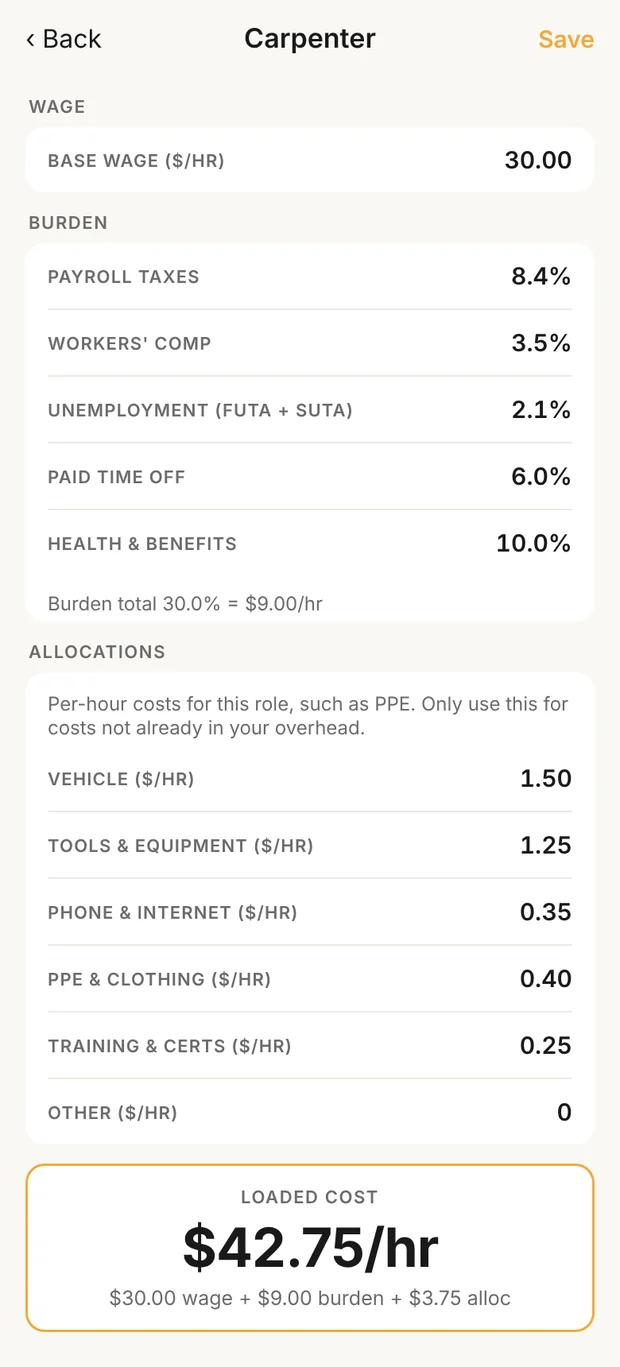
Loaded cost, by role
A role's loaded cost in Clamp: the wage, each burden line as a percent, and per-hour allocations for costs not already in overhead. Hours logged under the role cost this, never the base wage. Recreated from the app with sample data.
Consistency beats precision. The goal is a job cost you can trust from one estimate to the next, so the variance means something.
Three tests
MaterialsPrice what you would reasonably pay again for the same job next month. The scratch-and-dent deal you found once is not a rate
SubcontractorsGive the sub the whole scope, in writing, and price their whole scope. A sub who fills in the other 20% on their own is a variance you can't see coming
Tools and equipmentTools you need no matter what are overhead. A mixer or tile saw you rent for one job is job cost at the rental rate, even if you own it
The habit that breaks small contracting businesses: the owner swings a hammer, runs every job and the business, and takes whatever cash is left. That hides three different things in one number.
Three proofs
Wages prove the job worksYour hours on site are labor, at the rate you would pay someone else to do them. If the job can't carry that, the job doesn't work
Salary proves the business worksYour pay for running jobs and the business is overhead. When the markup carries it, you have a business, not a job
Profit proves ownership worksProfit is the reward for owning it, separate from both. The course sets 8% net as the floor
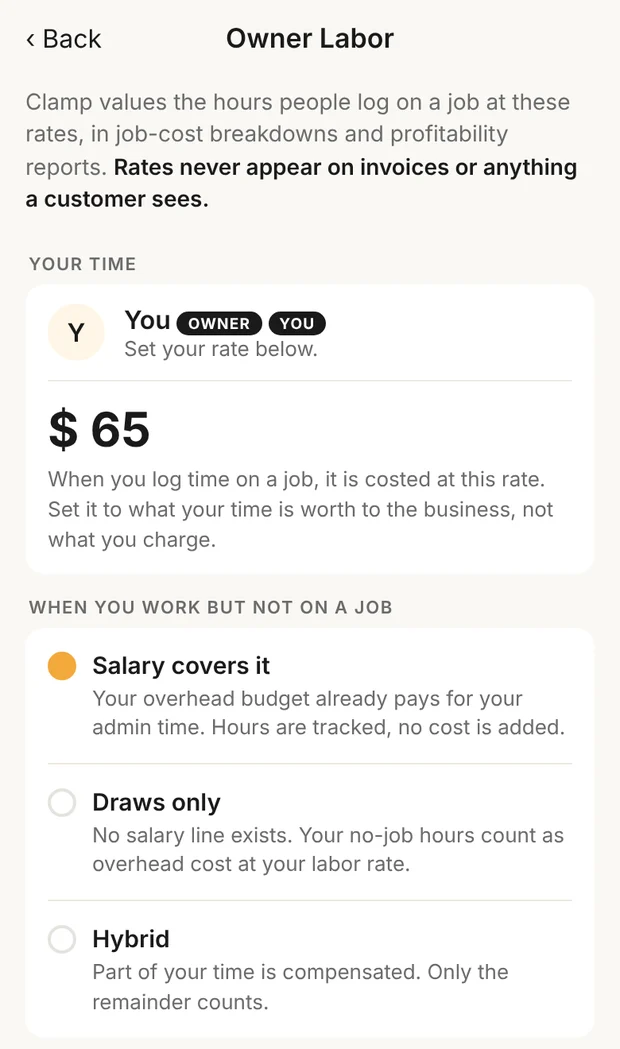
Field hours and salary, apart
Owner Labor in Clamp: your field hours cost the job at a rate you set, and your admin time is covered by the salary line in overhead. Recreated from the app with sample data.
The IRS draws the same line for S corporations: a shareholder who works in the business must be paid reasonable compensation before distributions. A sole proprietor's draws aren't a deductible expense at all.
The budget is the estimate linked to the signed proposal. It changes for one reason: a signed change order. Allowances that run over are recovered the same way: under AIA's A201 (section 3.8), the contract sum is adjusted by change order when the cost differs from the allowance.
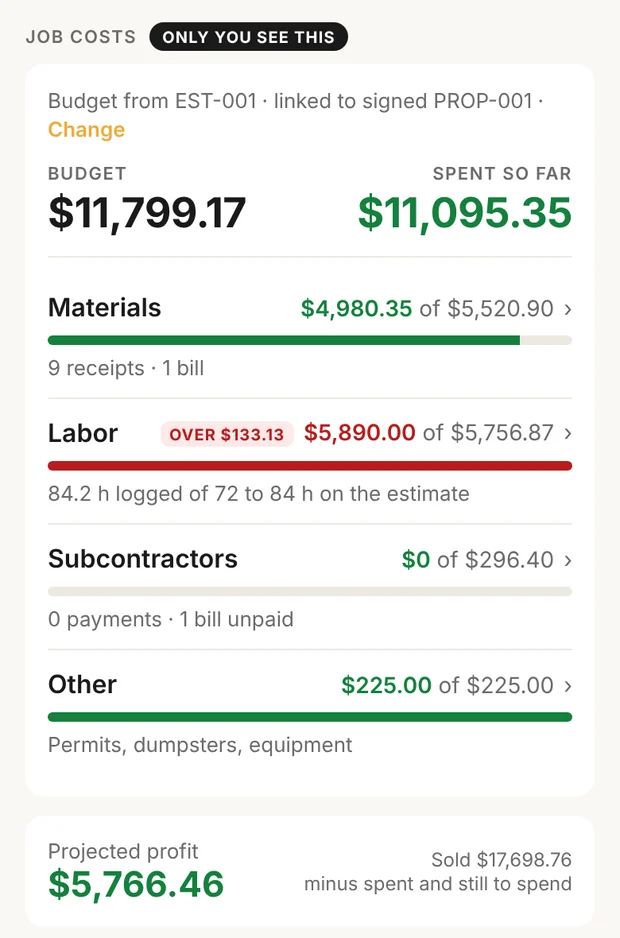
Budget from the signed estimate
The job costs card late in the job: budget from the estimate linked to the signed proposal, spent so far by category, labor already over with hours against the estimate's range. Owner and admins only. Recreated from the app with sample data.
Risk doesn't go in the lines. If the kitchen is a 1960s house and you don't know what's behind the walls, price it as a high-risk job and raise the profit, or carry a contingency the customer can see. Padding the tile hours to cover the unknown wrecks the one number you're trying to learn.
The Oak Street bathroom sold at $17,698.76 on an $11,799.17 estimate, a 1.50 markup. It closed at $11,972.65. The total passed the 2% test. One category didn't.
| Category | Actual | Variance |
|---|---|---|
| MaterialsBudget $5,520.90 | $5,431.25 | -1.6% |
| LaborBudget $5,756.87; 86 hours at the loaded rate | $6,020.00 | +4.6% |
| SubcontractorsBudget $296.40 | $296.40 | 0% |
| OtherBudget $225.00 | $225.00 | 0% |
| JobBudget $11,799.17 | $11,972.65 | +1.5% |
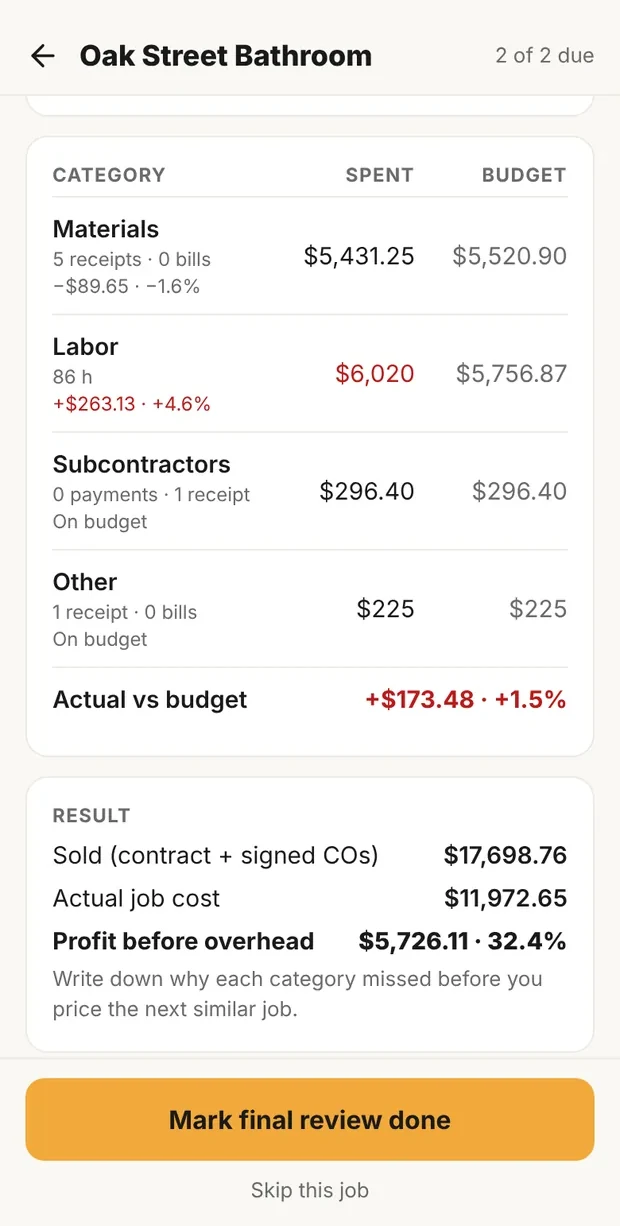
Estimated vs actual, by category
The final review in Clamp: estimated against actual by category with the variance, profit before overhead, and a prompt to write down why each category missed. Sample data.
A 1.5% total hides a 4.6% labor miss because materials came in under. The whole point of categories is to catch that. The question at close is why: did it take longer, or did the hours cost more than the rate?
Job costing pays on the next job. The hours tell you whether the estimate's labor was wrong or the crew was slow. The receipts tell you what tile really costs now.
| Measure | Figure |
|---|---|
| NAHB remodeler gross margin, 2024An effective markup of about 1.43 | 29.9% |
| NAHB remodeler net margin, 2024Highest since 1996 | 6.3% |
| Markup floor, remodelingStone; the course | 1.50 |
| Markup floor, specialty tradesThe course; Stone puts it at 1.35 | 1.40 |
| Net profit floorStone; the course | 8% |
Feed it back
HoursCompare logged hours with the estimate's hours, not just dollars. A miss splits into took longer and cost more per hour
RatesClamp suggests a new catalog rate only after three receipts tied to that line across two or more jobs. Tap Use to save it
Review cadenceMonthly by default; set it weekly for a tighter loop. Three checks: all costs in, on the right job and category, running over anywhere
What it means
Job costing on every plan
Clamp's job costs card budgets from the estimate linked to the signed proposal, in four categories. Receipts, bills and logged hours count against it, hours at the loaded rate of their role. Signed change orders adjust the budget. The review comes up on Home on your schedule, and the final review asks why on any category outside plus or minus 2%.
You won't hit 2% on the first bathroom. You hit it on the tenth, because you wrote down why the first nine missed.
Questions
What is job costing in construction?
Comparing what a job was estimated to cost with what it actually cost, by category, while it runs and when it closes. The budget is the estimate behind the signed contract. Every receipt, bill and hour is coded to the job. The point is the next estimate.
How accurate should a job cost estimate be?
Within plus or minus 2% of actual at close, including signed change orders, on work you do over and over. That is a target experienced remodelers set for themselves, not an industry standard, and a contractor in year one won't hit it yet. Check it by category, not just the total.
What is a fully burdened labor rate?
The wage plus everything you pay because that person is on payroll: Social Security and Medicare (7.65%), federal and state unemployment, workers' comp, paid time off and benefits. In construction, benefits average 43.8% of wages, so a $30 wage costs about $43 an hour.
Is the owner's salary a job cost?
No. Your hours building the job are labor at a market rate, like anyone else's. Your pay for running the business is overhead, recovered by the markup. An S corporation owner must take reasonable compensation; a sole proprietor's draws aren't an expense at all.
Does job costing include overhead?
Not in a direct cost system. Overhead is what the business pays whether or not the job exists: insurance, the truck, the office, your salary. The markup recovers it. Mixing it into job cost hides whether the estimate was right.
How much does job costing software cost?
QuickBooks Online puts project profitability on Plus at $140 a month list. Knowify's job costing plan is $329 a month billed yearly or $399 monthly. Clamp includes job costing on every plan, from $19.99 a month.
Sources & provenance
- The Minimum Pricing System (course transcripts, 16 lessons) Clamp Research
- Publication 15 (2026), Employer's Tax Guide IRS (official source)
- Contribution and Benefit Base Social Security Administration (official source)
- Topic No. 759, Form 940, Employer's Annual Federal Unemployment (FUTA) Tax Return IRS (official source)
- Unemployment Insurance Tax Rate Details, Rate Year 2026 Ohio Department of Job and Family Services (official source)
- Base rates by manual classification, effective July 1, 2026 (OAC 4123-17-06, Appendix) Ohio Bureau of Workers' Compensation (official source)
- Class 5645, carpentry, detached one or two family dwellings: rates Workers' Compensation Rating and Inspection Bureau of Massachusetts (official source)
- Employer Costs for Employee Compensation, June 2026 Bureau of Labor Statistics (official source)
- S Corporation Compensation and Medical Insurance Issues IRS (official source)
- Instructions for Schedule C (2025), Line 26, Wages IRS (official source)
- NAHB Chart of Accounts NAHB (official source)
- Remodelers Saw Profit Margin Gains in 2024 NAHB Eye On Housing (research)
- Job-Costing for Survival JLC (research)
- Calculating Your Markup, with Michael Stone (webinar summary) Clear Estimates (research)
- A503, Guide for Supplementary Conditions (2017/2019), on A201 Section 3.8 allowances AIA Contract Documents (research)
- QuickBooks Online plans and pricing Intuit (research)
- Knowify pricing Knowify (research)
- Bathroom Remodel From Estimate to Final Invoice: One Job, Every Document Clamp Research