How to Job Cost a Remodeling Job: Budget, Actual Cost, and Variance
Job costing compares what you expected a job to cost with what it is actually consuming. Where the budget comes from, what to record and when, the variance math on a published bathroom, what a 4% overrun does to profit, and the review that protects your next estimate.
The assumptions
This model assumes
- A residential contractor (remodeling, specialty trade, service or new construction), solo or with a small crew and trade subs
- The budget is the published 5x8 bathroom, version 3: $11,799.17; the actual costs at close are an illustration
- The overrun example uses the published 1.50x normal markup on an illustrative $10,000 job cost
- The plus or minus 2% target is the course author's experience-based target, not a benchmark
- Operational job costing, not tax or financial-statement accounting
The model, step by step
Nothing else on this list answers the job costing question.
| Record | What it answers |
|---|---|
| The estimate | What you expected the job to cost. |
| The price | What you're charging: the job cost times your markup. |
| Job costing | What this job cost against what you said it would. |
| What's been paid | Which bills you've settled. A paid bill isn't the measure of cost, and an unpaid one still counts. |
| Overhead | What the business costs whether or not this job exists. It is never job cost. See overhead categories. |
| Your books (profit and loss) | How the whole business did over a period, under your accounting method. |
| Cash in the bank | Whether you can pay this week. It says nothing about whether this job made money. |
What counts as a job cost in the first place is in what is job cost.
Sorted from always to when it applies.
| Item | When | Why |
|---|---|---|
| The budget and where it came from | Always | You need to know what actual cost is being compared against. |
| Materials | Always | One of the core direct-cost groups. |
| Labor, at a fully burdened rate | Always | Hours times the loaded labor rate, not the base wage. |
| Subcontractors | Always | A major cost that moves on its own, under its own contract and scope. |
| Other direct cost | Always | Permits, dumpsters, equipment for this job, and the rest. |
| Every receipt, bill and hour coded to the job and category | Always | An uncoded cost can't produce a trustworthy variance. |
| The review date | Always | You need to know how current the comparison is. |
| Signed change orders | Usually | They change both what was sold and what was budgeted. |
| Purchase orders not yet billed | Usually | Not spent yet, but they show what's still coming. |
| Still to spend | Usually | A mid-job profit figure needs a forecast, not only what's been spent. |
| The allowance reconciliation | When it applies | An allowance distorts the budget until the final selection's cost is settled. |
| The owner's field hours | When the owner works on the job | Otherwise that labor vanishes from the job's apparent cost. |
| Equipment for this job | When it applies | Rented for one job, it is job cost. Used across many jobs, it is overhead. |
The lines below are this guide's examples to adapt.
On the published 5x8 bathroom the budget is $11,799.17, with no signed change orders. Clamp groups it into four categories: labor $5,756.87, materials $5,520.90 (allowances count here), subcontractors $296.40 and other $225.00.
Ordered isn't spent, and spent isn't paid. A cost counts against the job when the job receives the goods or the work, not when the check clears. Paying a bill settles what you owe. It never makes the job cost more. The records are in How to Track What a Job Costs Before You Pay It.
Michael C. Stone, a builder and remodeler with more than six decades in the industry and the author of Estimating Construction Profitably, wants costs entered at least once or twice a week in a small company. He wants the estimator to see a job cost recap at least weekly, and says monthly is too slow. This guide follows him: review weekly.
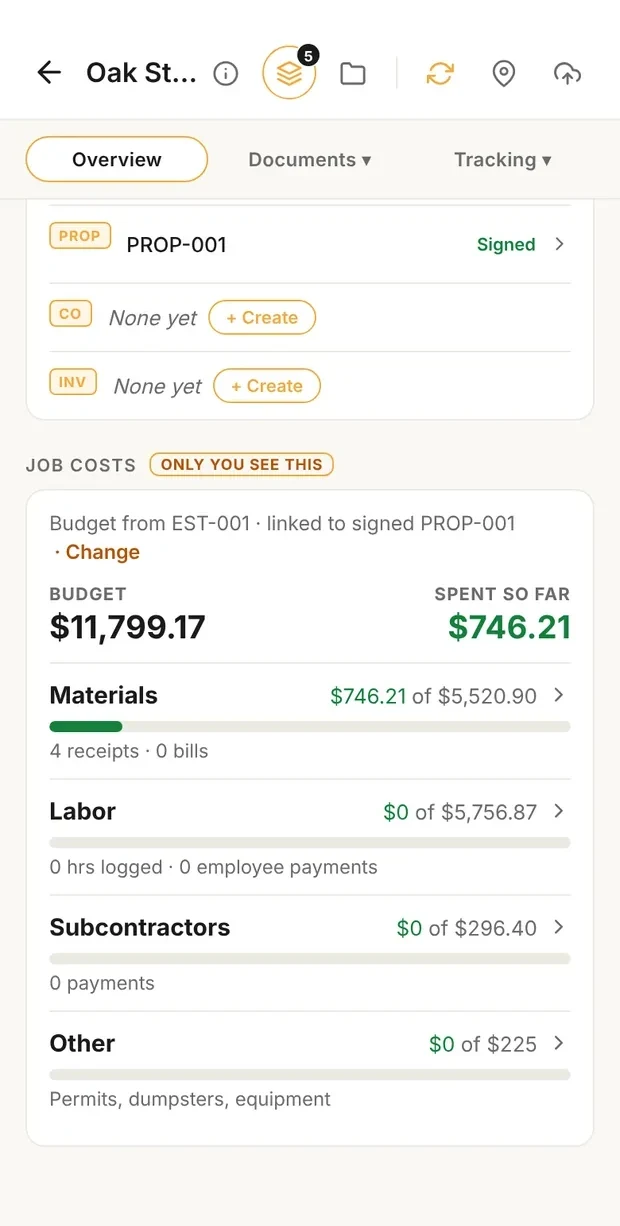
The job costs card
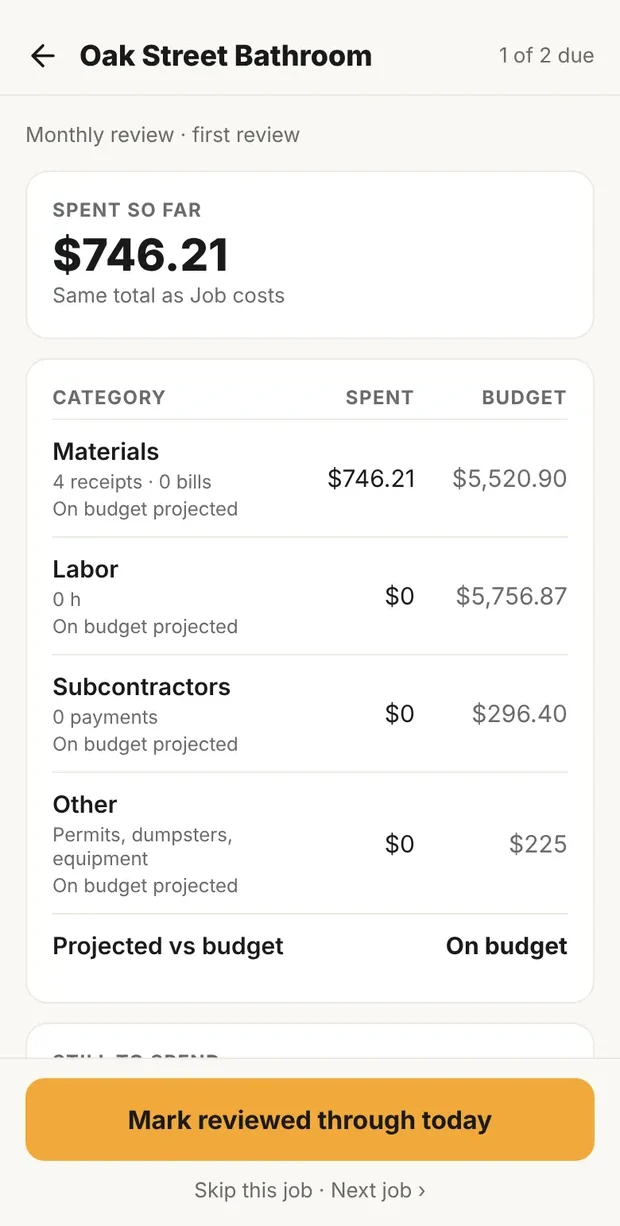
The review, with variance
Mid-job, in Clamp: the Oak Street job's costs card, and the review that projects the finish. The same job at close is under The math. Demo data on the published 5x8 bathroom.
Positive means over the estimate; negative means under. On the published 5x8 bathroom, with illustrative actual costs at close:
| Category | Estimated | Actual | Variance | Variance % |
|---|---|---|---|---|
| Labor | $5,756.87 | $6,020.00 | +$263.13 | +4.6% |
| Materials | $5,520.90 | $5,431.25 | -$89.65 | -1.6% |
| Subcontractors | $296.40 | $296.40 | $0.00 | 0.0% |
| Other | $225.00 | $225.00 | $0.00 | 0.0% |
| Total | $11,799.17 | $11,972.65 | +$173.48 | +1.5% |
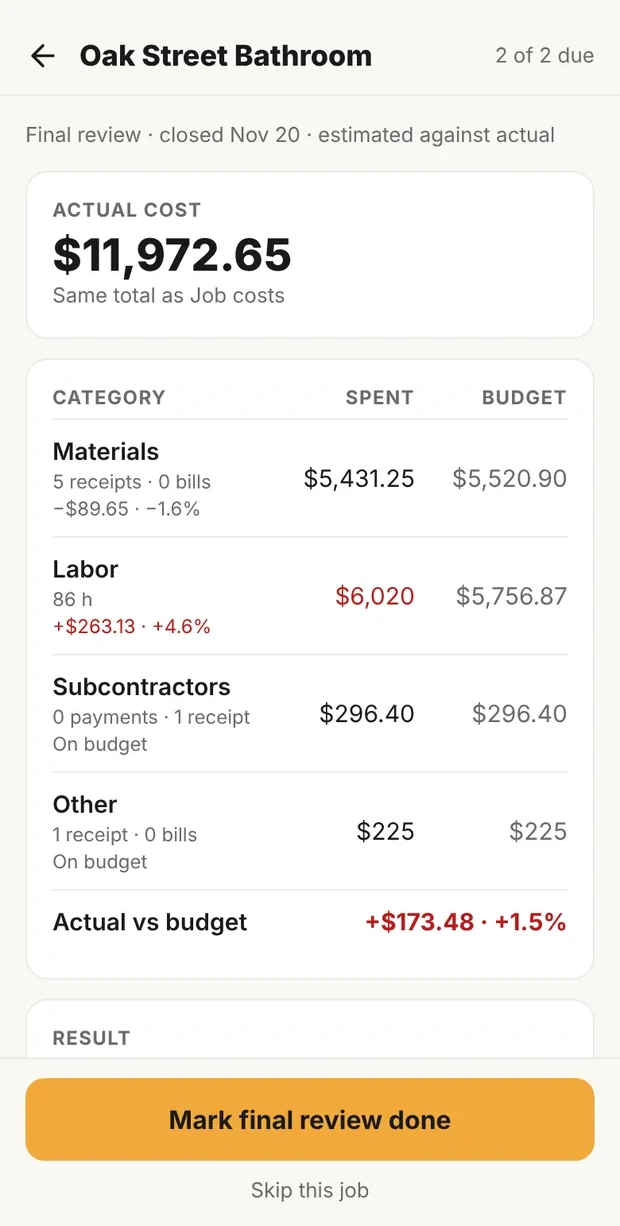
Final review, by category
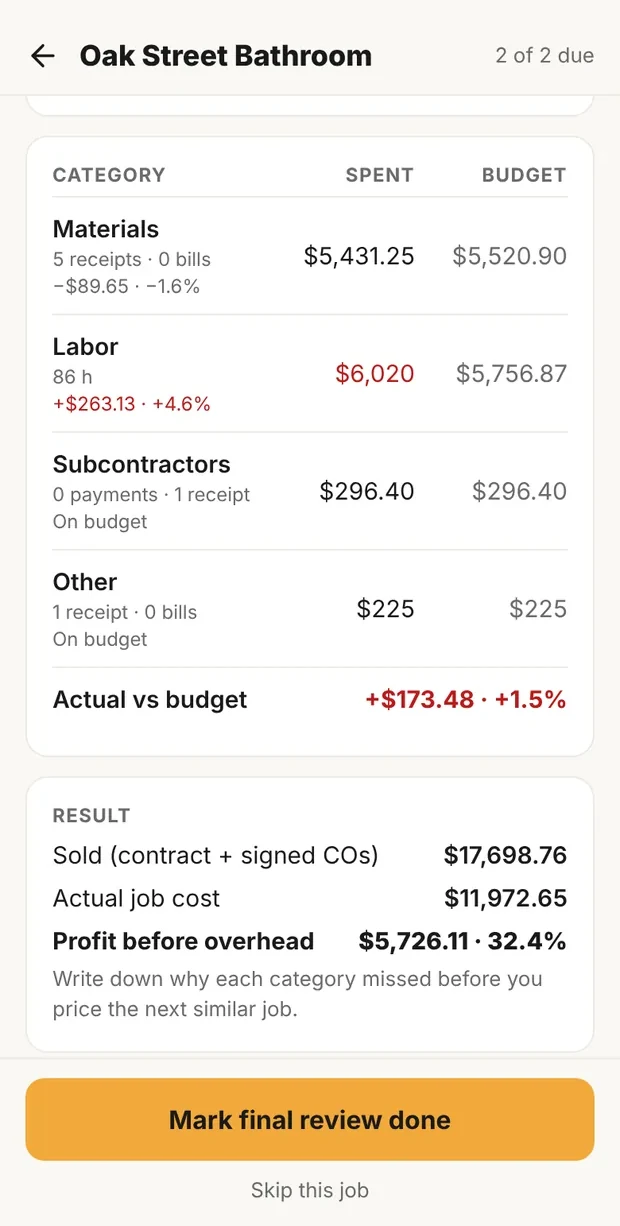
The result
At close, in Clamp: the final review of the same job, estimated against actual by category, and the result. Demo data on the published 5x8 bathroom.
When labor misses, compare hours before dollars. Stone's point is that a dollar comparison mixes two problems: the hours you guessed and the rate you used. The method is in contractor time tracking.
While the job runs, the review projects the finish:
Clamp counts still to spend category by category: whichever is larger, what's on order or what's left in the budget. That's an app rule for a forecast, not an accounting standard. Mid-job on Oak Street, sold is $17,698.76 and the projected final cost is $11,799.17, so projected profit before overhead is $5,899.59, 33.3%.
At close there is nothing left to project. The final review compares the actual cost with the estimate:
On Oak Street that is $17,698.76 - $11,972.65 = $5,726.11, 32.4%. The $173.48 between the projection and the result is the variance in the table above, most of it labor. The projection told you where the job was heading; the review at close tells you what to change in the next estimate.
What a miss does to profit. The risk markup guide publishes a normal markup of 1.50x: 23 1/3% overhead and 10% net profit. Take a job with an illustrative job cost of $10,000:
| Line | As estimated | With a 4% overrun |
|---|---|---|
| Job cost | $10,000 | $10,400 |
| Price (1.50x) | $15,000 | $15,000 |
| Overhead (23 1/3% of price) | $3,500 | $3,500 |
| Net profit | $1,500 (10.0%) | $1,100 (7.3%) |
Review every job at close, estimated against actual by category, before you price the next similar job. That is the rule that protects you. These make the review worth doing:
This is operational, not tax accounting. Recording a cost when the job receives the work is Clamp's job costing rule. It isn't a rule for when you deduct the expense on a tax return. Under the cash method, expenses are generally deducted when paid. Under an accrual method, they're generally deducted when incurred, subject to IRS rules. Your books and tax return follow your accounting method. Ask your accountant.
Decide these before the first job.
| Decision | Options | This guide's practice |
|---|---|---|
| How often to review while the job runs | Weekly; every two weeks; monthly | Weekly, as Stone recommends, plus a look whenever something big changes. |
| Categories | Four roll-up categories; many detailed ones | Record in four: labor, materials, subcontractors, other. Go finer only to find the cause of a miss, such as mobilization, site conditions or one trade. |
| The owner's field hours | Not costed; costed at a market wage | Costed at what you'd pay someone else to do that work, through a production role. Managing the business is salary, and ownership is profit. Neither is job cost. |
| Equipment | Job cost; overhead | Rented or used for one job: job cost. Used across many jobs: overhead, unless you set an internal rental rate. |
| Mileage | Job cost; overhead; in the loaded rate | When your loaded labor rate already includes a vehicle allocation, logged miles aren't added on top. Unusual project travel goes in the estimate. |
| What counts as a miss worth investigating | A fixed percentage; your own range | No universal percentage. Look into anything outside the range you expect for that kind of job, any miss that repeats, or any miss big enough to change the next estimate. |
What people get wrong with job costing, and what to do instead.
| Mistake | What to do instead |
|---|---|
| Reviewing only when the job is over | Review weekly while it runs, then once more at close. |
| Calling a purchase order spent | Keep committed and actual cost separate. |
| Counting a cost only when it's paid | Record it when the goods or work arrive, and the payment separately. |
| Coding costs at year end | Code the job and category when you record it. |
| Comparing labor dollars when the rate changed | Compare hours first, then fix the rate. |
| Moving the budget because the job is running over | Change the budget only for a signed change in scope. |
| Treating a price increase from a supplier as a budget change | It's a variance, unless a signed change order changed the scope. |
| Losing the owner's field hours | Log them under a production role at a market wage. |
| Counting the owner's management time as field labor | Keep production labor and running the business apart. |
| Adding mileage on top of a vehicle-loaded labor rate | Choose one way to recover vehicle cost. |
| Mixing overhead into a job after the fact | Classify costs the same way in estimates, markup and actuals. |
| Diagnosing a miss from one total | Drill into the category, then the cause. |
| Treating under budget as good news | Ask why. Missing work, a cost on the wrong job, or a late bill can look good for a while. |
| Updating the next estimate from memory | Use the actual hours and costs from comparable jobs. |
What it means
Job costing in Clamp
Each job's budget comes from the estimate linked to the signed proposal, and signed change orders add to it. The job costs card shows the budget against what's been spent across four categories: materials, labor, subcontractors and other. Receipts and bills count by their category, and hours count at the loaded rate of the role they were logged under. Purchase orders show as ordered, not spent. The card also shows projected profit before overhead. The job cost review comes up on Home on the schedule you choose, weekly included, with what's been spent, what's still to spend, the variance by category, and the projection. When you close a job, it comes up once more for a final review: estimated against actual by category, the variance, and the profit before overhead the job actually made. Job costs are visible to the owner and admins only. Clamp doesn't compare estimated with actual hours, count logged mileage as job cost, or produce a job cost report across jobs.
Score your Operations system in the contractor business self-assessment, where question 24 asks whether you do routine job costing, and see the risk markup guide for what job cost error does to your markup.
Sources & provenance
- Estimating Construction Profitably Michael C. Stone (book)
- Markup & Profit: A Contractor's Guide, Revisited Michael C. Stone (book)
- Publication 538, Accounting Periods and Methods Internal Revenue Service (official source)
- Publication 583, Starting a Business and Keeping Records Internal Revenue Service (official source)
- 5×8 Bathroom Remodel Cost and Labor (2026 Baseline) Clamp Research
- Three Markups, One Job Cost: How Contractors Price Risk and Change Orders Clamp Research
- Contractor Time Tracking: Compare Estimated Hours With Actual Job Hours Clamp Research