Kentucky Contractor Deposit Rules (2026): No Advance Payment on Insurance Work Until Day Five
Kentucky sets no general cap, but on work paid from an insurance claim a contractor can't require any advance payment until five business days after a denial. From KRS 367.626.
Not legal advice. General information from each state's statutes, checked Oct 20, 2026. Local rules and the facts of your contract can change the answer; for a specific contract, ask a lawyer licensed in your state.
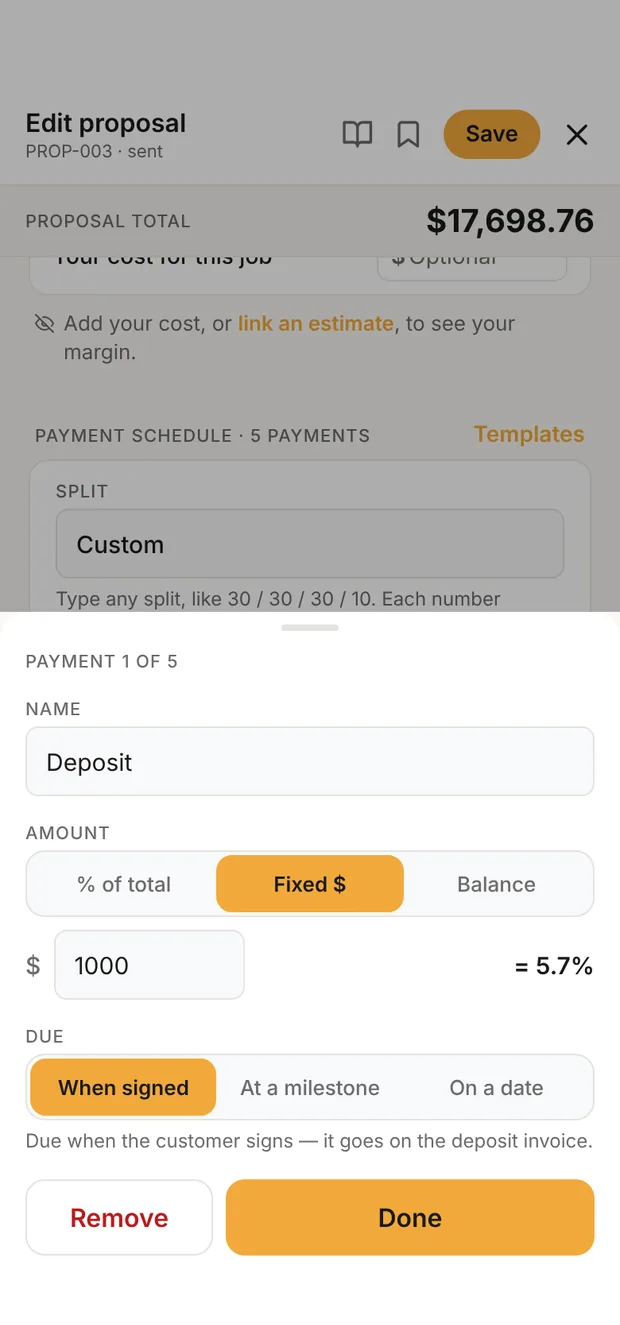
Set the deposit
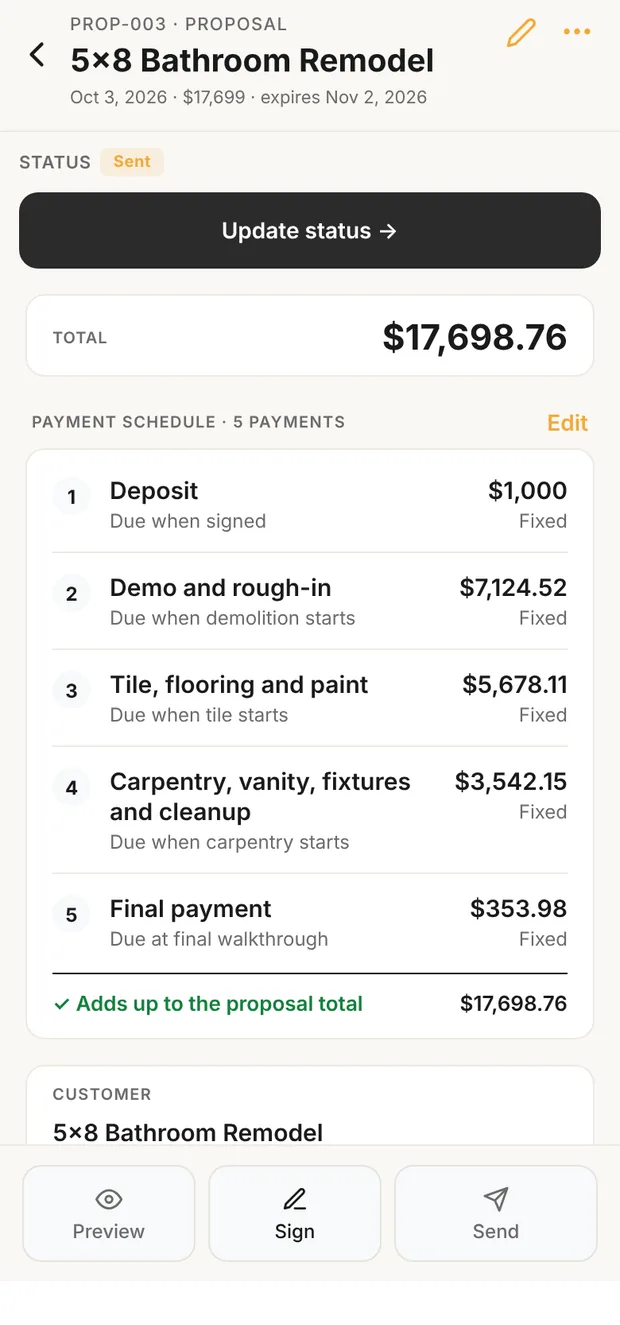
Every payment tied to a stage
The deposit and payment schedule in the Clamp app: a $1,000 deposit due when the customer signs, then every other payment tied to a stage of the job. $1,000 on this $17,699 bathroom is under every state's cap. Sample data.
What the law says
“Not require any advance payments under a real estate goods or services contract”
The maximum deposit, worked
| Contract price | How it works out | Maximum deposit |
|---|---|---|
| $8,000 | Insurance-paid work: nothing can be required until five business days after a denial | $0 |
| $25,000 | Insurance-paid work: nothing can be required until five business days after a denial | $0 |
| $60,000 | Insurance-paid work: nothing can be required until five business days after a denial | $0 |
Who it covers and the exceptions
Covers
Contracts for goods or services relating to residential or commercial real estate, paid from property, casualty, or property and casualty insurance proceeds (KRS 367.620).
Repair and emergency work
A contractor that provides repair services or emergency goods or services, including repairs needed to prevent further damage, can collect a reasonable and customary amount for them (KRS 367.626(3)).
Recent changes
Amended effective June 27, 2025 and July 15, 2026; each change applies to contracts entered on or after its date.
Kentucky deposit questions
Does Kentucky's rule cover commercial jobs?
Yes. It covers insurance-paid work on residential and commercial real estate.
Compare other states
How we checked
We read each state's statute or licensing rule on the official legislature or agency site and quote it as written. Where the official site would not load, the row says so and names the copy we read. A state stays "still being checked" until we have read the full rule; we never mark it "no cap" before then. Last checked .
This guide explains what the statutes say. It is not legal advice; for a specific contract, ask a lawyer licensed in your state.