How to Set Construction Milestones: Where to Divide the Job and How to Define Each Stage
A milestone is an event in the job, with evidence it happened, that something else depends on. What a good milestone includes, sample wording from the trigger to the start notice, the published bathroom divided into its stages, and the rule that protects you: every payment milestone is an event, never a percentage complete or a calendar date.
The assumptions
This model assumes
- A residential contractor (remodeling, specialty trade, service or new construction), solo or with a small crew and trade subs
- The worked example is the published 5x8 bathroom, version 3, with the payment schedule from the invoice guide
- The 14-day delay is an illustration
- Sample language is a drafting example, not legal advice; home improvement payment law varies by state
The model, step by step
What a milestone is for, against what it gets confused with.
| Thing | What it is for |
|---|---|
| The milestone | The event that has been reached: "demolition starts", "rough inspection passed". |
| The payment | What the milestone makes due. How much, and the start-or-done rule, are in the invoice guide. |
| The planned date | Your forecast of when you'll reach the event. It can move without changing the milestone. |
| The production schedule | Who works when. A schedule item may start a milestone; it isn't one. See how to coordinate a jobsite. |
| The inspection | The building department's check. It can be a condition inside a milestone, or separate from payments. |
| The checklist | Your record of what was completed toward a milestone. It documents the trigger and never redefines it. |
| The punch list | The remaining contract items at the end. See closeout. |
Sorted from always to only if required.
| Item | When | Why |
|---|---|---|
| A name | Always | Both sides need one stage to point at. |
| An objective trigger | Always | Says exactly what event has been reached. |
| Trigger type | Always | State exactly what event controls it: signing, a start, completion, inspection or acceptance, or another defined event. For a production stage, start or done is the choice: "demolition starts" and "demolition is complete" are weeks apart. |
| What depends on it | Always | A payment, a notice, an inspection, the next trade, a draw or closeout. A milestone with nothing depending on it is just a task. |
| The trigger written into the signed agreement | Always, when money or contract rights depend on it | A checklist written later can't repair a vague signed term. |
| A "what has to be done" checklist | Usually | Records the parts behind a "done" milestone. |
| A planned date | Usually | For planning. It can move without changing the milestone. |
| A start notice | Usually, for a stage that's due when it starts | Dated evidence the stage began. |
| Photos | Usually, when they show something | Evidence of the condition at start or completion. |
| An inspection result | When passing it gates the next phase | Evidence the gate was cleared. |
| A sub's or crew's start | When their work defines the stage | Often the most visible event. |
| A selection deadline | When a customer decision gates production | Sometimes the decision is what lets the next stage start. |
| A lender draw | When the job is financed with draws | The lender's draw rules apply, not yours. |
| Customer sign-off on the stage | Only if the contract, a lender or state law requires it | The default is the signed agreement plus your dated record. |
The agreement defines the event. The checklist and evidence show you reached it.
The lines below are this guide's examples to adapt, not a script or legal advice. Have your payment terms reviewed in your state.
Not "when rough-in is mostly complete". For a stage that's due when it's done, name the finished condition: "Payment 2 is due when rough plumbing and electrical are complete and the rough inspection has passed."
Michael C. Stone is a builder and remodeler with more than six decades in the industry, and the author of Markup & Profit: A Contractor's Guide, Revisited. He ties progress payments to the start of clearly identified segments, such as framing, rough plumbing or cabinet installation, because a start is easier to agree on than how complete something is.
The checklist records how you support the trigger. It doesn't rewrite the signed trigger.
Say what you reported. Don't say your software confirmed the work.
The signed change order updates the agreement before that work starts. See the change order guide.
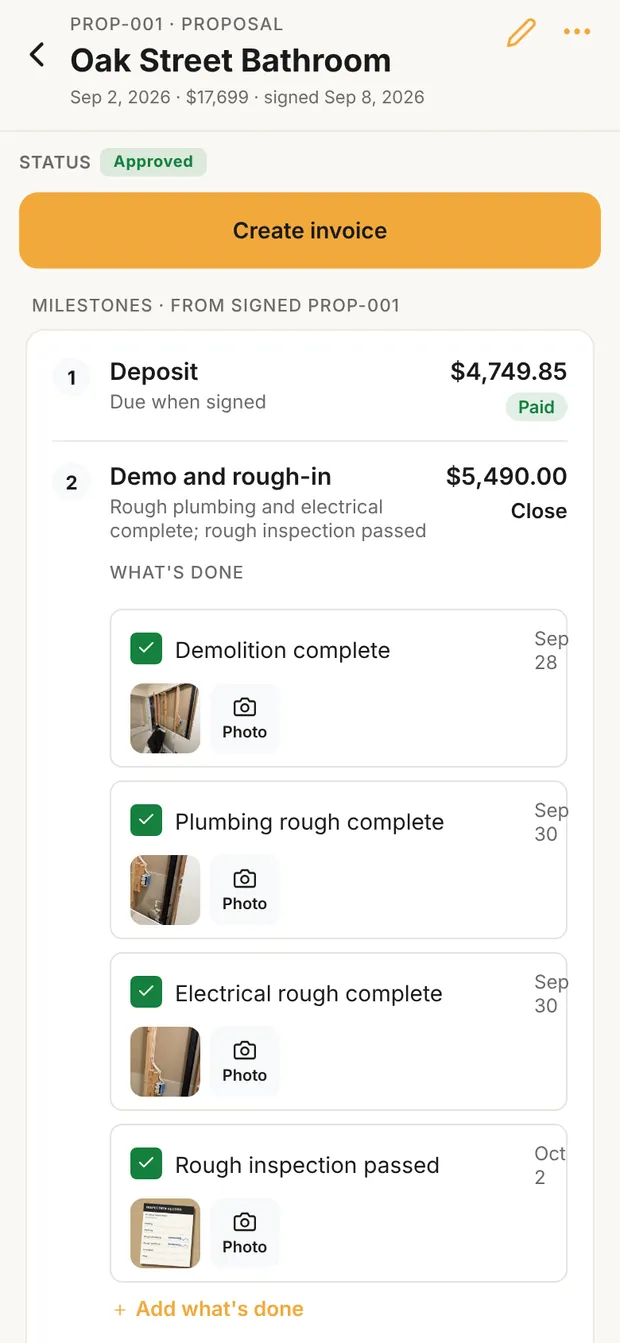
The checklist, with photos
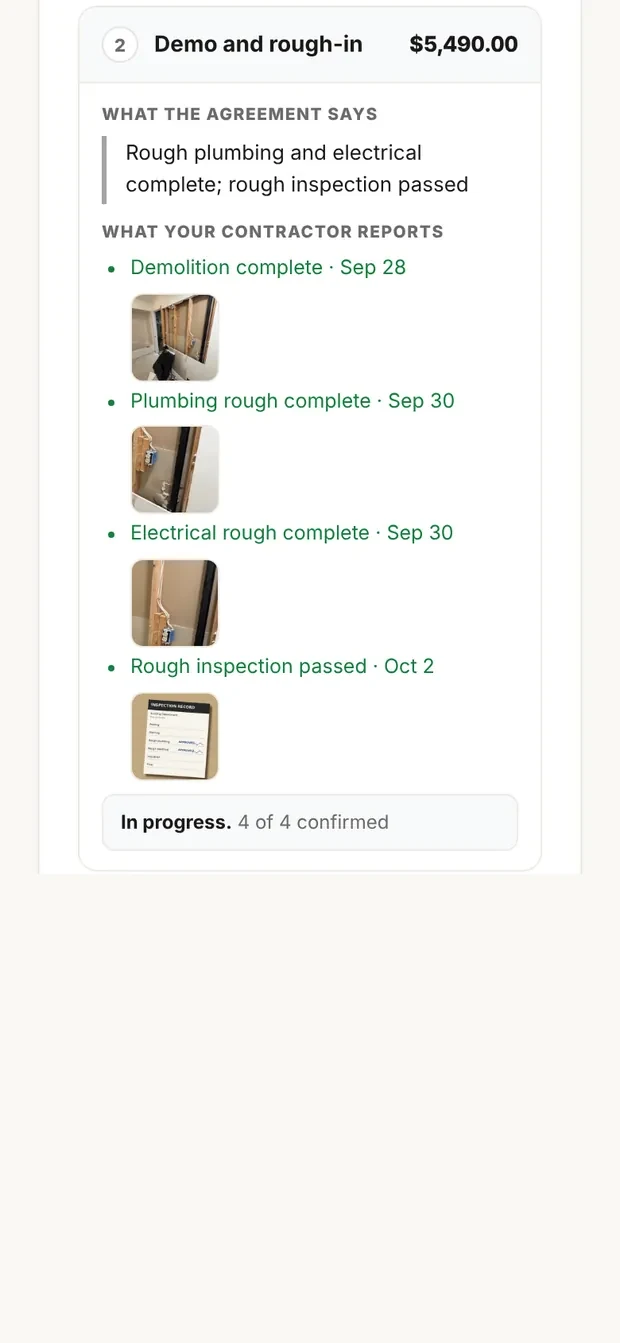
What the customer sees
The rough-in stage's "What's done" checklist in Clamp, each line with its date and a photo, and the same lines with their photos in the customer's portal, under "What your contractor reports". Demo data on the published 5x8 bathroom.
Answer with the milestone you both signed. "Our agreement says this stage is done when [event]. Here's the checklist with each item and the date it was completed. If one of those agreed conditions hasn't happened, the stage isn't done, and we'll finish it. If they have, we go by the trigger we signed rather than a new definition made now."
This case teaches more than a failed inspection, because it tests the whole system: the signed trigger, the checklist, the evidence and the payment timing. It also shows the limit. If the signed trigger was vague ("mostly complete"), no checklist can fix it after the fact. That's why the trigger is written as an event before the job starts.
The published bathroom, divided. The 5×8 bathroom has a direct cost of $11,799.17 and a contract of $17,698.76 at the published 1.50x illustration. The payment amounts are the invoice guide's worked schedule, and how they were sized is explained there.
| Milestone | Trigger | What the checklist holds | Payment | Stage direct cost |
|---|---|---|---|---|
| Deposit | The agreement is signed | Agreement signed; selections ordered | $4,749.85 | Not a production stage |
| Demo and rough-in | When demolition starts | Protection set up; demolition started | $5,490.00 | $5,160 |
| Tile, flooring, paint | When tile starts | Substrate ready and inspected where required; tile begun | $4,375.43 | $3,384 |
| Carpentry, vanity, fixtures and cleanup | When carpentry starts | Tile complete; vanity and fixtures on site | $2,729.50 | $3,255 |
| Final | At the final walkthrough, under the agreement | Final walkthrough held; closeout record prepared under the contract (see closeout) | $353.98 | Not a production stage |
Stage direct costs are rounded, from the invoice guide's worked example. The five payments add up to the contract: $4,749.85 + $5,490.00 + $4,375.43 + $2,729.50 + $353.98 = $17,698.76.
What a vague trigger costs. Suppose payment 2 had been written "due when rough-in is mostly done" instead of "when demolition starts", and the argument over "mostly" delays it by 14 days (an illustration).
You wait 14 extra days for that cash while you keep paying whatever job costs come due in the meantime. The stage's published direct cost is $5,160, but how much of it becomes contractor-funded during those 14 days depends on when the costs are actually paid and what customer cash is already on hand:
When that number is positive, the customer's job is running on your money, which is what the invoice guide's start-of-stage rule exists to prevent.
Every payment milestone is an objectively identifiable event, never a percentage complete or a calendar date.
"When framing starts" holds up. "When framing is 50% complete" is an argument. "On October 12" turns a weather delay into a late payment, or a payment for work that hasn't happened. Write the event in the signed agreement, decide start or done before the job starts, and keep dated evidence when you reach it.
A clear milestone doesn't override your state's home improvement payment law. Have your contract and payment triggers reviewed in your state.
Decide these before the contract is signed.
| Decision | Options | This guide's practice |
|---|---|---|
| Where to divide the job | By dollar size; by length; at control points | At control points: where payment, an inspection, a handoff to another trade or the next major phase changes. No count by job size. |
| Start or done | Start for every stage; done for every stage; by stage | By stage, decided before signing. Start where cash funds the stage (the invoice guide), done where completion is the point. |
| Inspections | Their own milestone; a condition inside one; separate | A condition inside a "done" milestone when passing it gates the next phase. Otherwise keep it separate from payments. |
| Customer sign-off per stage | Require it; offer it; rely on your record | Not by default. The signed agreement plus your dated report and evidence. Sign-off only where the contract, a lender or state law requires it. |
| Evidence | Nothing; a checklist; a checklist with photos | A dated checklist, with photos where they show something, including the signed inspection card. |
| What moves a milestone | The calendar; the event | Only the event. A slipped date moves the planned date. A changed event needs a signed change order. |
Financed work. In HUD's FHA 203(k) rehabilitation program, the contractor completes a phase, the work is inspected, and the draw is released through the lender. For financed jobs, the milestone that releases money may be "inspected and accepted", not your start-of-stage trigger. Follow the lender's draw agreement.
State law. In California, a home improvement contract's progress-payment schedule must describe each phase and the work or materials it covers. Except for the down payment, the contractor may not ask for or accept more than the value of the work performed or the material delivered (Bus. & Prof. Code §§ 7159 and 7159.5). The down payment is generally limited to the lesser of $1,000 or 10% of the contract price. So a covered California contract can't use a start-of-stage payment to collect more than the value of work already performed or materials already delivered. Start timing isn't the issue; the amount collected is.
In Massachusetts, a home improvement contract must include a payment schedule. The deposit is generally capped at the greater of one third of the price or the cost of special-order materials, and the final payment can't be demanded until the work is completed to the parties' satisfaction (M.G.L. c. 142A § 2).
These are examples, not a survey.
| Job type | Typical pattern |
|---|---|
| One-visit service | Authorization, then completion. Often one payment event. |
| Specialty replacement | A deposit or material commitment, then installation start or completion, then the final payment. |
| Remodel | Several visible production stages, then closeout. |
| Addition or new home | More production and inspection gates. When it's financed, the lender's draw schedule controls when money is released. |
What customers say about a milestone, and what to say back.
| The customer says | What to say back |
|---|---|
| "It doesn't look done to me." | "Let's use the trigger in our agreement. It says this stage is done when [event]. Here's the dated checklist. If an agreed condition is still open, we haven't reached it." |
| "The inspector hasn't been yet." | "The question is whether passing inspection is part of this milestone's signed trigger. If it is, the milestone waits. If not, the inspection is a separate step." |
| "Why is it due before you've finished?" | "Our agreement makes this stage due when it starts, not when it's finished, so the stage is funded before the work. Your state's payment rules still control what we can collect." |
| "You're behind, so I'll pay late." | "The planned date and the payment trigger are different things. If the stage hasn't started, the payment isn't due yet. Once the signed event happens, the agreement's payment terms apply." |
| Mistake | What to do instead |
|---|---|
| "50% complete" as a trigger | Name an event anyone can identify. |
| A calendar date as the trigger for a production stage | Use the event in the agreement, and keep the planned date movable. |
| Defining "done" when you send the invoice | Define it before signing. |
| Letting the checklist redefine the contract | The checklist documents the trigger. The signed agreement defines it. |
| Too few stages on a long job | Divide where payment, inspection or the next major phase changes. |
| Too many tiny stages | Combine work that has nothing depending on it. |
| Billing because the calendar says the stage should have started | Bill on the event. |
| Assuming every payment waits on inspection | Say in the agreement whether passing inspection is a condition. |
| Saying your software verified the work | Say what you reported, with your evidence. |
| Moving a milestone without updating the schedule | Move the planned start and the schedule together. |
| Using start-of-stage billing everywhere | Check your state's law first. California limits payments to work performed. |
What it means
Milestones in Clamp
Each payment in the proposal's schedule is a milestone with a trigger: at signing, on a date, at a milestone event, or at completion. A stage payment is due when its stage starts or when it's done, and the customer sees the signed line, such as "Due when demolition starts". On the job, each milestone has a "What has to be done" checklist. Check items off as they're completed, and add photos to any line, such as the signed inspection card. Mark done makes the payment ready to invoice. On a job with a customer portal, the customer sees each line and its photos, labeled as your statements, not Clamp's findings. For a stage due when it starts, send a start notice. A Jobsites schedule item can name the stage it starts. Moving that item offers to move the stage's planned start too, and the payment never becomes late because the date moved. Home shows stages starting within three days whose notice hasn't gone out, with a reminder the morning before. Clamp doesn't get customer sign-off on a stage, track inspections or handle lender draws.
Before you write the next payment schedule, see how to set a payment schedule and invoice for sizing each payment, and the Clamp method for where milestones sit between the proposal and the invoice.
Sources & provenance
- Markup & Profit: A Contractor's Guide, Revisited Michael C. Stone (book)
- Profitable Sales: A Contractor's Guide Michael C. Stone (book)
- California Business and Professions Code section 7159 California Legislature (official source)
- California Business and Professions Code section 7159.5 State of California (official source)
- Industry Bulletin: Progress Payment Restrictions Contractors State License Board (official source)
- Massachusetts General Laws chapter 142A, section 2 Massachusetts Legislature (official source)
- FHA 203(k) Draw Request, form HUD-9746-A U.S. Department of Housing and Urban Development (official source)
- How to Set a Payment Schedule and Invoice a Remodeling Job Clamp Research
- How to Write and Price a Change Order Clamp Research
- How to Coordinate a Remodeling Jobsite: Crew, Subs, Photos, and Schedule Clamp Research
- How to Close Out a Remodeling Job: Punch List, Final Payment, Warranty, and Handoff Clamp Research
- How to Job Cost a Remodeling Job: Budget, Actual Cost, and Variance Clamp Research
- 5×8 Bathroom Remodel Cost and Labor (2026 Baseline) Clamp Research