How to Write a Construction Proposal
A proposal is the scope, price and terms the customer accepts, and the agreement the job is built to. What it includes, sample language for each section, how to price real options at one markup, and the rule that protects you: build only what the signed agreement says.
The assumptions
This model assumes
- A residential remodel priced as a fixed price
- The options are priced at the Established profile's published 1.50x markup; the basic remodel is close to the published 5×8 bathroom, and the job costs and the $4,800 deposit are rounded illustrations
- The owner's practice: one proposal by default with up to three real options, a 30-day expiration, scheduling after signature and the initial payment
- Sample language is a drafting example, not legal advice. Have your form reviewed in your state.
The model, step by step
A proposal turns the estimate into an offer the customer can accept.
| Document | What it does |
|---|---|
| Estimate | Works out what the job costs you. It stays in your office. |
| Design agreement | Pays for the planning that settles scope and selections, when the job needs it |
| Proposal | Sets the scope, price, schedule and terms. Signed, with the initial payment handled, it is the construction agreement |
| Change order | Amends the signed proposal, one change at a time |
| Invoice | Bills a payment the signed schedule requires |
The proposal is not the estimate sheet reformatted for the customer. Michael C. Stone, a builder and remodeler with more than six decades in the industry and the author of Profitable Sales, Estimating Construction Profitably and Markup & Profit: A Contractor's Guide, Revisited, the books this guide draws on, warns against software that turns estimating lines into a contract. The customer needs a document that defines the job and the agreement. Your cost buildup stays yours.
Every proposal needs the same core terms.
| Item | Include |
|---|---|
| The customer, the contractor and the job-site address | Always |
| The scope of work, written as what will be done | Always |
| Materials and specifications that matter to the price: names, brands, models | Always, where they matter |
| The contract price | Always |
| The payment schedule: each payment, its trigger and its amount | Always |
| The expected start and duration | Always |
| The date the offer expires | Always |
| Signatures | Always |
| What is not included | Usually |
| Terms and conditions | Usually |
| How changes are handled | Usually |
| Allowances, for selections still open | Depending on the job |
| Credits and prior payments, such as a design agreement credit | Depending on the job |
| Sales tax, where it applies to your work | Depending on the job |
| Two or three options | Only when they are real alternatives |
| Permits, owner-supplied items, special site conditions | Only if stated |
The language below is a drafting example, not legal advice. Many states require specific home improvement contract language, disclosures or cancellation notices. Have your form reviewed in your state. How to size each payment is in How to Set a Payment Schedule and Invoice a Remodeling Job; changes after signing are in How to Write and Price a Change Order.
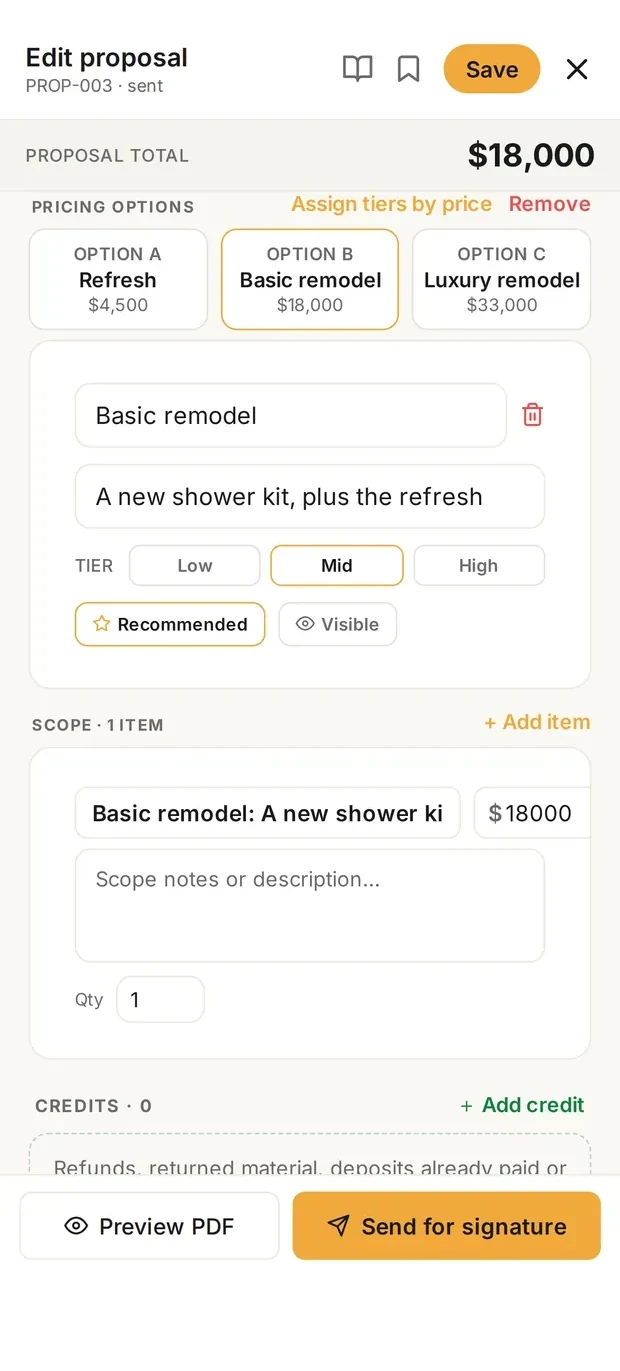
Three options
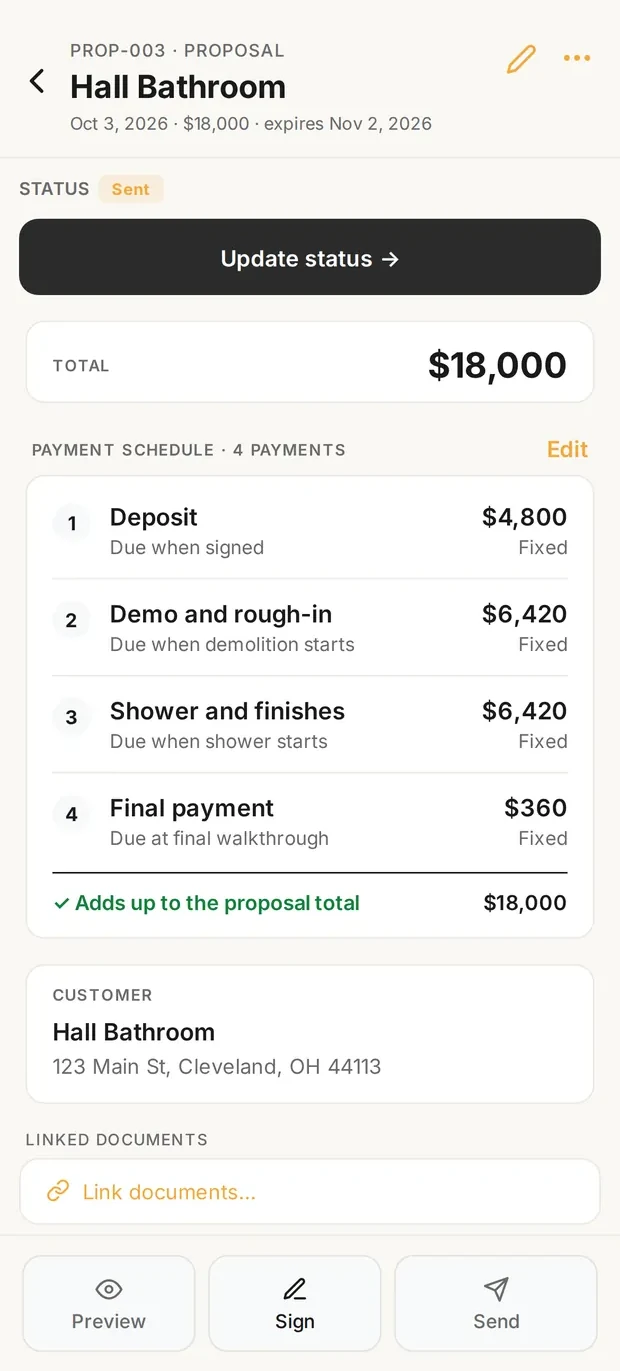
The payment schedule
A proposal in Clamp: three priced options with one recommended, then the recommended option's payment schedule. Demo lead; the figures are the worked example in step 4.
Price every option the same way: its own job cost at the markup your business requires. Never offer the same scope at three different markups. The markup is what your business needs, not a choice you hand the customer. This example is one 5×8 bathroom with three real alternatives, each priced at the Established profile's 1.50x markup from markup vs margin. The basic remodel is close to the published 5×8 bathroom, $11,799 in job cost and $17,699 at 1.50x; the job costs here are rounded illustrations.
| Option | Scope | Job cost | Price |
|---|---|---|---|
| Refresh | Paint, new LVP floor, a basic vanity | $3,000 | $4,500 |
| Basic remodel, recommended | A new shower kit, plus the refresh | $12,000 | $18,000 |
| Luxury remodel | A curbless walk-in shower, tile walls and floor, heated floors | $22,000 | $33,000 |
Each option is a different job priced at the same 1.50x markup, so each carries the same planned gross margin percentage, 33.3%. Recommend the option that fits the customer's stated scope, priorities and budget, not the most expensive one. Offer options only when they are real alternatives, settled in planning. Stone points out that several estimates for an undecided customer are real estimating work. Finish the design first, or charge for the extra estimates.
The payment schedule clause gives every payment its trigger and its amount, and each option carries its own. For the basic remodel: $4,800 at signing, $6,420 when demolition starts, $6,420 when the shower starts, and $360 at completion, which is 2%. The $4,800 deposit is close to the 5×8 bathroom's $4,750 in allowances, the selections bought before work begins.
This is the rule that protects you. Once the proposal is signed and the initial payment is handled, it is the agreement, and in Stone's words it guides what gets built. The scope, specifications, exclusions, price, timing and payment schedule are what it says. Anything else goes through a signed change order before the work.
That makes the proposal's detail your protection. A vague scope is an open promise. A missing exclusion leaves room to disagree about what the price included. A substitution nobody wrote down is a dispute at the final payment.
Decide these once, so every proposal says the same thing.
| Decision | Practice | Why |
|---|---|---|
| How many options | One by default; two or three when they are genuinely different scopes or finish packages | Several free estimates for an undecided customer is unpaid design work (Stone) |
| Option pricing | Each option's own job cost at the same markup | The markup is what the business needs, not a sales lever |
| How long the price holds | 30 days | This guide's practice. Stone recommends three days. Whichever period you choose, print the date |
| A verbal or text yes | Records intent only | The job is scheduled after the proposal is signed and the initial payment is handled |
| Cost breakdown | Not shared | The customer buys a defined scope, not your estimate sheet (Stone) |
| Changes after signing | A signed change order before the work | The signed proposal is the baseline |
When the proposal is signed, the deposit invoice is drafted. Review it and send it. Schedule the job once the initial payment is handled under the contract.
From then on, the signed proposal is the baseline. Each stage payment comes due when its stage starts, with a start notice before it (payment schedule guide). Any change is a signed change order before the work (change order guide). The final balance collects what remains.
Most objections are answered by a clear proposal.
| The customer says | What to say back |
|---|---|
| "Can you do it for less?" | Change the scope, the selections or the quantities. The price for an unchanged job stays what the business requires. |
| "Why is the deposit so large?" | It covers what has to be bought before work begins, within your state's limits. |
| "I need to think about it." | Of course. The price holds through the date on the proposal, and you can ask anything before then. |
| "Can you give me three prices?" | If there are real alternatives, like a refresh, a basic remodel and a luxury remodel, they become options. If the design is still open, finish the planning first, or the extra estimates are paid work. |
| "Can I hold some back until the punch list is done?" | Completion, punch work and the final payment are defined in the agreement before construction begins. A new holdback at the end is not part of it. |
| "Can you break down your costs?" | The proposal describes exactly what you are buying. How we price it is ours, like any business. |
| "Can we shake on it and do the paperwork later?" | The signed proposal is what defines the work, price and payments. We sign first, then schedule. |
| "Why does the proposal expire?" | Material prices, subcontractor availability and our schedule change. The date says how long this price holds. |
| Mistake | Instead |
|---|---|
| Sending the estimate sheet as the contract | Write the scope as what will be done |
| A vague scope | Name the work, the materials and the specifications that matter |
| No exclusions | List what a reasonable customer might assume is included |
| No payment schedule, or payments tied to dates | Each payment's stage and amount |
| Not walking through the agreement before signing | Review the scope, price and every payment first |
| No expiration date | Print the date the price holds through |
| Free multiple estimates for an undecided design | Finish planning first, or charge for them |
| Showing internal costs | Show what the customer is buying |
| Discounting an unchanged scope | Change the scope instead |
| Scheduling from a verbal yes | Signed and initial payment first |
| Leaving changes undefined | Say in the proposal that changes are signed change orders |
What it means
Proposals in Clamp
A Clamp proposal carries the scope, a Not included list and your terms, with credits, tax and the expected start and duration frozen once it is sent. It offers two or three options, each with its own price and payment schedule; you mark one recommended and can hide any of them. Linking an estimate fills an option's scope at customer price, and internal cost lines never reach the customer's PDF. A milestone payment is paid at the start or the finish of its stage, printed as "Due when demolition starts". A proposal cannot be sent without an expiration date, and it can be signed in the customer portal or in person, or recorded as a verbal approval, which notes intent but is not a signature. When it is signed, the deposit invoice is drafted for you.
Size the schedule in How to Set a Payment Schedule and Invoice a Remodeling Job, and score your Sales system in the contractor business self-assessment.
Sources & provenance
- Profitable Sales: A Contractor's Guide Michael C. Stone (book)
- Markup & Profit: A Contractor's Guide, Revisited Michael C. Stone (book)
- The Markup You Add Is Not the Margin You Keep Clamp Research
- 5×8 Bathroom Remodel Cost and Labor (2026 Baseline) Clamp Research
- How to Set a Payment Schedule and Invoice a Remodeling Job Clamp Research
- How to Write and Price a Change Order Clamp Research