Ohio Contractor Deposit Limit (2026): 10% on Contracts Over $25,000
Ohio caps the down payment at 10% on home construction and remodeling contracts over $25,000 with an insured contractor. Quoted from ORC 4722.04 and worked.
Not legal advice. General information from each state's statutes, checked Oct 20, 2026. Local rules and the facts of your contract can change the answer; for a specific contract, ask a lawyer licensed in your state.
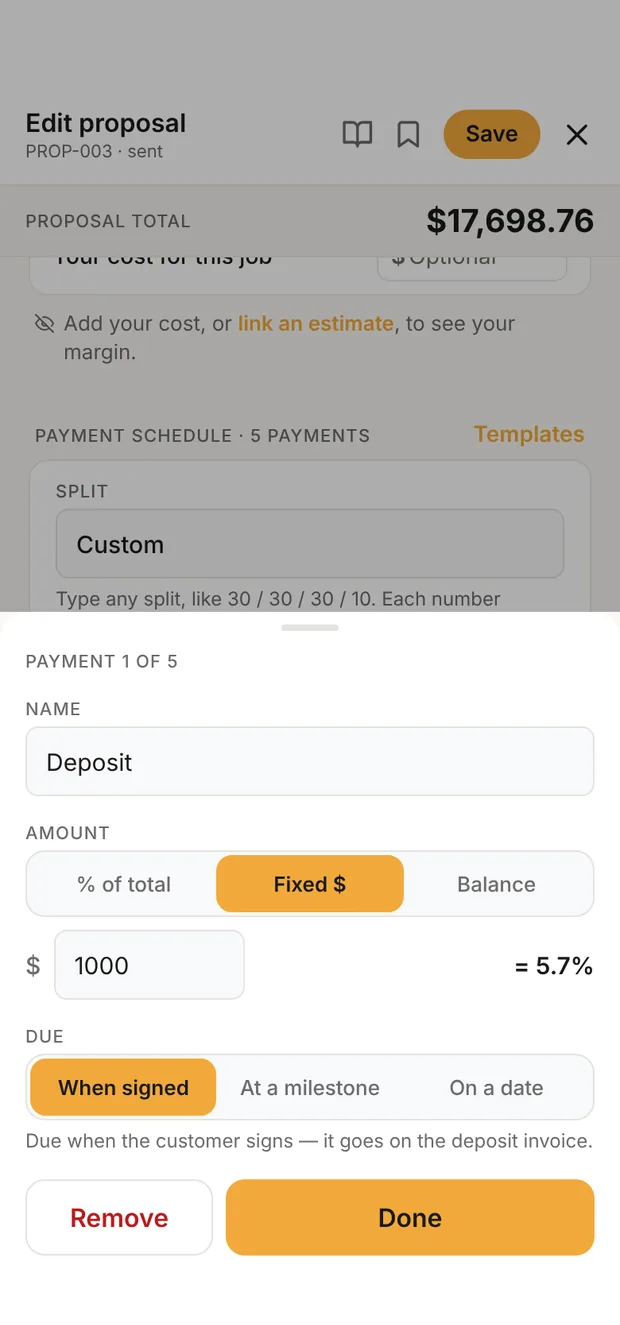
Set the deposit
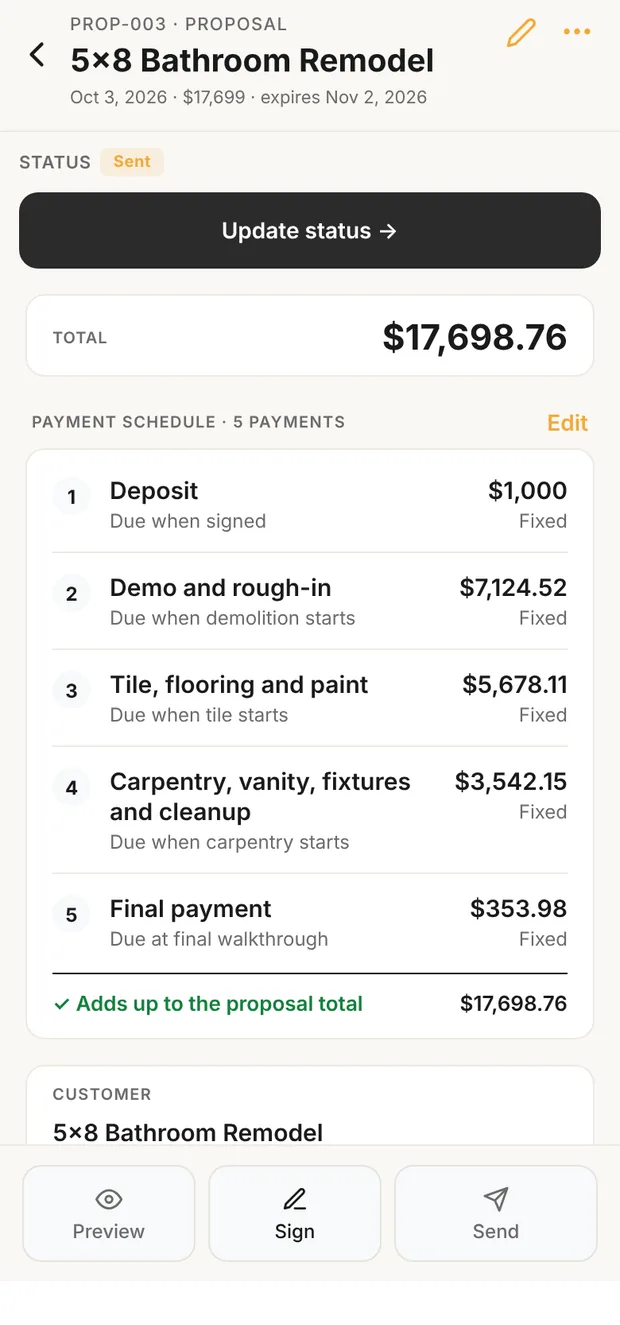
Every payment tied to a stage
The deposit and payment schedule in the Clamp app: a $1,000 deposit due when the customer signs, then every other payment tied to a stage of the job. $1,000 on this $17,699 bathroom is under every state's cap. Sample data.
What the law says
“A home construction service supplier may take as a down payment not more than ten per cent of the contract price before the supplier's performance that is required by the contract begins, except a supplier may take as a down payment not more than seventy-five per cent of the total cost of any special order item that is otherwise not returnable or usable before the supplier's performance that is required by the contract begins.”
The maximum deposit, worked
| Contract price | How it works out | Maximum deposit |
|---|---|---|
| $8,000 | Under $25,000, the 10% cap does not apply | No cap |
| $25,000 | Exactly $25,000 is unsettled; 10% avoids the question | $2,500 to be safe |
| $60,000 | 10% of $60,000 | $6,000 |
| $60,000 | With $20,000 of non-returnable special-order items: the larger of $6,000 or 75% of $20,000 | $15,000 |
Who it covers and what happens
Covers
Contracts exceeding $25,000 for new construction, or the repair, improvement, remodel or renovation of an existing one- to three-family home, with a supplier who maintains at least $250,000 of general liability insurance. Manufactured and mobile homes are excluded.
Special-order items
The statute says "except" and does not say whether the 75% allowance adds to the 10% or replaces it. The amount that complies under every reading is the larger of 10% of the price or 75% of the special-order cost.
Smaller or uninsured jobs
Outside the chapter, the Consumer Sales Practices Act applies. It sets no deposit percentage, but the contractor must deliver, refund, or give notice of a delay within eight weeks of taking money (OAC 109:4-3-09), and a job sold at the customer's home can be cancelled within three business days with a refund in 10 business days (ORC 1345.23).
The remedy
The owner can rescind the transaction or recover actual economic damages plus up to $5,000 in noneconomic damages (ORC 4722.08).
Also in the law
- The cap section has not changed since August 31, 2012. HB 50, effective September 20, 2024, expanded the definitions to include repair, improvement, remodeling and renovation.
- A contract of exactly $25,000 needs a written contract (ORC 4722.02 says "equals or exceeds"), but the cap's definition says "exceeding" $25,000. No court has settled which governs the deposit.
Ohio deposit questions
Does Ohio's 10% rule apply to every remodel?
No. It covers contracts over $25,000 with a contractor carrying at least $250,000 of general liability insurance, and not cost-plus contracts.
Can an Ohio contractor take more for custom materials?
Yes, up to 75% of the cost of special-order items that can't be returned or used elsewhere. The safe figure is the larger of 10% of the price or 75% of those items.
Compare other states
How we checked
We read each state's statute or licensing rule on the official legislature or agency site and quote it as written. Where the official site would not load, the row says so and names the copy we read. A state stays "still being checked" until we have read the full rule; we never mark it "no cap" before then. Last checked .
This guide explains what the statutes say. It is not legal advice; for a specific contract, ask a lawyer licensed in your state.