Vermont Contractor Deposit Limit (2026): Half the Labor or Materials
Vermont caps the down payment at half the labor or half the materials, whichever is greater, on contracts with a maximum price. Quoted from 26 VSA 5509 and worked.
Not legal advice. General information from each state's statutes, checked Oct 20, 2026. Local rules and the facts of your contract can change the answer; for a specific contract, ask a lawyer licensed in your state.
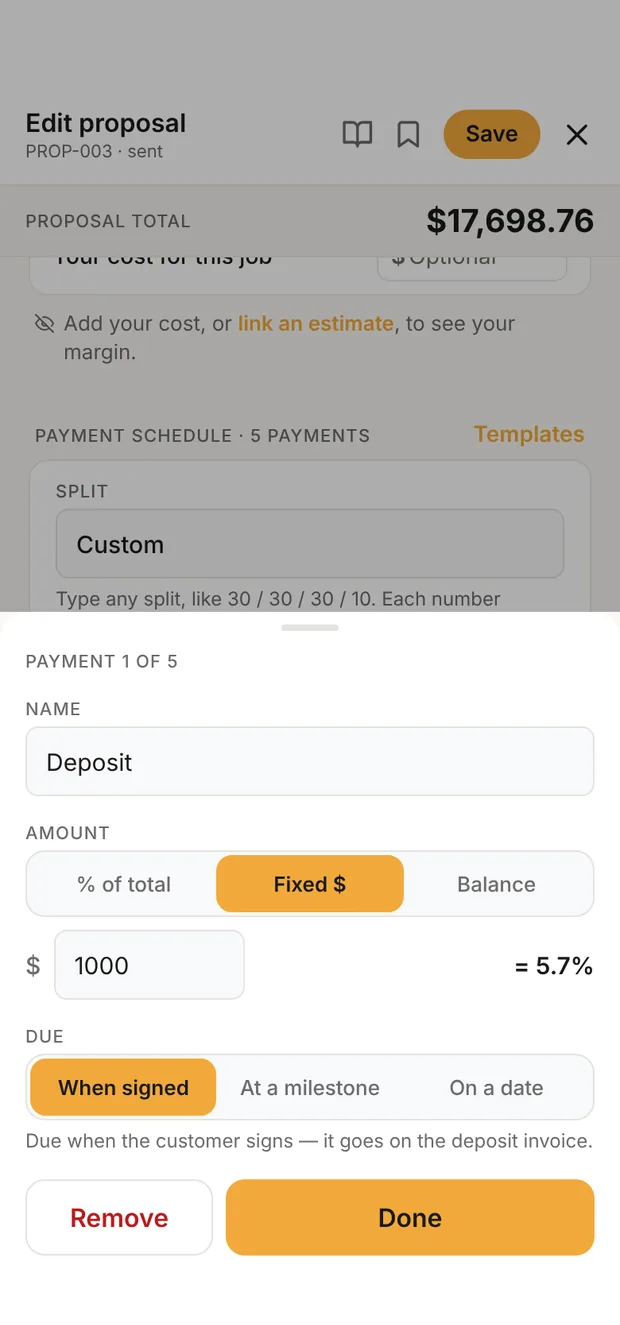
Set the deposit
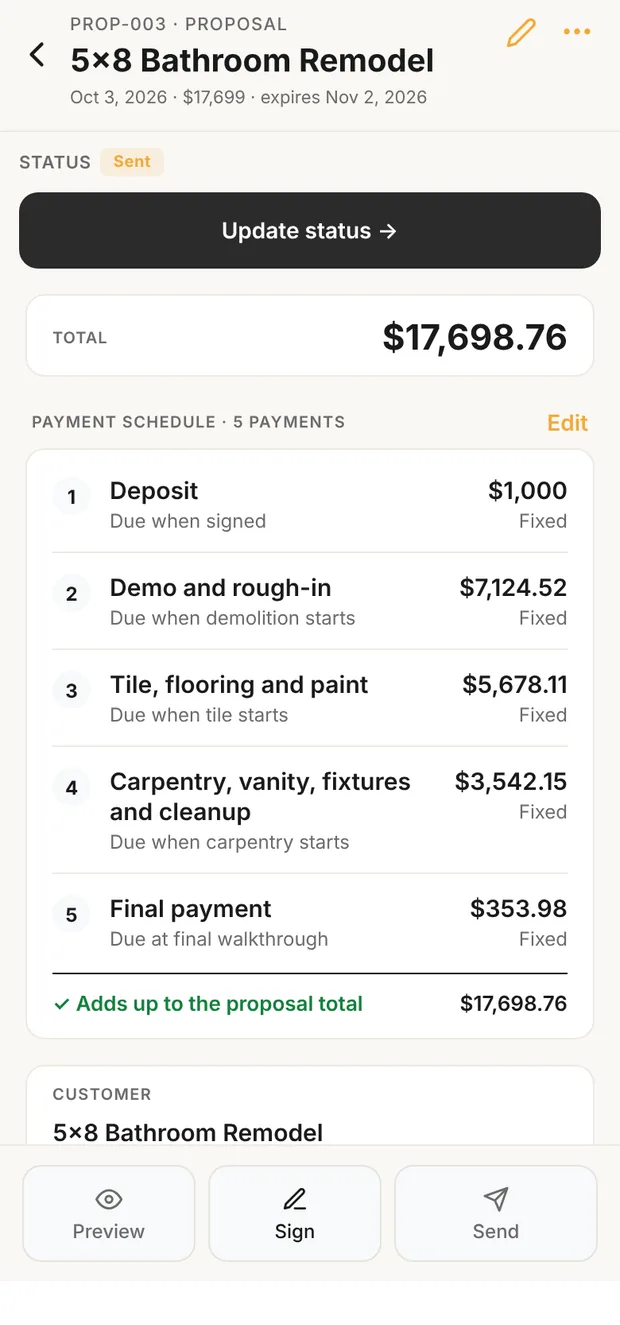
Every payment tied to a stage
The deposit and payment schedule in the Clamp app: a $1,000 deposit due when the customer signs, then every other payment tied to a stage of the job. $1,000 on this $17,699 bathroom is under every state's cap. Sample data.
What the law says
“If a contract specifies a maximum price for all work and materials or a statement that billing and payment will be made on a time and materials basis, not to exceed a maximum price, the contract may require a down payment of up to one-half of the cost of labor to the consumer, or one-half of the price of materials, whichever is greater.”
The maximum deposit, worked
| Contract price | How it works out | Maximum deposit |
|---|---|---|
| $8,000 | Registered contractor: depends on the labor and materials split | $2,000 to $4,000 |
| $25,000 | Depends on the labor and materials split | $6,250 to $12,500 |
| $25,000 | At 60% labor ($15,000) and 40% materials ($10,000): half of $15,000 | $7,500 |
| $60,000 | Depends on the labor and materials split | $15,000 to $30,000 |
Who it covers and what happens
Covers
Every residential construction job over $10,000, where registration with the Office of Professional Regulation is required (26 VSA 5501), and a registered contractor's smaller jobs. The rule sits in the section on requirements of registrants and has no dollar threshold of its own.
No maximum, no cap
If a time-and-materials contract has no maximum price, the down payment is whatever the parties negotiate (26 VSA 5509(c)(2)).
What happens
No statute names a penalty. For a registered contractor, the likely route is discipline by the Office of Professional Regulation for failing to follow a statute governing the profession, with an administrative penalty of up to $5,000 per violation (3 VSA 129a, applied by 26 VSA 5510(b)).
Not covered
Work the chapter exempts, such as landscaping or a structure not attached to a home (26 VSA 5502). The Office has told the Legislature it has no jurisdiction over unregistered contractors on projects of $10,000 or less.
Vermont deposit questions
Is Vermont's cap 50% of the contract?
No. It is half the labor or half the materials, whichever is greater, which works out to between 25% and 50% of the contract.
Compare other states
How we checked
We read each state's statute or licensing rule on the official legislature or agency site and quote it as written. Where the official site would not load, the row says so and names the copy we read. A state stays "still being checked" until we have read the full rule; we never mark it "no cap" before then. Last checked .
This guide explains what the statutes say. It is not legal advice; for a specific contract, ask a lawyer licensed in your state.