How to Handle the First Call With a Remodeling Lead: What to Ask and What Comes Next
The first call decides whether there is a next step, and whether it is paid. What to ask, how to score the lead while you're on the phone, what each grade gets, and what to write down before the next call.
The assumptions
This model assumes
- A residential remodeler, or a trade contractor, taking calls from homeowners
- The scoring method in full, with worked calls, is in How to qualify a contractor lead; this guide carries the short version
- The routing by grade and the 12-month timeline window are the owner's, from his Lead Filter System course
- The owner's practice: never drive to an unscored lead, a record for every inquiry, a lead marked lost after the follow-up sequence
- The sample lines are examples to adapt, not a script to read
The model, step by step
The first call is one step in a short chain. Each step is for something different.
| Step | What it is for |
|---|---|
| The inquiry (a call, a text, a web form, a referral) | Someone wants to talk. Nothing is known yet. |
| The first call | Decides whether there is a next step, and whether it is paid. |
| The lead record | The durable record of what you learned and decided on the call: the facts, the score, how they found you, and the outcome. |
| The site visit or planning meeting | Professional work on their project: measurements, conditions, options. |
| The design agreement | A paid, signed agreement for the design and planning work. |
| The estimate | Your cost and price for a defined scope. |
The call is a filter, not a sales presentation, and not every caller is your customer. The Lead Filter System, the owner's course this guide's method comes from, rests on one premise: a caller who won't go along with your process won't go along with your price either. Michael C. Stone, a builder and remodeler with more than six decades in the industry and the author of Profitable Sales, treats taking the lead as a job of its own: you ask, listen and write it down. The presentation and the firm price come later.
Sorted by how often it belongs on the call.
| Item | When |
|---|---|
| Name and a reliable way to reach them | Always |
| The project address | Always |
| What they want done, in their words | Always |
| The five scores: project, budget, decision-makers, motivation, timeline | Always |
| How they found you | Always |
| The outcome or next action | Always, with a date when there is one |
| The start window they want | Usually |
| Your price range for this kind of work, and their reaction | Usually |
| Who else decides, and whether they can be at the visit | Usually |
| The paid planning step and its fee | Depends on the grade |
| Short notes on anything that doesn't fit a field | Usually |
| Photos or existing plans | When the scope can't be understood by phone |
| HOA or condo rules, known permit or design limits, the age of the house, living there during the work | When their answer gives you a reason to ask |
| An insurance claim, or a homeowner who wants to do part of the work | Only if it comes up; each affects the score in its own way |
| Financing, a previous contractor | Only if it comes up |
The rows from photos down are not a checklist. Asking all of them on every call turns a ten-minute filter into a site survey. How an insurance claim or a homeowner doing part of the work changes the score is in the lead types guide.
Clamp's minimum to save a scored lead is the five scores. That is the app's floor, not this guide's standard. A lead without a reliable contact method can't be followed up well, and a lead without a source weakens your source reporting.
The lines below are this guide's examples to adapt, not a script to read.
Asking permission before the questions is how both Stone and the Lead Filter System open the call. A caller who pushes back on a few minutes of questions has given you the first red flag. Two red flags in a row end the call; the qualify guide has the exit rule.
Add them up: 4 or 5 is a Great Fit, 2 or 3 Possible, 0 or 1 Unclear, and below 0 a Bad Fit. How to qualify a contractor lead has the exact choices for each score and worked calls.
That is your range for your kind of work, not a guess at their project. Have it before the call. It comes from your minimum price, what each job has to carry so your overhead and profit get paid; see break-even and markup vs margin. A range invented on the phone is a guess the caller will remember as a quote.
Agree first, then set the condition. If they can't all be there, reschedule rather than meet with half the decision.
You're the leader here. State the fee once, plainly, and stop talking.
You're the guide here: a visit to take a look, with the paid step named now so it isn't a surprise later. A remodeler may nurture these leads. A trade contractor whose policy is to pursue only 4s and 5s may pass on them.
State the boundary and the fee, then let them choose. A yes books the paid step. A no parks the lead, or ends it.
The closing line reads the lead record back to the caller. Anything they correct, you fix before the next call.
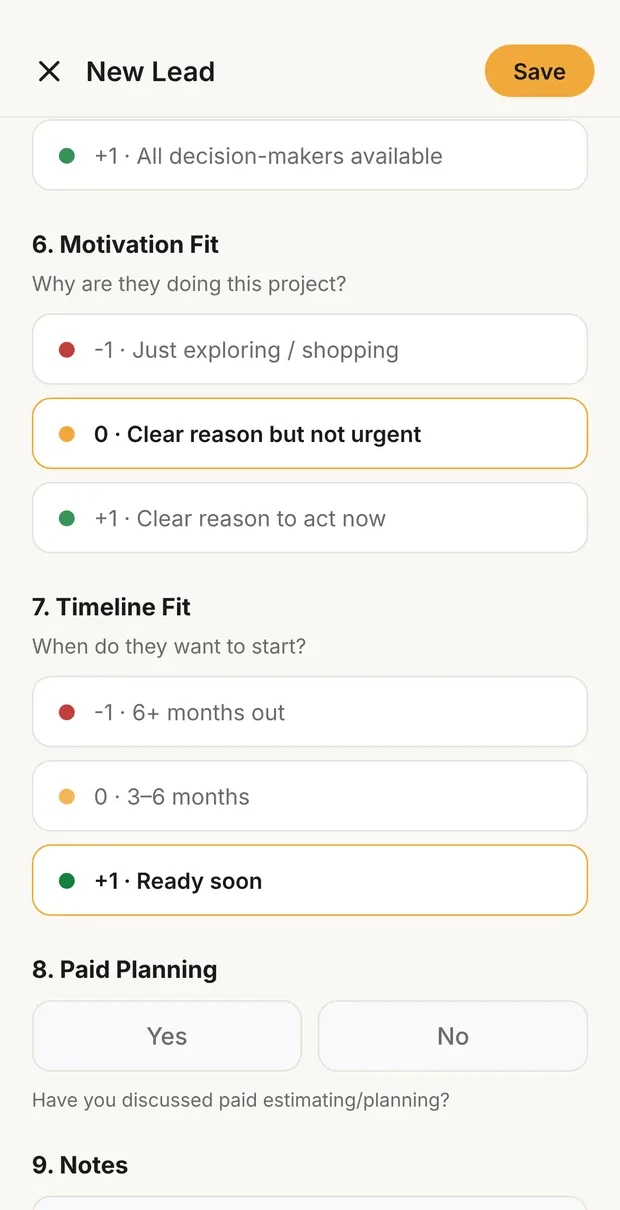
Score it on the call
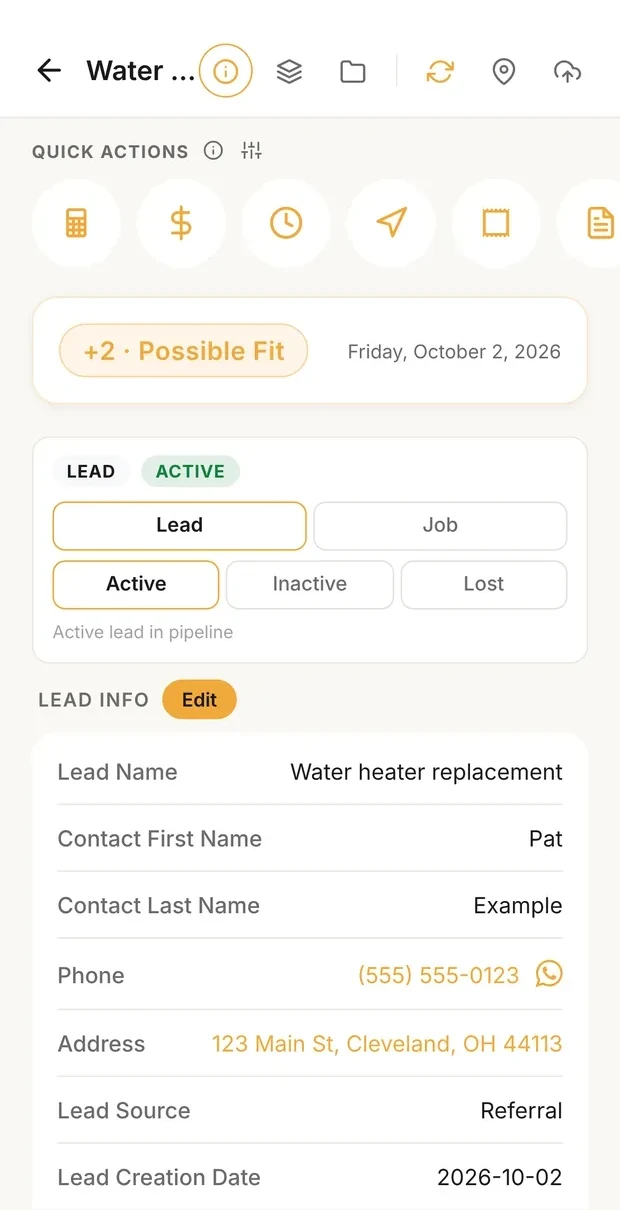
Saved with its grade
The call in Clamp: the five scores on the New Lead form, then the saved lead with its grade and source. Demo lead; the scores are the worked example in step 4.
This one exchange carries most of the call: scope before price, your range against their price, the budget score, and a boundary held politely. Stone treats repeated demands for a quick number as a qualification signal in their own right.
The score is a sum. Here is the published plumber call from How to qualify a contractor lead.
| Criterion | Score |
|---|---|
| Project | +1 |
| Budget | 0 |
| Decision-makers | 0 |
| Motivation | 0 |
| Timeline | +1 |
| Total | +2 |
A +2 is a Possible Fit, so the caller isn't asked for paid planning on this call. A remodeler might book a visit to take a look and name the paid step for after it. A trade contractor whose policy is to pursue only 4s and 5s may pass. Why each answer scored what it did is in the qualify guide.
Never drive to a lead that hasn't been scored.
A site visit costs the drive, the time on site, and often estimating afterward. The score is what earns it. A lead that hasn't been scored hasn't earned a visit, however good it sounds at the start. A caller who opens with exactly the work you love can still finish the call as an Unclear Fit.
This is the owner's practice, and it doesn't forbid talking about money. Your range for your kind of work belongs on the call. A firm price waits for a defined scope.
Decide these before the phone rings.
| Decision | Options | This guide's practice |
|---|---|---|
| What each grade gets | Book every lead; book only Great | By grade. Great: the paid planning step, on this call. Possible: a visit to take a look, with the paid step named for after it, if your business nurtures leads. Unclear: the paid step stated plainly, yes or no. Bad: a polite no. |
| The first visit | Always free; always paid; depends on the work | The call is free. A visit is paid when it delivers professional work (measurements, condition assessment, design or estimating judgment), and free only while it is still a fit conversation, as a Possible Fit's look is. |
| Call-back speed | Within the hour; same day; no target | The same day, or by 9 AM the next morning. That is Stone's No. 1 rule in Profitable Sales. |
| Which inquiries get a record | Every one; only those you pursue | Every one, including those declined on the call, with the source and the outcome. |
| When a lead is lost | A day count; a follow-up count; your sequence | When your follow-up sequence is done, or you learn the real reason. Record the reason. |
Whether to charge for a visit, and how much, is in when to charge for the estimate.
A Great Fit books your paid planning step: a paid visit, a planning package, or a design agreement, whichever you sell. A Possible Fit gets a visit to take a look, or a pass if you pursue only 4s and 5s, and the paid step after it if it makes sense. An Unclear Fit books the paid step on a yes; on a no, it is parked, with a follow-up date if you'll come back to it. A Bad Fit is declined and marked lost with the reason "Not a fit, we declined".
Every lead keeps its source. Once a lead is decided, its outcome is part of the funnel. The main close rate counts decided qualified leads only, those scored 4 or 5; see what close rate you need.
What callers say, and what to say back.
| The caller says | What to say back |
|---|---|
| "Can you just give me a ballpark?" | "I can tell you our range for this kind of work once I understand the project. A number for your project comes from defining it, not from a phone call." |
| "Other contractors come out for free." | "That may be how their process works. Ours is [your process and what they get]. I'd rather explain that now, so you can decide whether it fits." |
| "My spouse isn't here." | "That's fine for today. When we meet, we'd want both of you there, so let's find a time that suits you both." |
| "I don't know my budget." | "That's okay. I can tell you our range for work like you've described, and you can tell me whether it's one you'd consider." |
| "Can you come out and tell me what I should do?" | "That's what our [visit or planning process] is for. Before I book it, I want to make sure the project and our process fit." |
| "Just email me a quote." | "A real price comes after the scope is defined. Right now I can tell you whether this is work we take on, and what the next step is." |
| "I'm getting three bids." | "That's your call. Before we schedule, I want you to understand our process and what you'll get from us, so you're comparing the right things." |
Stone's advice for a caller's questions is to answer briefly and go back to yours, so the call doesn't become a sales presentation.
| Mistake | What to do instead |
|---|---|
| Booking before you know what the project is | Settle project fit before you give away a visit. |
| Getting excited when the caller opens with exactly your work | Score the whole call. The Lead Filter System warns that a caller after your ideas often turns noncommittal at the budget. |
| Turning the call into a presentation | Ask, listen, answer briefly, ask the next question. |
| Naming a range you haven't worked out | Build your range from your minimum price before the call. |
| Guessing a price for their project | Give your range for your kind of work; their number comes from planning. |
| Booking a visit half the decision-makers can't attend | Reschedule until everyone who decides can be there. |
| Springing paid planning on them after the visit | Name it on the call, as the grade calls for. |
| Recording only the good leads | Record the declined ones too, with source and outcome. |
| Leaving the source blank | Ask how they found you before you hang up. |
| Hanging up with "I'll get back to you" | Book it, date a follow-up, or decline it. |
| Treating the score as the last word | A confirmed mismatch on project or price outranks the arithmetic. |
| Leaving an unanswered lead open forever | Finish your follow-up sequence, then mark it lost with the reason. |
| Re-scoring because the lead bought, or didn't | Re-score only when you learn new facts about the five criteria. |
What it means
Lead records in Clamp
New Lead takes the contact, the address, how they found you, the project and its start window, a price range, the five scores, whether paid planning came up, and notes, which you can dictate. The five scores are all it needs to save, and it shows the grade you've scored: Great, Possible, Unclear or Bad Fit. Quick Add needs only a name, for when you can't score yet; the lead shows as Unclear Fit until you do. A follow-up or appointment date sends a reminder that morning, and Mark lost asks why. Home › Sales shows won, decided and close rate by source, with open and parked leads left out of the rate and the fit filter set to Great Fit by default. Clamp does not record calls, reply automatically, or capture leads from a web form.
Score your Leads system in the contractor business self-assessment, and see how many leads you need.
Sources & provenance
- Profitable Sales: A Contractor's Guide Michael C. Stone (book)
- How to Qualify a Contractor Lead in Seven Minutes Clamp Research
- When to Charge for the Estimate, and How Much Clamp Research
- What Is a Good Close Rate for a Contractor? Measure Yours Against Your Plan Clamp Research
- What a Contractor Has to Sell Before the Business Earns a Profit Clamp Research