Home Office Deduction for Contractors (2026): $1,200 or $3,328, Plus the Miles It Unlocks
A remodeler's 240 sq ft office worked both ways for 2026, and why it turns 9,000 miles of driving to job sites from commuting into a $6,682.50 deduction.
The assumptions
This model assumes
- A solo remodeler, sole proprietor, single, tax year 2026
- An office used only for the business, where the admin work is done, and no other office
- Schedule C profit of $91,556.50 before the office and the miles
- Standard deduction, no other income, federal tax only
- Not tax advice for a specific situation
The model, step by step
Two tests. Most remodelers who run the business from home pass both, as long as the room is only for work.
Used only for the business
ExclusiveThe room or a clearly marked part of it is used for nothing else. A desk in the family den fails.
RegularYou use it for the business on a steady basis, not now and then.
Your principal place of business
Admin countsBids, invoicing, scheduling, ordering and the books count as administrative work
No other officeYou qualify if there's no other fixed place where you do much of that work
IRS exampleA plumber who spends most days at customers' homes still qualifies
Contractors use more of the house than most people. Here's how the rules treat the usual spaces.
| Space | Counts? |
|---|---|
| Spare room, only an office | Yes |
| Desk in the den or kitchenFamily use breaks exclusive use | No |
| Detached shop, only businessA separate building qualifies on its own | Yes |
| Garage with the family car | No |
| Attached garage, tools onlyInside the house, storage is a use only for sellers' inventory | Rarely |
| Detached shed, only toolsA separate building used only for the business | Yes |
A solo remodeler, single, runs the business from a 240 sq ft room in a 2,400 sq ft house. Before the office and the miles, Schedule C profit is $91,556.50.
The house
Office240 of 2,400 sq ft, or 10%
Bought$400,000, of which $80,000 is land
Office use beganJanuary 2026
2026 home costs
Mortgage interest$12,000
Real estate tax$6,000
Insurance$2,400
Utilities$4,200
Repairs$800
The driving
Home to job sites9,000 miles, half before July 1
Multiply the office's square feet by $5, up to 300 sq ft. No receipts for the house, no depreciation.
The trade-offs
Cap$1,500, at 300 sq ft
LimitNo more than the business's profit before the office deduction. Any excess is lost, not carried over
Schedule AIf you itemize, your mortgage interest and taxes stay there, within the usual limits
CarryoversUnused amounts from a regular-method year wait for the next regular-method year
Form 8829 takes 10% of what the house costs to run, plus depreciation on the office's share of the building.
| Expense | Office share |
|---|---|
| Mortgage interest10% of $12,000 | $1,200 |
| Real estate tax | $600 |
| Insurance | $240 |
| Utilities | $420 |
| Repairs | $80 |
| Depreciation | $787.52 |
| Total, line 30 | $3,327.52 |
The building is depreciated over 39 years. A full year after this one is 2.564%, or $820.48.
This is the part most pages miss. Driving from home to a job site in your area is commuting, unless your setup changes that.
| Your setup | Those miles |
|---|---|
| No office, no shopUnless the site is outside your metro area | Commuting |
| A shop away from homeTo temporary sites, a year or less | Deductible |
| Qualifying home officeTo any job site | Deductible |
The rule turns on the office qualifying as your principal place of business. The ruling doesn't depend on which method you use to figure the office deduction.
Driving between job sites during the day is deductible either way, for trips in the same business.
Federal tax for this remodeler in 2026, with self-employment tax and the QBI deduction.
| Setup | Tax | Saved |
|---|---|---|
| Neither | $19,790 | $0 |
| Simplified office | $19,425 | $365 |
| Regular office | $18,776 | $1,014 |
| Simplified + miles | $17,494 | $2,296 |
| Regular + miles | $17,004 | $2,786 |
The regular method's depreciation comes back when you sell the house. The home sale exclusion doesn't cover it.
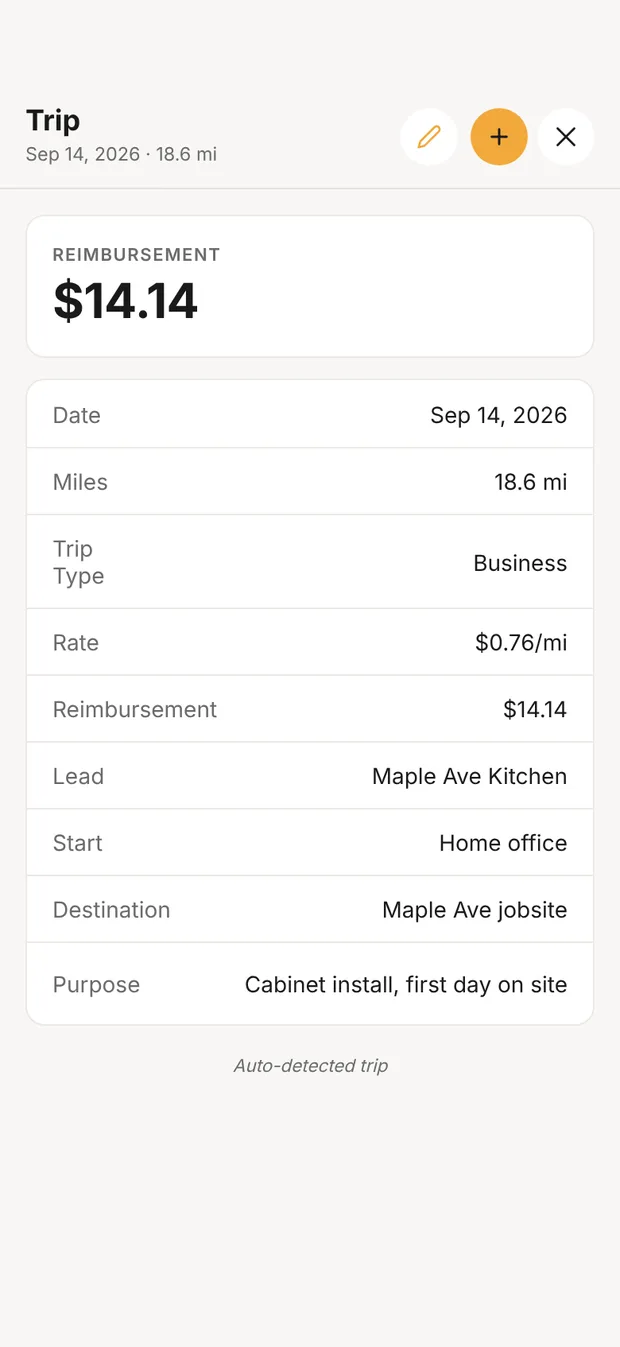
Office to job site, priced by date
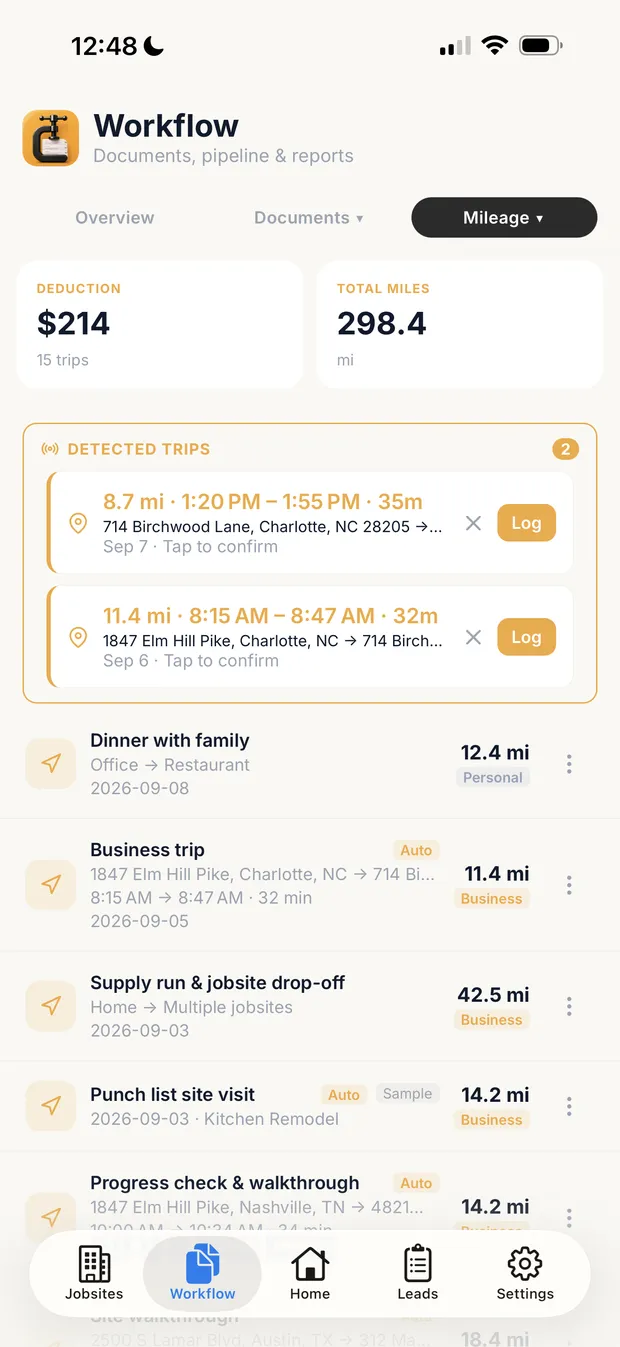
Every drive, typed and logged
In Clamp, a trip from the home office to a job site priced at the July rate, and the trip list with each drive's start and type. Demo data.
Even then, five years of the regular method saves far more than $1,017 over the simplified method here. Keep the closing papers and the office measurements.
For the miles, the IRS wants each trip's date, miles, destination and business purpose, recorded at or near the time.
What it means
Every drive from the office, on record
With trip detection on, Clamp records each drive's start and end for you to confirm as business or personal, with the destination and purpose. It prices each trip at the IRS rate for its date: 72.5 cents before July 1, 2026 and 76 cents from July 1. Clamp doesn't figure the home office deduction or fill out Form 8829.
Before December 31, measure the office and the house, pull this year's mortgage interest, tax, insurance and utility totals, and check that the room isn't used for anything else.
Questions
Can a contractor claim a home office?
Yes, if a room is used only for the business and it's where you do the bids, invoicing, scheduling and books, with no other office for that work. The IRS's own example is a plumber who works at customers' homes all day and qualifies.
Is driving from home to a job site deductible?
It is when your home office is your principal place of business, or when you have a shop away from home and the job is temporary. With neither, driving from home to a job site in your area is commuting, and it isn't deductible. A temporary job outside your metro area is deductible either way.
Simplified vs regular home office deduction: which is better?
For a 240 sq ft office, the simplified method is $1,200 and the regular method is $3,327.52 in this example. The regular method is more work and its depreciation is taxed when you sell, but it usually wins when the home costs much more than $5 a square foot.
Does a garage or shop count as a home office?
A detached shop or shed counts if it's used only for the business, even if it just stores your tools. An attached garage where the family car parks doesn't, and the storage exception inside the house is for sellers' inventory, not tools.
Do I pay back the home office deduction when I sell my house?
For an office inside the house, only the depreciation. It isn't covered by the home sale exclusion and can be taxed at up to 25%. Years on the simplified method have no depreciation. A detached shop can be different, so ask your tax pro.
Sources & provenance
- Publication 587 (2025), Business Use of Your Home Internal Revenue Service (official source)
- 26 U.S. Code 280A, disallowance of certain expenses in connection with business use of home Legal Information Institute, Cornell Law School (official source)
- Instructions for Form 8829 (2025), Expenses for Business Use of Your Home Internal Revenue Service (official source)
- 2026 Instructions for Schedule C (Form 1040), draft dated October 8, 2026 Internal Revenue Service (official source)
- Rev. Rul. 99-7, daily transportation expenses, 1999-5 I.R.B. 4 Internal Revenue Service (official source)
- Publication 463 (2025), Travel, Gift, and Car Expenses Internal Revenue Service (official source)
- Notice 2026-10, 2026 standard mileage rates Internal Revenue Service (official source)
- Announcement 2026-11, Internal Revenue Bulletin 2026-29 Internal Revenue Service (official source)
- Rev. Proc. 2025-32, Internal Revenue Bulletin 2025-45 Internal Revenue Service (official source)
- 2026 Schedule SE (Form 1040), draft Internal Revenue Service (official source)