Schedule C Deductions for Remodelers (2026): Every Line, Worked on One Year
A remodeler with $280,000 of receipts, worked line by line on the 2026 Schedule C: materials in cost of goods sold, subs on line 11, the two mileage rates, and what a deduction really saves.
The assumptions
This model assumes
- A solo remodeler, sole proprietor, single, tax year 2026
- Cash basis, no employees, no inventory at the start or end of the year
- An eligible small business using the simplified inventory method
- Standard deduction, no other income, federal tax only
- 2026 line numbers from IRS draft forms. Not tax advice for a specific situation
The model, step by step
A solo remodeler, single, files Schedule C for 2026. Cash basis, no employees, no inventory left at year end. Here is the year.
Money in
Gross receipts$280,000 from kitchens and baths
Job costs
Materials$92,000 installed in client homes
Subcontractors$64,000, W-9s on file
Running the business
Truck15,000 business miles, half before July 1, plus $380 of parking and tolls
Insurance$6,800 general liability
Tools$4,100, every item under $2,500
Phone$1,320, 80% business
Software$720
Advertising$3,200
License and permits$1,450
Accountant$1,800
Meals$1,600 with clients and subs
Home office200 sq ft, used only for the business
Most remodelers are small businesses for inventory: $32 million or less in average gross receipts for 2026. They can use the simplified inventory method, where job materials run through cost of goods sold and labor stays out.
| Line | Amount |
|---|---|
| 35 Beginning inventory | $0 |
| 38 MaterialsTile, cabinets, lumber and fixtures in client homes | $92,000 |
| 41 Ending inventory | $0 |
| 42 Cost of goods soldCarried to line 4 | $92,000 |
The $64,000 of subs goes on line 11, contract labor. Line 37 is for labor you include in cost of goods sold, and this method leaves labor out.
Put materials on line 22 and subs in Part III instead, and net profit is still $91,556.50. Only gross profit changes. What you can't do is count the same dollar on two lines.
With materials in Part III, line 7 gross income is $188,000. These are the expense lines a remodeler uses.
| Line | Amount |
|---|---|
| 8 Advertising | $3,200 |
| 9 Car and truckMiles, parking and tolls; step 4 | $11,517.50 |
| 11 Contract labor | $64,000 |
| 15 InsuranceBusiness policies, not health | $6,800 |
| 17 Legal and professional | $1,800 |
| 23 Taxes and licenses | $1,450 |
| 24b Meals50% of $1,600 | $800 |
| 25 Utilities80% of the phone | $1,056 |
| 27b Other expensesTools and software, from Part V | $4,820 |
| 28 Total expenses | $95,443.50 |
The IRS raised the mileage rate on July 1. Miles before and after count at different rates, so the log needs dates.
The mileage rate replaces gas, repairs, insurance on the truck and depreciation. You can't add those on top. Parking and tolls for business trips are the exception.
Pick the mileage rate in the truck's first business year to keep both options later. Take Section 179 or bonus depreciation on it, and the mileage rate is off the table for that truck. A leased truck on the mileage rate stays on it for the whole lease.
Four smaller lines, each with a rule that trips people up.
Tools, $4,100
WherePart V, line 48, carried to line 27b
WhyEach item is $2,500 or less, so the de minimis election lets you expense it instead of depreciating it
ElectWith a statement attached to your return, every year
WatchLine 27a is now the energy-efficient commercial buildings deduction, not other expenses
Phone, $1,056
WhereLine 25, utilities
How muchThe business share: 80% of $1,320
Meals, $800
WhereLine 24b
How muchHalf of $1,600 with clients and subs
Home office, $1,000
WhereLine 30
How much200 sq ft x $5, the simplified method, capped at 300 sq ft
TestUsed regularly and only for the business
Some of the biggest write-offs a contractor has are real, but they're claimed elsewhere on the 1040.
| Item | Where it goes |
|---|---|
| Your health insurance | Schedule 1, line 17 |
| Your retirement planSEP, SIMPLE or solo 401(k) for you | Schedule 1, line 16 |
| Half of SE tax$6,468.26 in this example | Schedule 1, line 15 |
| Income tax, SE tax | Not deductible |
| Fines, penaltiesPaid to a government | Not deductible |
| Personal costsIncludes commuting | Not deductible |
The first three still lower your income tax. They don't lower Schedule C profit, so they don't lower self-employment tax.
Net profit of $91,556.50 drives two taxes: self-employment tax, and income tax after the QBI deduction.
The shortcut of 22% plus 15.3% says $373. It's lower because SE tax applies to 92.35% of profit, and a smaller profit also shrinks half of SE tax and the QBI deduction. A deduction still costs real money: $1,000 spent saves $305, so it costs you $695.
About $6,400 more in deductions would drop this remodeler into the 12% bracket, and each $1,000 after that saves about $231.
Line I asks if you made payments in 2026 that require a Form 1099. Line J asks if you did or will file them. For subs who aren't corporations, the 1099-NEC is required at $2,000 or more for the year, up from $600. A W-9 on file doesn't answer either question; your payment totals do.
| Clamp account | Line |
|---|---|
| 5200 MaterialsPart III, cost of goods sold | 38 |
| 5100 Subcontractors | 11 |
| 6100 Marketing | 8 |
| 6400 Insurance | 15 |
| 6450 Taxes & Licenses | 23 |
| 6600, 6610 Professional FeesIncludes Bookkeeping & Accounting | 17 |
| 5380, 6390 MealsHalf of the total | 24b |
| 5400, 6550 Tools27b if expensed, 13 if depreciated | 27b or 13 |
| 6500 Software | 27b |
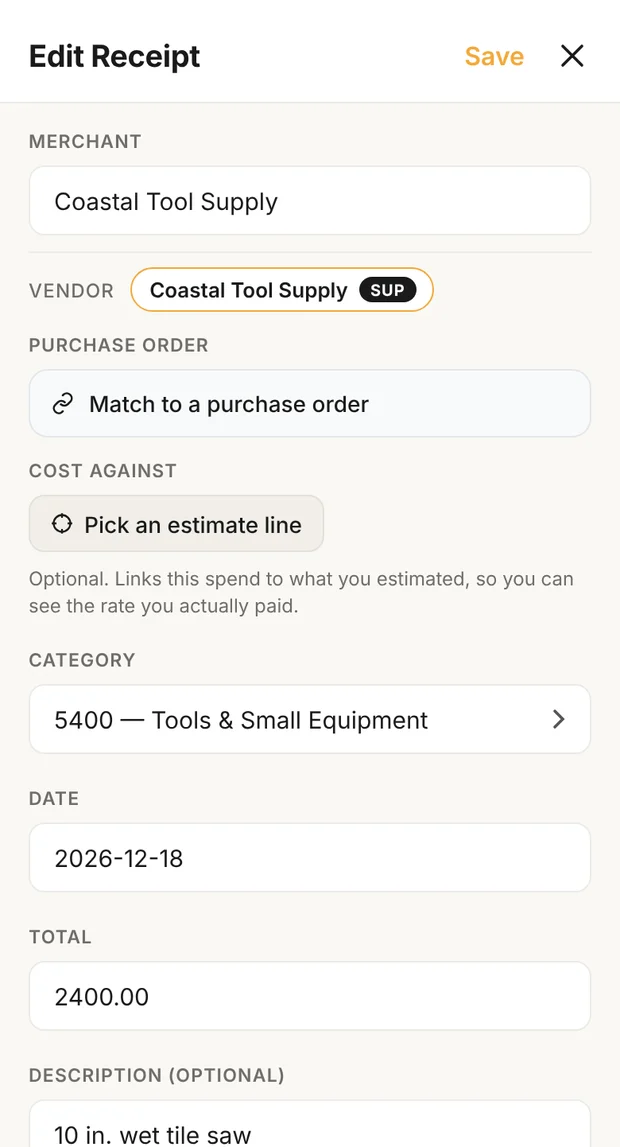
Each receipt, filed to an account
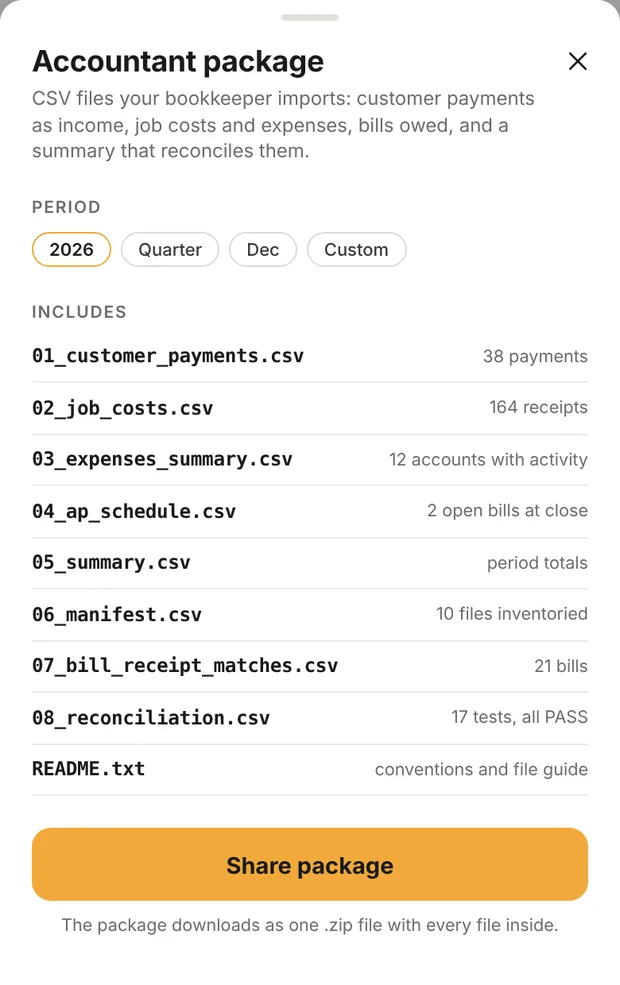
The year, totaled by account
In Clamp, a tool receipt filed to its account, and the accountant package for all of 2026 with expenses totaled by account. Demo data.
On the mileage rate, gas and repair receipts for the truck aren't deducted. The mileage log is the number for line 9.
What it means
The year's expenses, by account
Clamp files each receipt to an account as you snap it, prices every trip at the IRS rate for the date you drove, and exports the year as an accountant package with expenses totaled by account. Clamp doesn't fill out Schedule C; your preparer maps the totals to the lines.
Before December 31, pull this year's receipts by account and compare them to last year's Schedule C. A category that's missing, like parking and tolls or the phone, is usually a receipt that never got filed.
Questions
What can a contractor deduct on Schedule C?
Job materials, subs, truck miles, insurance, tools, phone, software, advertising, licenses, your accountant, half of business meals and a home office. A remodeler with $280,000 of receipts and these costs nets $91,556.50 in 2026. Health insurance and retirement go on Schedule 1, not Schedule C.
Do subcontractors go in cost of goods sold or contract labor?
Contract labor, line 11, for most small remodelers. The small business inventory method keeps labor out of cost of goods sold, so materials go in Part III and subs go on line 11. Net profit is the same either way.
Can I deduct my truck as a contractor?
Yes, the business miles. In 2026 that's 72.5 cents a mile through June 30 and 76 cents from July 1, plus parking and tolls. 15,000 business miles split evenly is $11,137.50. Use the mileage rate the first year to keep the choice later.
Where do tools go on Schedule C?
Tools you expense under the $2,500 de minimis election can go in Part V, carried to line 27b, or on line 22. The IRS doesn't name a line. Line 27a is now the energy-efficient commercial buildings deduction. Larger equipment is depreciated on line 13.
How much does a $1,000 deduction save a contractor?
About $305 for a single remodeler netting $91,556.50 in 2026: $141 less self-employment tax and $164 less income tax. Not the $373 the 22% plus 15.3% shortcut suggests, because SE tax applies to 92.35% of profit and the QBI deduction shrinks too.
Sources & provenance
- 2026 Instructions for Schedule C (Form 1040), draft dated October 8, 2026 Internal Revenue Service (official source)
- 2026 Schedule C (Form 1040), draft Internal Revenue Service (official source)
- Instructions for Schedule C (Form 1040), 2025 Internal Revenue Service (official source)
- T.D. 9942, small business taxpayer exceptions, Internal Revenue Bulletin 2021-3 Internal Revenue Service (official source)
- Notice 2026-10, 2026 standard mileage rates Internal Revenue Service (official source)
- Announcement 2026-11, Internal Revenue Bulletin 2026-29 Internal Revenue Service (official source)
- Publication 463 (2025), Travel, Gift, and Car Expenses Internal Revenue Service (official source)
- Tangible property final regulations Internal Revenue Service (official source)
- Rev. Proc. 2025-32, Internal Revenue Bulletin 2025-45 Internal Revenue Service (official source)
- 2026 Schedule SE (Form 1040), draft Internal Revenue Service (official source)
- Instructions for Form 8995, 2025 Internal Revenue Service (official source)
- 2026 Instructions for Form 8995, draft Internal Revenue Service (official source)