How to Track What a Job Costs Before You Pay It: Purchase Orders, Bills and Vendors
A purchase order is what you committed to, a bill is what you owe, and a payment is what you paid. Only one of them is job cost. What each record includes, a published countertop sub worked from quote to partial payment, and how to count every purchase once.
The assumptions
This model assumes
- A residential remodeler buying from suppliers and paying trade subcontractors
- The countertop lines are from the published 5x8 bathroom, version 3; the dates, the payment and the retainage amount are an illustration
- Retainage is optional and set in the subcontract; state law can govern it
- Recordkeeping guidance, not tax or legal advice
The model, step by step
Five records touch one purchase. Only some of them are job cost.
| Record | What it is | Is it job cost? |
|---|---|---|
| Vendor | Who you buy from: a supplier or a subcontractor | No |
| Purchase order | What you committed to buy, before you buy it | No: committed, not cost |
| Receipt | Records a purchase | Yes when assigned to the job, once; otherwise overhead or Multi-Job |
| Vendor bill | What you owe a vendor | Yes, once the goods or work are received or performed |
| Payment | That you paid some or all of a bill | No: it reduces what you owe |
Three records, three sets of fields.
| Field | This guide | Why |
|---|---|---|
| Name | Always | Who you buy from or owe |
| Supplier or subcontractor | Always | Separates trade subs from suppliers |
| Default account | Usually | Codes their purchases the same way every time |
| Phone and email | Usually | Sending purchase orders, asking questions |
| Notes | Usually | What belongs with the vendor, such as a license number |
| A W-9, kept outside Clamp | For a U.S. independent contractor you engage for services | The correct name and taxpayer number for information reporting |
| A written subcontract, kept outside Clamp | For every subcontractor | Scope, payment terms, changes and what can stop payment (Stone) |
| License, bond or insurance evidence, kept outside Clamp | When the trade, the contract or the law requires it | Check before the sub starts |
In Clamp, tax goes inside the purchase order's line amounts; a purchase order has no tax field.
| Field | This guide | Why |
|---|---|---|
| PO: job, vendor and PO number | Always | One job, one vendor, a reference for every later record |
| PO: a description and amount for each line | Always | What you committed to, and for how much |
| PO: account | Always | The kind of cost you expect |
| PO: estimate line | When the job has a matching line | Connects the commitment to what you estimated |
| PO: written specifications | For subcontracted or specification-sensitive work | So the sub quotes and builds the same thing (Stone, chapter 9) |
| Bill: vendor, bill date, total | Always | Who is owed, when, how much |
| Bill: reference number and due date | Usually | The vendor's invoice number; without a due date a bill is never overdue |
| Bill: allocation (job, overhead or non-business; account; cost date) | Always, for the part you assign | Where the cost belongs and when |
| Bill: work performed | Always, per allocation | Whether the amount is job cost yet |
| Bill: the purchase order it bills | When there was one | Connects ordered to billed |
| Bill: a paid receipt for the same purchase | When one was already recorded | One purchase, one cost |
| Bill: retainage | When the subcontract provides for it | Separates earned cost from what is payable now |
This amount is committed, not cost.
Once the allocation is recognized, it is the job's actual cost. Paying the bill does not add it again.
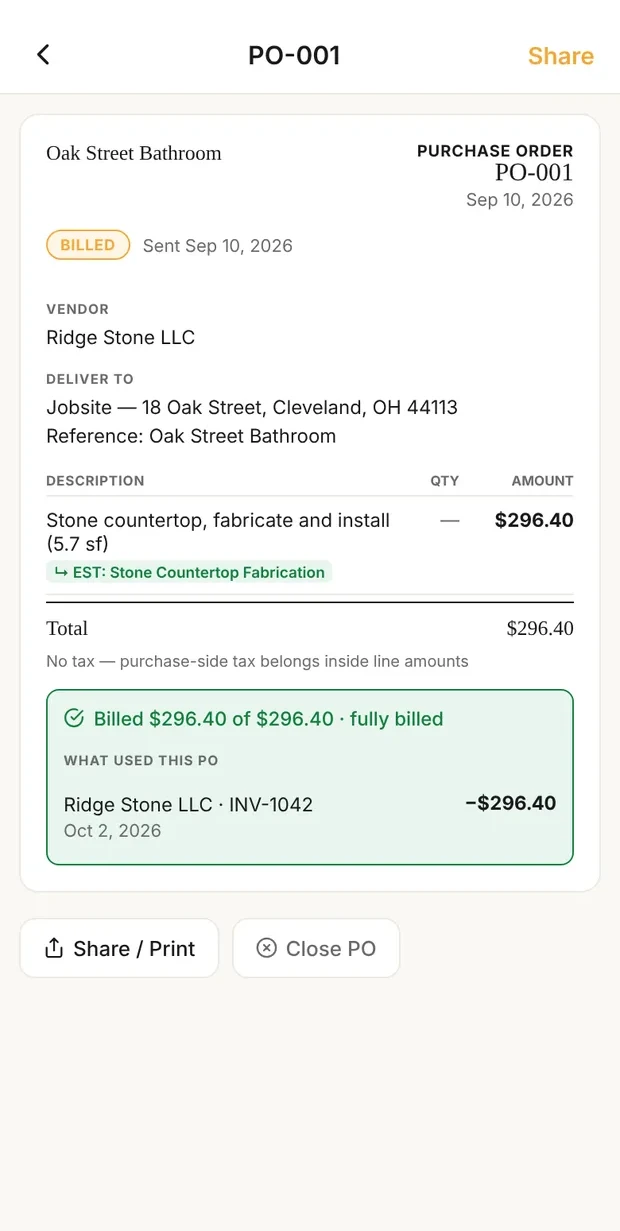
The purchase order, billed
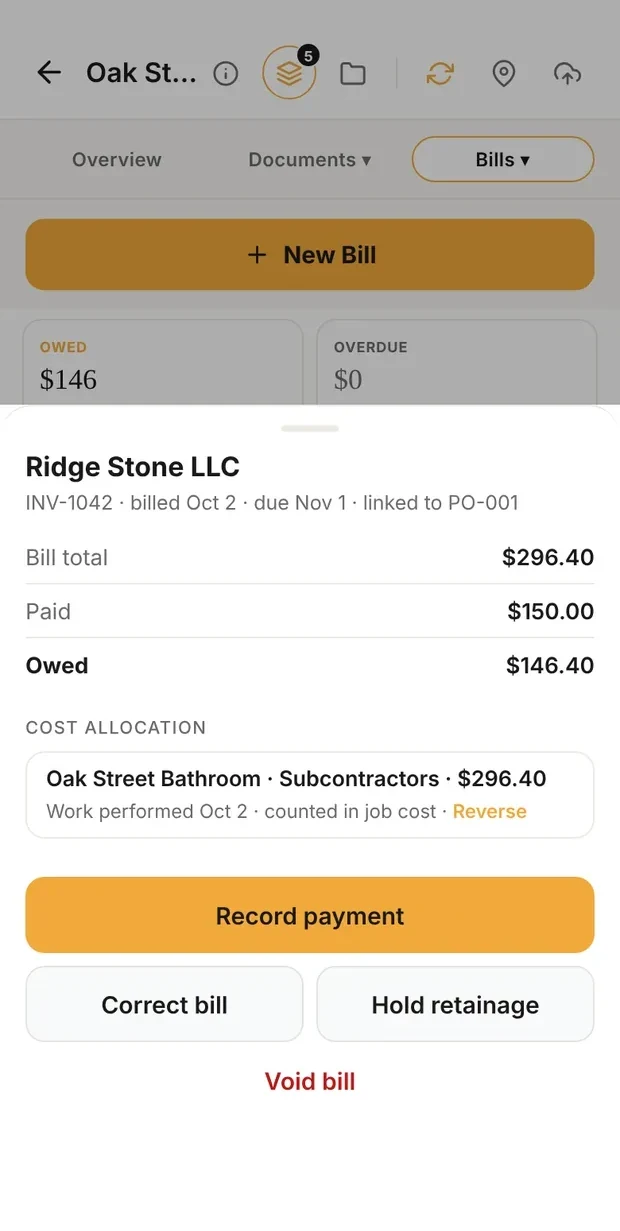
The bill, partly paid
The countertop sub's purchase order and bill in Clamp: the bill uses the order up, and the $150 payment leaves $146.40 owed. Demo data on the published 5x8 bathroom.
Who gets a purchase order. Special orders, subcontractors and other meaningful commitments. A routine counter purchase is a receipt.
Who gets a vendor record. Every subcontractor, and every supplier you buy from by purchase order, by bill, or often.
From the published 5x8 bathroom (Clamp Research). The countertop lines are published; the dates and the payment are an illustration.
| Amount | |
|---|---|
| Committed: PO-001 to Ridge Stone | $296.40 |
| Actual cost: INV-1042, work performed and recognized | $296.40 |
| Still on order: PO-001 | $0.00 |
| Paid so far | $150.00 |
| Owed: INV-1042 balance | $146.40 |
Committed, actual cost, owed and paid are four different numbers. Only actual cost is job cost.
Clamp's job costs screen labels actual cost "Spent", even when the bill isn't paid yet.
A paid receipt meets a bill. You bought the tile setting materials at the counter and logged the receipt: $86.96 on the company card. If the supplier's monthly bill later lists the same purchase, match the bill to the paid receipt. That matched transaction is one cost and one existing settlement, not a second cost or a second payment.
Retainage, if your subcontract has it. The recognized subcontractor cost can be $296.40 while only $266.40 is payable now, because $30.00 is held until the agreed release condition. The $30.00 is an illustration, not a recommended amount. Whether you hold retainage, how much, and when it is released are set in the subcontract. State prompt-payment and retainage law can govern all three. Check your state and have your agreement reviewed.
One economic cost enters job cost once. A purchase order is a commitment, a recognized bill is cost, a paid receipt records the cost and its existing settlement, and a payment settles what you owe. Matching a receipt to a bill makes them one cost and one settlement.
The paper trail. Where the records exist, link them, so you can trace the purchase from the agreed scope or commitment through the bill or receipt to the payment, and show why you paid what you paid.
What a sub's bill should tie to. The vendor, the agreed scope or purchase order, the amount, the job, the date, and evidence the work was done. This is this guide's practice; Stone's support is upstream, in a written scope and a written price.
Tax information. Once you've determined that the person you're paying is an independent contractor, the IRS says the first step is to have the contractor complete Form W-9. It gives you the correct name and taxpayer identification number, and the IRS says to keep it in your files for four years. For payments made in 2026, the federal Form 1099-NEC threshold for qualifying nonemployee compensation is generally $2,000 (it was $600 for payments before 2026, and it is adjusted for inflation after 2026). Entity type, payment method, backup withholding and other rules can change whether a form is required. Confirm your year-end process with your tax professional. Clamp doesn't track W-9s or prepare 1099s.
Then compare. Recognized costs feed the job's estimated-vs-actual. Michael C. Stone, a builder and remodeler with more than six decades in the industry, says in Estimating Construction Profitably (chapter 12) that this comparison, by estimate section, is how estimates get better. The method is in How to Job Cost a Remodeling Job.
Decide these before the first purchase order.
| Decision | This guide's practice | Why |
|---|---|---|
| Which purchases get a purchase order | Special orders, subcontractors and other meaningful commitments | Controls the purchases most likely to move cost or schedule, without paperwork for every counter buy |
| When a bill is job cost | When the goods or work it bills are received or performed | Job cost follows the work, not the mail or the bank |
| Retainage on subcontractors | Optional, set in the subcontract | It holds part of the payment until a stated condition; state law can govern it |
| When vendors and subs are paid | On the agreed terms, after checking the bill against the scope and the work | Predictable for both sides. Stone puts payment terms in the sub agreement and rejects "I can't pay you until I've been paid" (Markup & Profit, chapter 6) |
| Who gets a vendor record | Every subcontractor; suppliers you buy from by PO, by bill or often | Vendor history where it matters, without a record for every one-off store |
What people get wrong with purchase orders, bills and vendors, and what to do instead.
| Mistake | Instead |
|---|---|
| Treating a purchase order as cost | It is committed until a receipt or a recognized bill makes it actual cost |
| Recording a receipt and its matching bill as two costs | Match them: one purchase, one cost |
| Adding a payment to job cost | A payment reduces what you owe; the bill already made the cost |
| A sub starting from a verbal scope | Written specifications and a written quote (Stone, chapter 9) |
| Accepting a sub's quote without checking what it includes | Go through it and ask (Stone, chapter 9) |
| No payment terms in the sub agreement | Say when and how the sub is paid and what can stop payment (Stone, Markup & Profit, chapter 6) |
| Telling a sub they'll be paid when the customer pays | Pay on the agreed terms, subject to state law (Stone, Markup & Profit, chapter 6) |
| Paying without checking the bill | Check it against the agreement, the purchase order and the work first |
| Leaving finished purchase orders open | Close them so committed cost isn't overstated |
| No due date on a bill that has one | Enter it, so owed and overdue mean something |
| Recording a bill but never recognizing the job's part | Recognize it when the goods or work are received or performed |
| Waiting until year end for the W-9 | Get it when you set up the sub; the IRS calls it the first step |
| Using the old $600 threshold for 2026 payments | Generally $2,000 for payments made in 2026, subject to the IRS rules |
What it means
Purchase orders, bills and vendors in Clamp
Each vendor is a supplier or a subcontractor, with contact details, notes and a default account, and its screen shows what you've spent with them by job and what you owe. Each purchase order belongs to one job, with lines you can tie to the job's estimate; job costs shows it as "Ordered, not billed", never as spent, and receipts and bills draw it down until it reads fully billed. Allocate a bill to one or more jobs, overhead or non-business, mark when the work was performed, link it to the job's purchase orders, and match a paid receipt so the cost and payment count once. Record payments in full or in part, from your payment accounts. On a subcontractor bill you can hold retainage and release it later. Clamp doesn't pay vendors, sync with QuickBooks, track W-9s, 1099s, insurance certificates or lien waivers, or put line items on a bill.
Read How to Track Job Receipts for what each purchase record must show, and score your Operations system in the contractor business self-assessment.
Sources & provenance
- Estimating Construction Profitably Michael C. Stone (book)
- Markup & Profit: A Contractor's Guide, Revisited Michael C. Stone (book)
- Forms and associated taxes for independent contractors Internal Revenue Service (official source)
- Instructions for Forms 1099-MISC and 1099-NEC (2026) Internal Revenue Service (official source)
- 5×8 Bathroom Remodel Cost and Labor (2026 Baseline) Clamp Research
- 5x8 bathroom remodel, published itemized estimate (data file) Clamp Research