How to Track Job Receipts: What Each One Must Show, and Where It Goes
Record every receipt the same day, while you still know what it was for. What each entry must show, a published tile line bought, returned and compared with the estimate, what the IRS asks for, and where each receipt goes next.
The assumptions
This model assumes
- A residential remodeler buying materials for jobs, alone or with a small crew
- The estimate line is from the published 5x8 bathroom, version 3; the purchase and the return are an illustration
- Sales tax is left out of the illustration, as the published estimate leaves it out
- Recordkeeping guidance, not tax advice; confirm retention with your tax professional
The model, step by step
A receipt is one piece of evidence. Job cost is what it becomes once it is assigned to the right job and the right line.
| Record | What it is |
|---|---|
| Receipt | A record supporting a purchase, whether it was paid now or charged to an account. |
| Vendor bill | An amount the business owes a vendor and tracks for later payment. See the bills guide. |
| Purchase order | A purchase you agreed to before buying. |
| Job cost | What the job's receipts, bills and labor add up to. See What is job cost. |
Clamp saves a receipt with only a total. That is the app's minimum, not a good record.
| Field | This guide | Why |
|---|---|---|
| Total | Always | The amount spent |
| Merchant | Always | Who sold it. IRS supporting documents identify the payee |
| Date | Always | When the expense was incurred |
| Description | Always | What was bought and for what, so the cost can be assigned and its business purpose shown |
| Category | Always | What kind of cost it is in the books: materials, dump fees, office supplies |
| Job, Overhead or Multi-Job | Always | Where the cost belongs |
| The image | Usually | A copy of the supporting document |
| Paid with | Usually | Card, cash, check, paid personally or on account; separates business from personal money |
| Subtotal and tax | Usually, when the receipt shows them | Bookkeeping detail |
| Vendor | When it differs from the merchant name or you buy there often | Vendor history and, later, bill matching |
| Estimate line | When it is a job cost on a job with an estimate | Makes estimated vs actual possible |
| Purchase order | When a PO authorized the purchase | Connects the purchase to the prior commitment and its remaining balance |
| Return | When goods go back | A linked negative entry; the original stays as it was |
The same day, by the person who bought it. On a crew, the buyer captures and codes the receipt before the end of the day; the office reviews the exceptions. IRS Publication 583 says to record transactions as they occur, and that daily is generally best. Michael C. Stone, a builder and remodeler with more than six decades in the industry and the author of Estimating Construction Profitably, is blunter about why (chapter 12): an estimated-vs-actual comparison breaks down when whoever enters the cost doesn't know which part of the job a purchase was for.
A filled example from the published 5x8 bathroom:
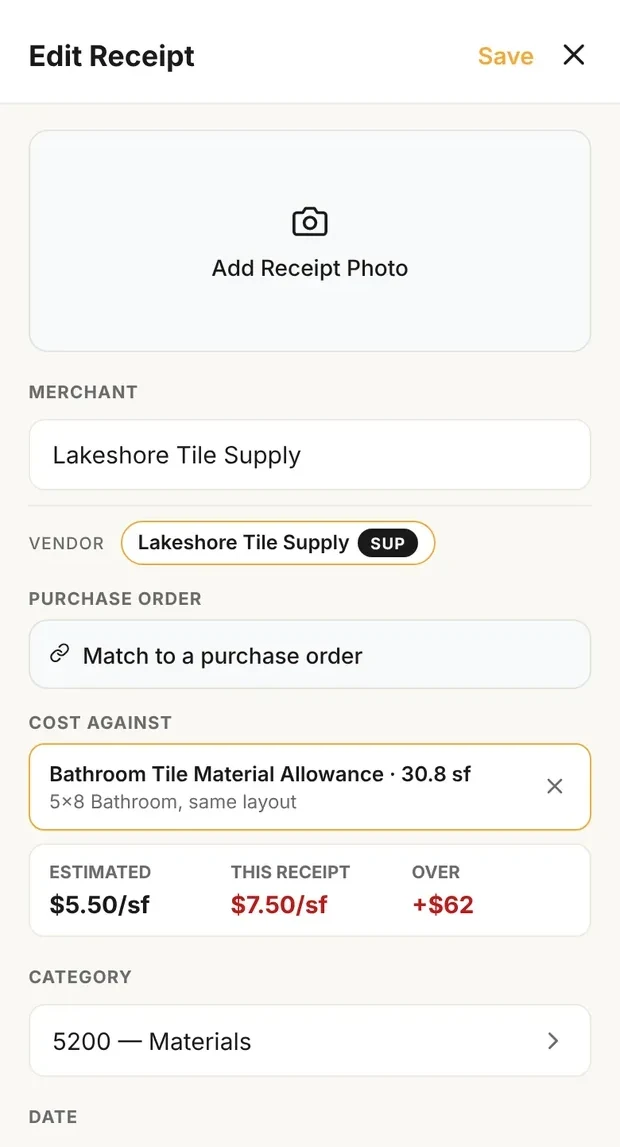
Costed against the estimate line
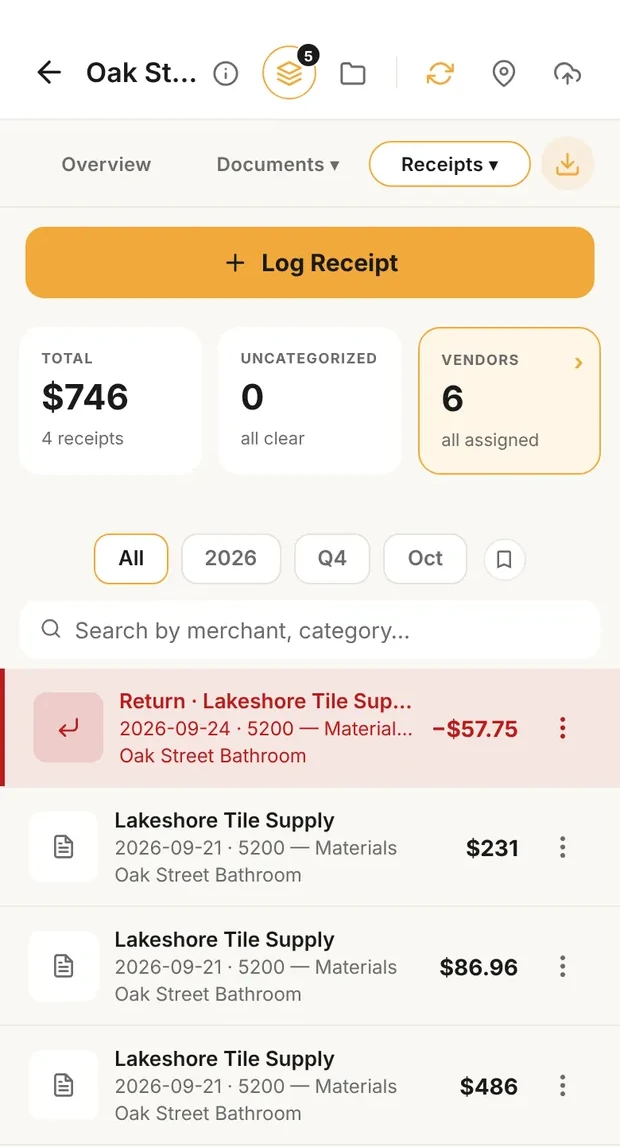
The return, its own entry
The floor tile receipt in Clamp, costed against the estimate's tile allowance line, and the job's receipts with the return as its own entry. Demo data on the published 5x8 bathroom.
Job or overhead? Tile set on the bathroom is job cost. Printer toner for the office is overhead. Which account a cost uses is covered in What is job cost and the overhead categories.
One purchase for several jobs. Clamp can't split one receipt across jobs. Ask for a separate ticket for each job at the register. When one receipt covers several jobs, log it to Multi-Job. Because a Multi-Job receipt is not assigned to an individual job, it can't make any one job's estimated-vs-actual complete. If accurate per-job costing matters, ask for separate tickets.
Paid personally. Log it the same day as "Paid personally", not after you pay yourself back. Waiting leaves the job's cost short in the meantime.
From the published 5x8 bathroom (Clamp Research). The purchase and the return are an illustration; the estimate line is published.
The estimate carries 30.8 sf of floor tile at $5.50 = $169.40: the 28 square feet of floor plus waste.
You buy 44 sf, four boxes, at $5.25 = $231.00. Clamp compares this receipt with the line: it divides the $231.00 by the line's 30.8 sf and shows $7.50/sf against $5.50/sf estimated, $62 over.
One unopened box, 11 sf, goes back for $57.75. The return is its own entry, linked to the original.
Net job cost for the line is $173.25, $3.85 over the $169.40 estimate. You paid less per square foot than estimated, but bought whole boxes.
Two questions, two answers. The variance tells you whether this line cost more or less than you estimated, which is a lesson for your next estimate. What the customer owes for a selection that ran over the allowance is a different question, answered by the signed agreement and a change order (How to Write and Price a Change Order). A receipt is evidence of cost. It is not, by itself, a bill to the customer.
For the IRS. The IRS doesn't prescribe a receipt format. Keep enough supporting records to identify the payee, amount, proof of payment, date incurred, and the item purchased or service received, showing that the amount was for a business purchase or expense (IRS, "What kind of records should I keep?"). One receipt may show most of that; another record, such as a card statement or canceled check, may be needed to prove payment. Proof of payment alone does not establish the expense (Pub. 583). Keep records for the applicable IRS limitations period, commonly three years for ordinary return-supporting records, and longer when special rules apply. Confirm your retention policy with your tax professional.
The paper. A receipt photo can be part of a compliant electronic recordkeeping system, but taking a picture does not by itself establish that the system meets the IRS electronic-storage requirements (Rev. Proc. 97-22). This guide keeps the paper until your tax professional approves a photo-only process.
For a customer dispute. The receipt is evidence of what you bought. Under this guide's contract process, the chain that settles an allowance question is the signed allowance baseline, the purchase evidence, any return or credit, the resulting difference, and the signed change order that adjusts the customer's price.
For a job-cost review. A receipt holds up when it carries the job, the category, the estimate line, the amount, the date and the description. Then you can say: we estimated this, we spent this, here is the evidence. Stone (chapter 12) says the only way to improve estimate accuracy is to know how the finished job's actual cost compared with the estimate. The method is in How to Job Cost a Remodeling Job.
Decide these before the first receipt.
| Decision | This guide's practice | Why |
|---|---|---|
| When receipts are logged | The same day | The purpose is still fresh (IRS Pub. 583: daily is generally best) |
| Who logs them on a crew | The buyer; the office reviews exceptions | The buyer knows what it was for |
| One purchase for several jobs | A separate ticket per job; otherwise Multi-Job | Clamp can't split one receipt |
| Paid personally | Logged the same day as "Paid personally" | The job's cost isn't short while you wait to be repaid |
| The paper after the photo | Kept until your tax professional approves photo-only | Electronic records have their own IRS requirements |
What people get wrong with receipts, and what to do instead.
| Mistake | Instead |
|---|---|
| Reconstructing purchases at the end of the week | Log it the same day (IRS Pub. 583) |
| A photo with no description | Say what it was and what it was for |
| Everything coded "Materials" with no job | Assign the job and the estimate line (Stone, chapter 12) |
| Job materials in overhead, or office costs on a job | Use the same job and overhead definitions every time |
| Losing purchases paid personally | Log them as "Paid personally" the same day |
| Editing the original when goods go back | Record the return as its own entry |
| Treating a receipt as proof the customer owes an overage | The signed agreement and a change order decide that |
| Keeping only proof of payment | Keep the purchase evidence too; proof of payment alone does not establish the expense (Pub. 583) |
| Throwing out the paper once it is photographed | Keep it until your tax professional approves photo-only (Rev. Proc. 97-22) |
| Recording costs and never comparing them to the estimate | Each receipt can show its estimate line's over or under; review estimated vs actual by estimate section regularly (Stone, chapter 12) |
What it means
Receipts in Clamp
"Take a photo" reads the merchant, total, subtotal, tax, date and a suggested category on your phone. It works offline, with no subscription, and anything it can't read is marked to fill in before you save. Every receipt is attached to a job, to Overhead or to Multi-Job. On a job with an estimate, "Cost against" ties the receipt to one estimate line and shows the rate you paid against the rate you estimated. Match a receipt to an open purchase order, and a paid job receipt can settle a bill from the same vendor. "Record a return" adds a linked entry with a date and a reason, and the original isn't changed. Each job's receipts export as a spreadsheet or a PDF report laid out for tax records. Clamp doesn't connect bank or card feeds, sync with QuickBooks, take emailed receipts or split one receipt across jobs.
Check what goes in job cost in What is job cost, and score your Operations system in the contractor business self-assessment.
Sources & provenance
- What kind of records should I keep Internal Revenue Service (official source)
- Publication 583, Starting a Business and Keeping Records Internal Revenue Service (official source)
- How long should I keep records? Internal Revenue Service (official source)
- Revenue Procedure 97-22 Internal Revenue Service (official source)
- Estimating Construction Profitably Michael C. Stone (book)
- 5×8 Bathroom Remodel Cost and Labor (2026 Baseline) Clamp Research
- 5x8 bathroom remodel, published itemized estimate (data file) Clamp Research