How to Write and Price a Change Order
A change order is a signed amendment to the contract. What it includes, how to write each section, how to price work added and credit work removed, and the rule that protects you: no signed change order, no changed work.
The assumptions
This model assumes
- A residential remodel with a signed contract
- Pricing the extra risk of a change is covered in Three markups, one job cost
- The owner's practice: removed work credited at its sold price, every change signed before the work, a three-day deadline
- Sample language is a drafting example, not legal advice. Have your final form reviewed in your state.
- The $40,000 average project and the 1.76x and 1.50x markups are published Clamp model figures; the quantities are an illustration
The model, step by step
A change order amends a signed contract, one change at a time.
| Document | What it does |
|---|---|
| Proposal or contract | Sets the scope, price, schedule and payment terms |
| Change order | Amends them, one change at a time, signed before the work |
| Allowance adjustment | Reconciles an allowance when the selection costs more or less than the amount in the contract. If the selection also changes labor, scope or schedule, those changes need a change order |
| Invoice | Bills the work, including any signed changes |
Not every request is a change. If the work is already in the signed scope, it is not a change order. If it adds to, removes from or modifies the agreed work, it is one. And something you left out of your own estimate for work you already promised is not a change the customer pays for.
Michael C. Stone, a builder and remodeler with more than six decades in the industry and the author of Markup & Profit: A Contractor's Guide, Revisited, the book this guide draws on, recommends explaining the change-order process before the original contract is signed. Then the first change is a step the customer already expects.
Every change order needs eight things.
| Item | Include |
|---|---|
| A change order number and date, and the contract it amends | Always |
| The reason for the change | Always |
| The work added, written as the operations to be done | Always |
| The work removed, named, not just shown as a credit | Always |
| Three dollar figures: this change, the contract price before it, the contract price after it | Always |
| The schedule effect, in days, even when it is zero | Always |
| How the change will be paid | Always |
| Signatures from the customer and the contractor | Always |
| An approval deadline | Usually |
| Sales tax, where it applies to your work | Depending on the change |
| Permit, engineering or design changes the work requires | Depending on the change |
| A design or estimating fee, when pricing the change takes real drawing or estimating work | Depending on the change |
| Photos of the field condition, for a discovered condition | Depending on the change |
Stone treats the three dollar figures as the critical disclosure: the price of the change alone does not tell the customer what the contract now costs.
The language below is a drafting example, not legal advice. Have a lawyer in your state review your final form.
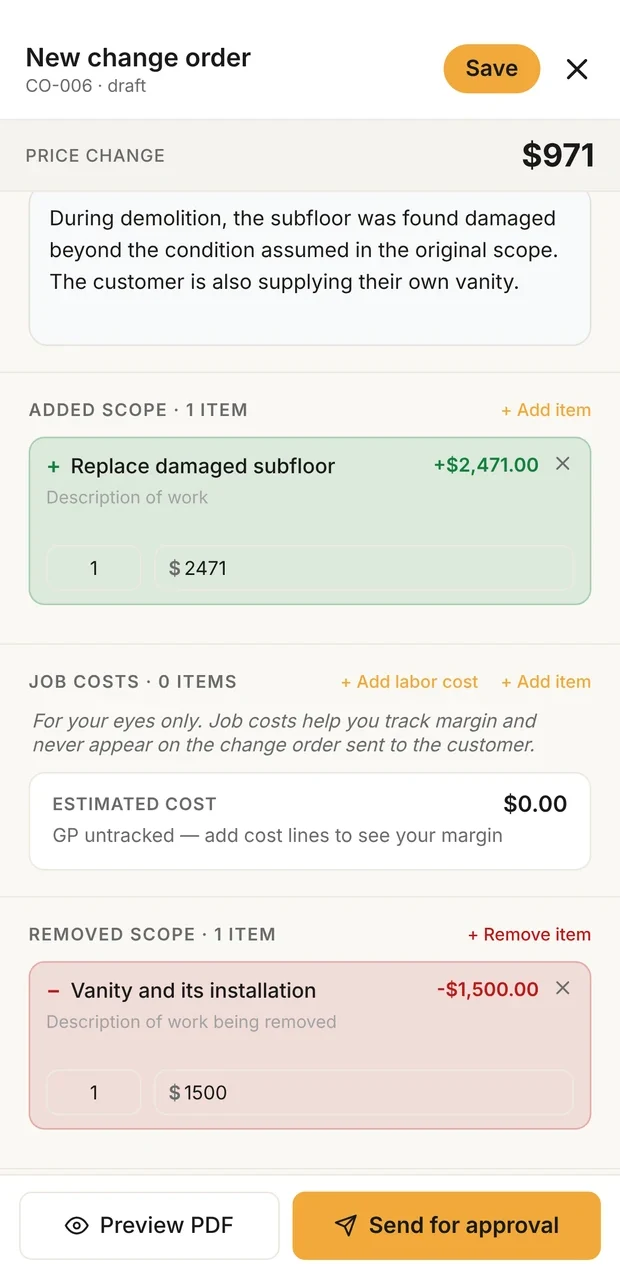
Work added and removed
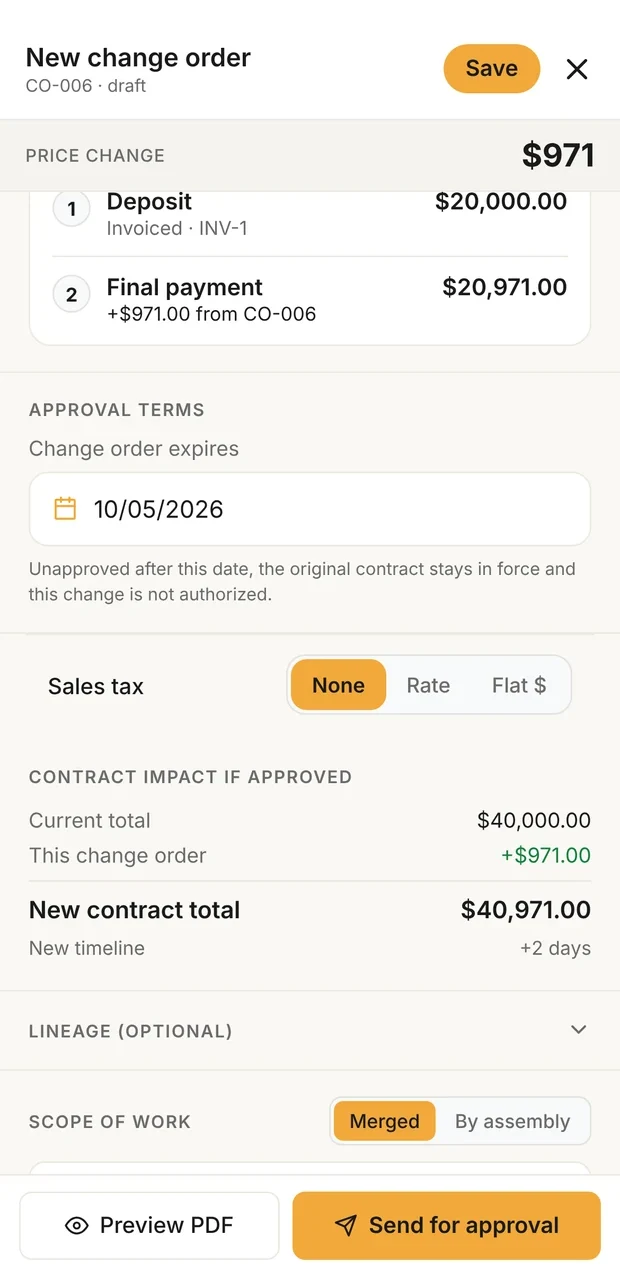
Deadline and contract impact
A change order in Clamp: the work added and removed on the form, then the approval deadline and the contract impact. Demo lead; the figures are the worked example in step 4.
Price the work added at your change-order markup. Credit the work removed at the price it was sold for. Three markups, one job cost explains why a change carries 10 more points of net profit than the original job. This example reuses its figures, on the Established profile, against the published $40,000 average project from What a Solo Contractor Has to Charge. The quantities are an illustration.
| Line | Job cost | Markup | Price |
|---|---|---|---|
| Work added | $1,400 | 1.76x | $2,471 |
| Work removed, credited at its sold price | $1,000 | 1.50x | −$1,500 |
| Price of this change | $971 |
Under this guide's deduct policy, removed work is credited at the price it was sold for. If costs have already been incurred for work that is later removed, identify them separately under your written deduct policy rather than treating the work as never started. The added work carries the change-order markup because it is being introduced after the original job was priced and scheduled.
In this guide's practice, routine pricing and coordination are covered by the change-order markup. When a change needs separate drawings, engineering or substantial estimating, that work is billed on its own, before the change is priced. Stone recommends charging for design, drafting, estimating and coordination work on a change, even one the customer declines.
| Contract | Amount |
|---|---|
| Contract price before this change | $40,000 |
| This change | +$971 |
| Contract price after this change | $40,971 |
This is the rule that protects you. Nobody on the job changes the work until the change order is signed: not you, your crew, your subcontractors or your suppliers. Stone is explicit that work outside the signed contract needs a signed change order first.
When the customer asks for something different on site, stop at the decision point. Say yes, you can look at it, and that you will price it and write it up before the original scope changes. Then define the change, price the work added and removed, show the schedule and payment effect, and get it signed.
A verbal or text approval records the conversation. It does not amend the contract, and it does not authorize the work.
Signing authorizes the change. Payment then follows the method written on the change order, under your contract and your state's law.
A delayed decision can cost money. If waiting to approve a change creates extra work, Stone's practice is to write a new change order with the added cost.
Write your choices into the contract, so the customer knows them before the first change comes up.
| Decision | Practice | Why |
|---|---|---|
| Small changes | Each one gets its own signed change order, before the work | Batching means doing unapproved work |
| Signatures | The customer and the contractor | Stone's contract language calls for one signature from each party |
| Verbal approval | Records intent only | The contract changes only when the change order is signed |
| Credit for removed work | The full price it was sold for | The customer gets back what they paid for that work. Costs already incurred are handled under your written deduct policy |
| Fee to price a change | None on ordinary changes. Design and estimating time is billed when a change needs it | The change-order markup covers routine pricing |
| Approval deadline | 3 days, adopting Stone's recommendation | A short deadline keeps the job from stalling while a decision waits |
| Where credits are applied | Stone applies them at final payment rather than to progress payments | That is his policy, not a legal rule |
The signed change becomes part of the contract price, and the next invoice and the payment schedule reflect it. How to set a payment schedule and invoice a remodeling job covers the invoice itself. The payment follows the method written on the change order: the next payment, the final payment, or its own invoice.
If it is not signed by the deadline, it lapses. The original contract stays in force and the changed work is not authorized. Work continues on the original scope wherever it can proceed without the unresolved change. A discovered condition that stops the original work stays a decision point until it is resolved. If the customer still wants the expired change later, issue a new or revised change order at the current price and schedule effect.
Most objections are answered by the signed contract and the change order itself.
| The customer says | What to say back |
|---|---|
| "I thought that was included." | Compare the request to the signed scope. If it is included, it is not a change. If it is not, write the difference down before going further. |
| "Why does a small change cost so much?" | A change in the middle of a job can require new pricing, ordering, scheduling and coordination, and can interrupt the planned sequence. Stone notes that a change often costs more than the same work would have cost in the original scope. |
| "Just do it and add it to the end." | The work continues under the signed contract until the change is approved. Doing it first removes the protection both of you have. |
| "We agreed to this yesterday." | The conversation started the change. Signing the change order completes it. |
| "Can't we decide later?" | You can, if the original work can continue without closing off the decision. If waiting creates rework or delay, the change is repriced when you decide. Until then, the original contract stays in force and the change is not authorized. |
| "Why am I paying for you to price this?" | Only changes that need drawings, engineering or a full estimate carry a fee, and that work costs money whether or not you go ahead. |
| Mistake | Instead |
|---|---|
| Starting changed work before the change order is signed | Sign first, then change the work |
| Letting the crew, subcontractors or suppliers accept changes informally | Route every change through you |
| Showing only the price of the change | Show the contract price before and after |
| Ignoring the schedule | State the schedule effect, even when it is zero |
| Pricing a change as if it had been in the original job | Use your change-order markup |
| Doing design or estimating work on a change for free | Bill it when the change needs it |
| Leaving removed work off the paper | Name it and credit it |
| Not explaining the change process before the contract | Explain it at the contract |
| Leaving expected work out of the proposal to sell it later | Price it in the proposal |
| Not repricing when a delayed decision costs more | Write a new change order |
What it means
Change orders in Clamp
A change order in Clamp lists the work added and the work removed, shows the contract before and after and the schedule effect, and sets how it is paid: added to the final payment, added to the next payment, or billed on its own. Only a signed change order changes the contract total, and a change order sent for signature asks for your countersignature by default.
See why a change carries 10 more points in Three markups, one job cost, and score your Operations system in the contractor business self-assessment.
Sources & provenance
- Markup & Profit: A Contractor's Guide, Revisited Michael C. Stone (book)
- Estimating Construction Profitably Michael C. Stone (book)
- Three Markups, One Job Cost: How Contractors Price Risk and Change Orders Clamp Research
- What a Solo Contractor Has to Charge to Make $100,000 Clamp Research