How to Write a Remodeling Estimate: What Goes In, How Cost Becomes Price
An estimate works out what the job costs you and what you will charge. What it includes, how to write each line in the order the job is built, a published bathroom priced at cost and marked up, and how to make every unknown visible.
The assumptions
This model assumes
- A residential remodeler pricing a fixed-scope job
- The published 5x8 bathroom, version 3: $11,799.17 direct job cost, 53 lines, ten trades
- Labor priced at what a remodeler pays a trade subcontractor for the work
- 1.50x is an illustration, not a recommended markup
- Sample language is a drafting example, not legal advice
The model, step by step
Four documents carry a job from price to payment. Each one does something different.
| Document | What it does |
|---|---|
| Estimate | Works out what the job costs you and what you will charge. |
| Proposal | Sets the scope, price, schedule and terms the customer signs. |
| Change order | Amends the signed proposal, one change at a time. |
| Invoice | Bills a payment the signed schedule requires. |
You can send an estimate, but this guide recommends sending only the proposal. The estimate is your cost buildup. The proposal is the offer. Michael C. Stone, a builder and remodeler with more than six decades in the industry and the author of Profitable Sales, Estimating Construction Profitably and Markup & Profit, the books this guide draws on, treats the estimate sheet as proprietary: the customer buys a defined scope at a price, not your labor, material and markup breakdown.
Stone builds job cost from four kinds of cost: labor, materials, subcontractors and other costs. Clamp uses 14 more specific categories, such as permits, dump fees, allowances and other direct costs, so you can track those costs separately.
| Item | Include |
|---|---|
| A description of the work for each line | Always |
| Quantity and unit (each, square foot, linear foot, hour) | Always, where the work can be measured |
| Cost rate and cost category | Always |
| Direct-cost subtotal | Always |
| Markup, applied after direct cost and contingency, if any | Always, before any customer price |
| Notes that explain a line | Usually |
| Includes, excludes and assumptions | Usually |
| Allowances, for selections not yet made | Depending on the job |
| Contingency | Depending on the job and your policy |
| Permits, disposal and dump fees, equipment rental | Depending on the job |
| A concealed-conditions disclosure | Depending on the job and what cannot be verified before work begins |
| Engineering, testing or surveys | Only if the job requires them |
| Sales tax | Only where it applies to your work |
Estimate in the order the job is built (Stone, Estimating Construction Profitably, chapter 6): protection and demolition, then rough-in, then the walls and floors, then finishes and fixtures. Estimating the job in sequence makes missing operations easier to spot.
One line is one measurable operation, or one identifiable cost responsibility. Someone who knows the trade should be able to read the line and see what was priced, how much, in what unit, at what cost, and which trade owns it. From the published 5x8 bathroom:
Not this:
The plumbing subtotal is still on the estimate. It is the sum of the plumbing lines (the valve set, fixture setting, the tub and fixture allowances and their materials), not a substitute for them. A lump sum hides the operations it was meant to count.
Write allowances with their basis. Stone (Estimating Construction Profitably, chapter 15) says to keep allowances few, define each one clearly, and state how a difference is handled. A drafting example:
Includes, excludes and assumptions. The language below is a drafting example, not legal advice. Check it for your state. It follows the published 5x8 bathroom.
An assumption is not an exclusion. An assumption states a fact the price depends on. An exclusion says the work is not included. If an assumption proves false after signing, the signed agreement and its change-order terms decide what happens.
The published 5x8 bathroom (Clamp Research): a same-layout remodel with 53 lines across ten trades. No specific locality and no market median. The published estimate prices labor at what a remodeler pays a trade subcontractor for the work; Subcontract is the countertop fabricator, priced as a sub's line.
The two tables below are two views of the same lines, and both total the same direct cost. Cost type tells you what kind of cost the line carries. Trade tells you which part of the project the cost belongs to.
Then the markup. At the 1.50x illustration from The markup you add is not the margin you keep:
1.50x is an illustration, not a recommendation. Your markup comes from your own overhead and net profit goal. Clamp adds contingency, if you use it, to direct cost before the markup. The published 5x8 uses none. Allowances are job cost at their baseline amount; they get the same markup as every other line.
| Cost type | Amount |
|---|---|
| Labor | $5,756.87 |
| Materials | $771.05 |
| Subcontract | $296.40 |
| Allowances | $4,749.85 |
| Dump fees | $225.00 |
| Direct cost | $11,799.17 |
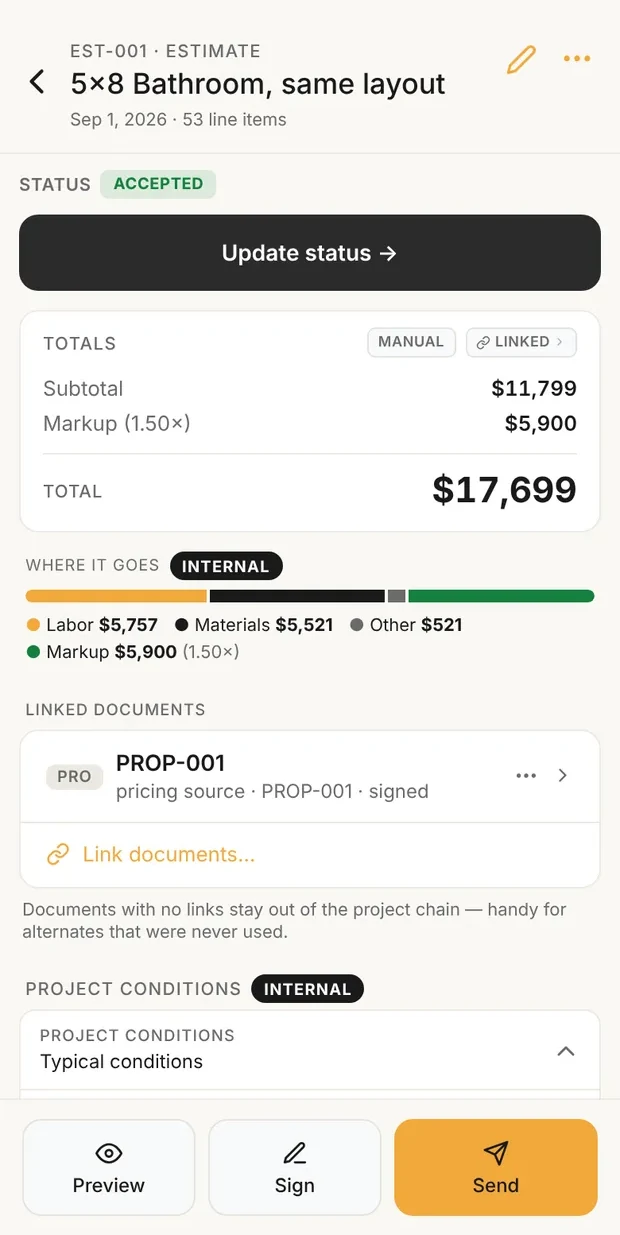
The totals
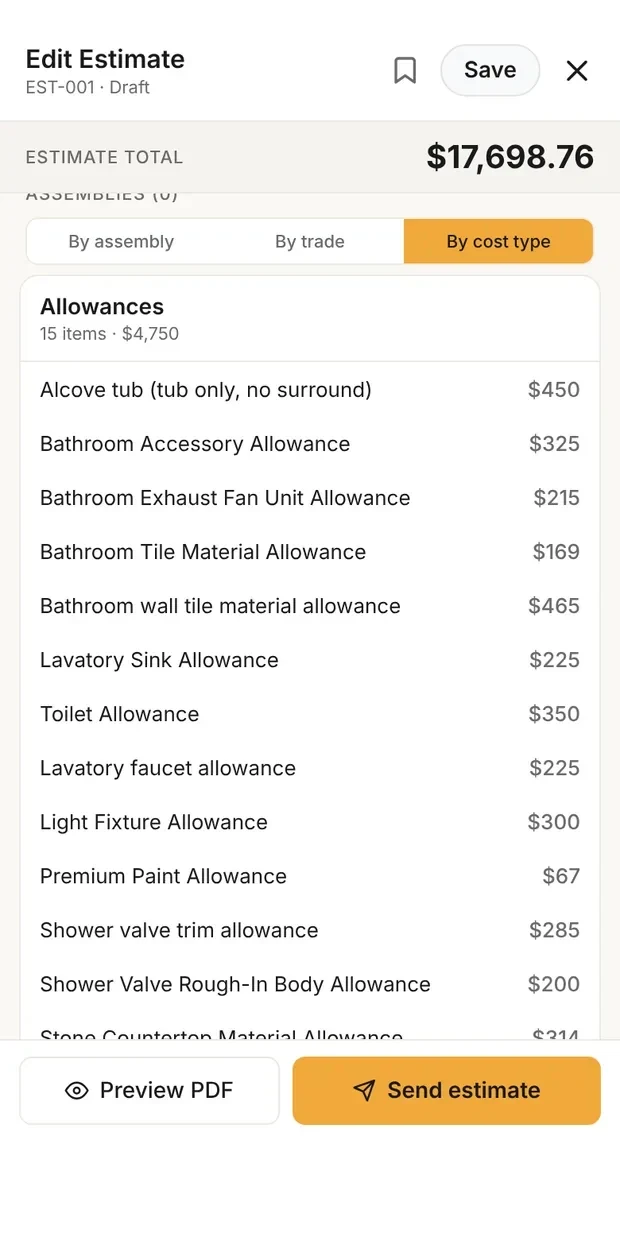
Grouped by cost type
The published 5x8 bathroom in Clamp: the estimate's totals and where the money goes, and the same lines grouped by cost type. The app rounds these views to the dollar. Demo data on the published 5x8 bathroom.
The same lines, by trade:
| Trade | Amount |
|---|---|
| Tile | $3,007.83 |
| Plumbing | $2,940.00 |
| Vanity & Fixtures | $1,982.15 |
| Carpentry | $1,187.50 |
| Electrical | $1,035.00 |
| Demo & Prep | $970.00 |
| Painting | $296.69 |
| HVAC | $215.00 |
| General | $85.00 |
| Flooring | $80.00 |
| Direct cost | $11,799.17 |
This is the rule that protects you. An estimate does not pretend uncertainty is certainty.
Do not let an unknown silently become a zero-dollar assumption, and do not let a required operation disappear from the estimate. Then review the finished estimate before it goes anywhere. Stone recommends a knowledgeable second checker; without one, set the estimate aside for a few days and review it again with fresh eyes (Estimating Construction Profitably, chapter 11).
Our own published 5x8 bathroom exposed the second problem. Earlier versions carried installation work for accessories, light fixtures and a mirror without carrying all of the corresponding supplied items. The arithmetic on every included line could be right while the estimate was still incomplete. An outside market check caught the omissions, and the version shown here corrects them.
Decide these before the estimate goes out.
| Decision | This guide's practice | Why |
|---|---|---|
| Who sees the estimate | You may send it; this guide recommends sending only the proposal | The proposal is the offer; the estimate is your cost buildup |
| Internal cost rates and markup | Never shown to the customer | The customer buys a defined scope at a price (Stone) |
| How long the price holds | 30 days, printed on the proposal | This guide's practice. Stone recommends three days. See the proposal guide |
| A mistake found before sending | Correct the same estimate | A correction fixes the estimate you meant to make |
| A changed job, or any change after sending | Revise it: a new version, then a new proposal | A revision reflects a changed job |
| A changed job after signing | A signed change order | The signed proposal is the baseline |
A correction fixes an internal draft before it is sent: a typo, an arithmetic error, a wrong rate, or a clearer note that does not change the intended scope. A revision changes an estimate after it has been sent, or reflects a changed scope, quantity, allowance, site condition, subcontractor quote, markup, contingency or alternative. Once the proposal is signed, changed work is no longer an estimate revision. It is a change order. How long a price holds is covered in How to Write a Construction Proposal.
The estimate becomes a proposal option. Linking it fills the option's scope at customer price. Once the estimate is sent, its markup and contingency are frozen. From there:
What customers say about an estimate, and what to say back.
| The customer says | What to say back |
|---|---|
| "Why is yours higher?" | Compare scope, quantities, selections, allowances and exclusions before totals. A lower number can carry less work or smaller allowances. |
| "Can you break down every cost?" | The proposal shows exactly what you are buying. How we price it is ours, like any business. |
| "Can you just give me a ballpark?" | If your sales process uses an early planning range, label it clearly as a range, not an estimate. A firm price waits until the scope, quantities, selections and conditions support it. Stone is more cautious: he treats repeated ballpark requests as a qualifying question (Profitable Sales, chapter 16). |
| "The other contractor's tile allowance is lower." | Compare what each allowance buys: the quantity and the product level. |
| "Can you guarantee there's no hidden damage?" | No one can before the walls are open. The estimate says what it assumes, and a discovery is handled under the signed agreement. |
| "Can you hold this price for a few months?" | The proposal holds for 30 days. After that, we review the price and the schedule and issue a new one. |
| Mistake | Instead |
|---|---|
| Estimating in no particular order | Follow the order the job is built (Stone, chapter 6) |
| A lump sum hiding several operations | One line per operation |
| Forgetting other direct costs: permits, dump fees, equipment | Go through the estimate sheet in sequence; these are job cost |
| Guessing what a sub's quote covers | Quote against your specs and ask (Stone, chapter 9) |
| Vague or unrealistic allowances | Few allowances, each with an amount and a basis (Stone, chapter 15) |
| Pricing an unknown as if it were known, or leaving out a required operation | An allowance, an assumption, or an investigation; then review |
| Marking up before every cost is in | Job cost first, then markup (Stone, chapter 11) |
| Skipping the review | A second checker, or fresh eyes a few days later (Stone, chapter 11) |
| Sending the estimate sheet as the contract | Write a proposal |
| Using someone else's rates or markup | Published figures are a starting point; price from your own costs |
What it means
Estimates in Clamp
Each line carries a description, quantity, unit, rate and one of 14 cost categories. Lines can come from saved assemblies, and your own catalog rates take priority over the baseline rates. You can start an estimate by describing the job, typed or spoken; Clamp drafts the assemblies and you edit them. Project conditions, such as a vacant house or difficult access, adjust the baseline. The builder shows subtotal, contingency, markup, credits, tax and total, in that order, and groups the lines by assembly, trade or cost type. Your markup comes from your Profit Goal, and each estimate is Normal, High-risk, Change order or Custom. The PDF can show or hide includes, excludes and assumptions, and can carry a concealed-conditions disclosure. Once it is sent, its markup and contingency are frozen. Link the estimate to a proposal option and its lines fill the option at customer price; internal cost lines never appear on the customer's proposal PDF.
Check what goes in job cost in What is job cost, and score your Pricing system in the contractor business self-assessment.
Sources & provenance
- Estimating Construction Profitably Michael C. Stone (book)
- Profitable Sales: A Contractor's Guide Michael C. Stone (book)
- 5×8 Bathroom Remodel Cost and Labor (2026 Baseline) Clamp Research
- 5x8 bathroom remodel, published itemized estimate (data file) Clamp Research
- The Markup You Add Is Not the Margin You Keep Clamp Research