How to Set a Payment Schedule and Invoice a Remodeling Job
A payment schedule that bills each stage when it starts, so you never finance the customer's job. What an invoice includes, how to write the payment terms, a schedule built from a published bathroom estimate, and what to do when a payment is late.
The assumptions
This model assumes
- A residential remodel with a signed contract and a payment schedule
- The worked example is the published 5×8 bathroom at the Established profile's 1.50x markup
- The example assumes every allowance is paid for before the first stage payment; on a real job, use what you actually must pay or commit
- The owner's practice: a deposit sized to cash need, stage payments due at the start, a 2% final payment, written notice before stopping work
- Sample language is a drafting example, not legal advice. Have your payment terms reviewed in your state.
The model, step by step
The invoice does not set the contract price or change the scope. It bills an amount that has become due under the signed agreement. The payment schedule itself is written into the proposal; see How to Write a Construction Proposal.
| Document | What it does |
|---|---|
| Proposal or contract | Sets the price and the payment schedule |
| Start notice | Tells the customer when a stage begins, so its payment is due |
| Change order | Amends the scope, price, schedule or payment terms, one change at a time |
| Invoice | Bills a payment that is due under the contract or a signed change order |
| Final balance | Collects what remains at completion |
Michael C. Stone, a builder and remodeler with more than six decades in the industry and the author of Profitable Sales, Estimating Construction Profitably and Markup & Profit: A Contractor's Guide, Revisited, the books this guide draws on, puts the principle plainly: a contractor is in construction, not lending. In Markup & Profit, chapter 7, he builds the payment schedule around the contractor's cash flow and makes progress payments due at the start of each work segment. He treats the signed schedule itself as notice of when each payment is due. The invoice is the record of it.
Every invoice needs the same core facts.
| Item | Include |
|---|---|
| Invoice number, date and due date | Always |
| The customer, the project and the contract it bills against | Always |
| The payment being billed, named as the schedule names it | Always |
| Amount, payments and credits already applied, and the balance due | Always |
| How to pay | Usually |
| Signed change orders not yet billed | Depending on the invoice |
| Sales tax, where it applies to your work | Depending on the invoice |
| Custom lines, when the invoice is not simply the next payment | Depending on the invoice |
| Lien-waiver or other forms your contract, lender or state requires | Only if listed |
The language below is a drafting example, not legal advice. Have your contract and payment terms reviewed in your state.
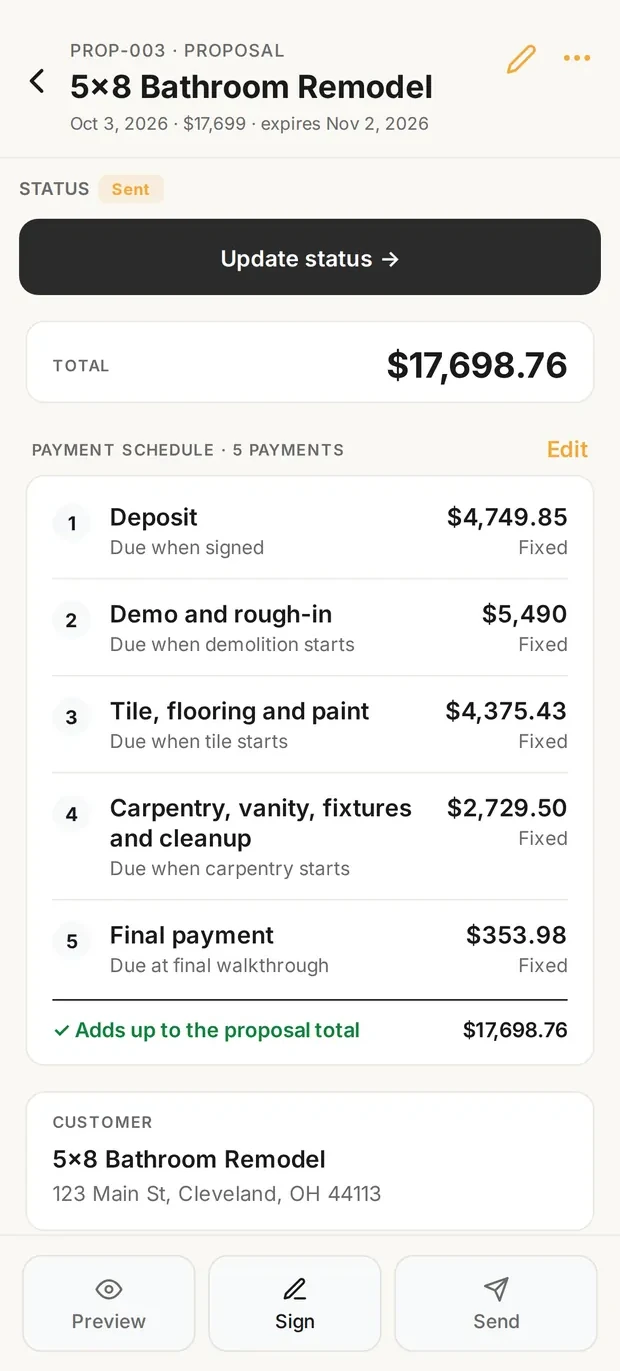
The schedule
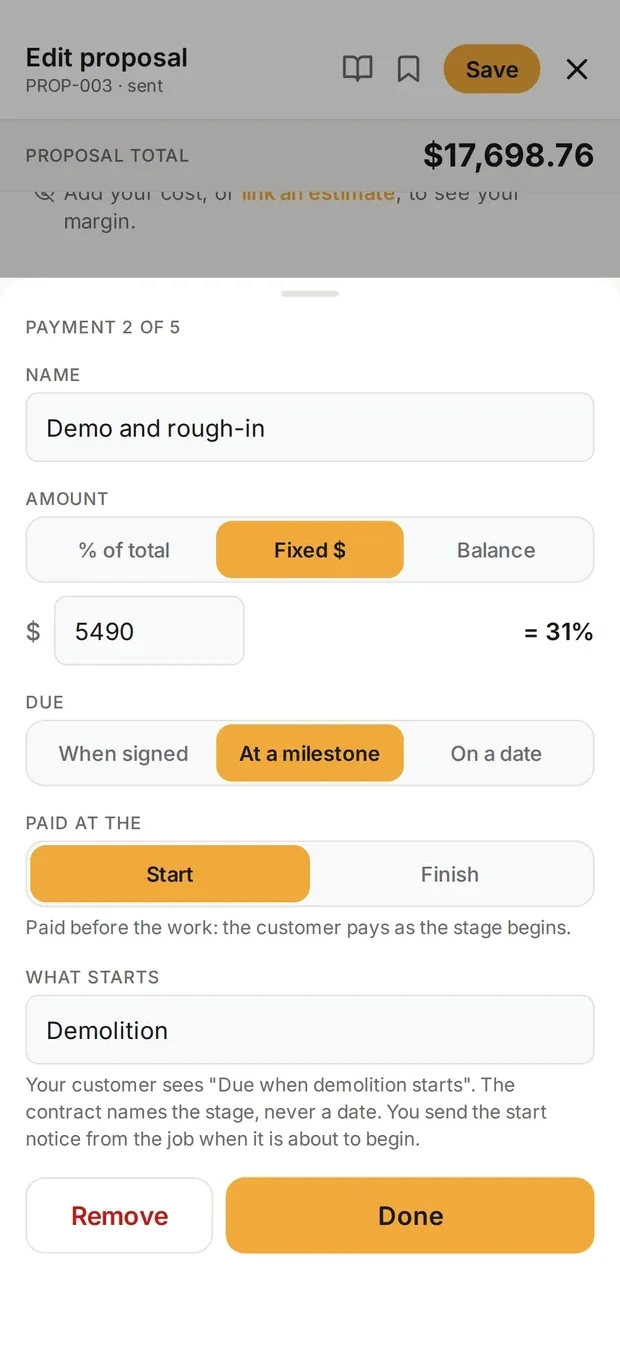
Paid at the start
A payment schedule in Clamp: the proposal's five payments, then one stage payment set to be due when its stage starts. Demo lead; the figures are the worked example in step 4.
The contract names the stage, never a date. If the start moves, the payment moves with it, so a late start never makes the customer late.
Start from cash flow, not a percentage. Stone's rule in Markup & Profit, chapter 7, is that the customer's money finances the customer's job: several progress payments, each due at the start of a segment, sized to what that segment needs. This example is the published 5×8 bathroom: $11,799 in direct cost, at the Established profile's 1.50x markup, a contract of $17,699.
The deposit covers the cash the job needs before the first stage payment. The bathroom carries $4,750 in allowances: tub, toilet, sink, faucet, shower valve and trim, tile, paint, vanity, countertop, mirror, light fixtures, accessories and exhaust fan. For this illustration, assume all of them have to be bought before the first stage payment arrives, so the deposit is $4,750, 27% of the contract. The share is high because the selections are a large part of a small bathroom's cost. On a real job, use what you actually have to pay or commit before the first stage payment, which may be less than every allowance, or include permits, engineering or subcontractor deposits.
Each stage bills what it is worth, less what the deposit already paid. A stage is worth its direct cost at 1.50x. Each selection is assigned to the stage that installs it, and its cost comes off that stage, so the same dollars are not collected twice. The deposit advances the selections' direct cost, not their selling price; the markup on them is collected in the stage payments. The estimate's trades fall into four groups; the last two, carpentry, vanity and fixtures ($3,170) and cleanup ($85), are billed as one stage, with $354 held back as the final payment.
| Payment | Cost | Value | Amount |
|---|---|---|---|
| Deposit | $4,750 | ||
| Demo and rough-in | $5,160 | $7,740 | $5,490 |
| Tile, flooring, paint | $3,384 | $5,077 | $4,375 |
| Carpentry, fixtures | $3,255 | $4,882 | $2,730 |
| Final | $354 | ||
| Total | $11,799 | $17,699 | $17,699 |
Cost is the stage's direct cost from the estimate, and Value is that cost at 1.50x. The deposit is due at signing and the final payment at completion; the stages are due when they start. Each Amount is the Value less the selections the deposit already paid for in that stage: the tub, plumbing fixtures, light fixtures and fan ($2,250), the tile and paint ($701), and the vanity, countertop, mirror and accessories ($1,799, plus the $354 held for the final payment). Each column is rounded to the dollar so it adds to its total.
The final payment is 2% of the contract. In Markup & Profit, chapter 7, Stone keeps it at about 2% or less, and in Profitable Sales, chapter 12, he says plainly that this is his method, not an industry standard. A small final payment means a slow last check costs you little.
Check your state before you copy this. Some states limit deposits and progress payments on home improvement work. In California, a deposit may not exceed $1,000 or 10% of the contract, whichever is less, and apart from the deposit a contractor may not ask for or accept more than the value of the work performed or materials delivered (Business and Professions Code section 7159.5). For a home improvement contract covered by that section, billing a whole stage because it is about to start does not fit the rule. Build the schedule around work performed and materials delivered, keep the deposit within the cap, and have the schedule reviewed where you work.
This is the rule that protects you: build the schedule so you are not expected to fund the customer's stage from company cash.
Completion billing: you incur the stage's costs, the work is done, then the payment becomes due.
Start billing: the stage is ready to begin, the payment becomes due, then you incur the stage's costs.
When a payment is missed, stop spending into the stage it was supposed to fund. Stone's practice is to deal with an overdue payment at once and shut the job down if the customer does not cure it under the contract. This guide's practice is a written notice first, then stopping work as the contract and your state's law allow.
That is a drafting example, not legal advice. Notice periods and stop-work rights vary by contract and state.
Write your choices into the contract, so the customer knows them before the first payment comes due.
| Decision | Practice | Why |
|---|---|---|
| Stage payments | Due when the stage starts | Keeps collections in step with the costs each stage creates |
| When "done" is right | When you choose to carry that stage, or when the law does not allow collecting it in advance | The choice is yours, payment by payment |
| Deposit | Sized to what must be paid or committed before the first stage payment, within your state's cap | It is the cash need, not a percentage |
| Final payment | About 2% of the contract | Little is left at risk at the end (Stone) |
| Due date on a start payment | The planned start | The contract trigger is the start, so no Net 15 is needed |
| A missed payment | Written notice, then stop work under the contract | Do not keep funding a stage that was not paid for |
| Retainage | None unless the contract, lender or law requires it | Stone argues it leaves you financing work already earned |
The deposit invoice is drafted when the proposal is signed. Review it and send it. Before each stage, send the start notice: it makes the payment ready to invoice, due on the planned start. If the start moves, move it, and any open invoice for that payment moves its due date with it, so the customer is never late because the schedule slipped. For a done payment, you can invoice ahead: create the invoice now, due on the planned finish.
Signed change orders that are not yet billed go on the next invoice, or wherever the change order says. An invoice never changes the contract on its own; see How to Write and Price a Change Order. Credits apply to new invoices by default. Partial payments and refunds are recorded on the invoice, so the paid and credited amount and the balance due always reconcile. The final balance bills whatever remains on the contract. A wrong invoice is voided, never deleted, so the record stays whole.
Most objections are answered by the signed schedule itself.
| The customer says | What to say back |
|---|---|
| "I'll pay when it's all done." | Each payment is tied to a stage named in the agreement you signed, so the whole price is not left until the end. |
| "Why am I paying before you start?" | The agreement makes this payment due when the stage starts, so the contractor is not expected to fund that stage first. It is tied to the stage, never to a date. |
| "The start moved. Why is this still due?" | It is due when the stage starts. If the start moved, so did the due date. |
| "Can I hold back until the punch list is done?" | The final payment is small for exactly this reason. Completion and the punch list are defined in the contract, before work begins. |
| "Can I pay part now?" | Yes, and it is recorded. The rest of the payment is still due under the schedule. |
| "Why is this invoice higher?" | Compare it with the signed schedule and change orders. An invoice never raises the price on its own. |
| Mistake | Instead |
|---|---|
| Setting the deposit as a round percentage | Size it from what you must pay first, within your state's cap |
| Billing a stage after you have paid for it | Bill it when it starts, where your state allows |
| Vague triggers, like "when rough-in is mostly done" | Name a start the customer can see |
| Leaving a large final payment | Keep it to about 2% |
| Not walking through the schedule before signing | Explain every payment at the contract |
| Putting a date in the contract for a start payment | Name the stage, and move the planned date |
| Working on after a missed payment | Notice, then stop work under the contract |
| Changing the price on an invoice | Sign a change order first |
| Deleting a wrong invoice | Void it |
What it means
Payment schedules in Clamp
Each stage payment is due when the stage starts or when it's done, and your default lives in Settings › Document defaults. The proposal, PDF and portal print the agreement's own line, such as "Due when demolition starts". Send start notice sets the planned start and sends the message: on Assistant and Teams, Clamp emails it and sends you a copy; on any plan, it can go by text or email from your phone. Move start carries open invoices with it, and invoice ahead bills a done payment before the finish. Clamp does not process payments or add late fees; the invoice shows your payment links and you record each payment.
Price the job first in the 5×8 bathroom cost breakdown, and score your Operations system in the contractor business self-assessment.
Sources & provenance
- Markup & Profit: A Contractor's Guide, Revisited Michael C. Stone (book)
- Profitable Sales: A Contractor's Guide Michael C. Stone (book)
- California Business and Professions Code section 7159.5 State of California (official source)
- 5×8 Bathroom Remodel Cost and Labor (2026 Baseline) Clamp Research
- How to Write and Price a Change Order Clamp Research