Section 179 for a Work Truck Over 6,000 lbs (2026): Worked Both Ways
A pickup rated over 6,000 pounds with a 6-foot bed can be written off in its first year, up to the business share of its cost. The 2026 limits, a $68,000 truck worked under Section 179 and under bonus depreciation, and the mileage log that keeps the deduction.
The assumptions
This model assumes
- A sole proprietor or single-member LLC filing Schedule C, calendar year
- $68,000 truck acquired after January 19, 2025 and placed in service in March 2026
- 80% business use from a mileage log, kept above 50% unless stated
- Net business profit of $150,000 before the truck, and no other large purchases
- Federal amounts; state returns are covered in step 7. Not tax advice for a specific return
The model, step by step
A work truck gets the full first-year write-off only if all five are true. Check them in this order; a no on any one changes the answer.
1. Rated over 6,000 pounds
Where to lookThe gross vehicle weight rating (GVWR) on the label in the driver's door jamb. Not the curb weight, and not the brochure for the model line.
If notThe truck is a passenger automobile for depreciation, capped at $20,300 in year one (step 4).
2. A bed at least 6 feet long inside
The testA cargo area of at least 6 feet interior length, open or under a cap, that you can't reach directly from the cab.
If notSection 179 is generally held to $32,000 under the SUV ceiling (step 4). Bonus depreciation still covers the rest.
3. More than 50% business use, logged
The testBusiness miles divided by total miles, with commuting counted as personal.
If notNo Section 179 and no bonus at all. Straight-line only.
4. Placed in service by December 31, 2026
The testDelivered and ready and available for use in the business in 2026. A signed order or a deposit is not enough.
If notThe deduction moves to the year you put it to work.
5. Acquired after January 19, 2025
The testAcquired under the binding contract rules after that date for the 100% bonus rate.
If notA truck acquired earlier and placed in service in 2026 gets 20% bonus. Section 179 is unaffected.
Two separate write-offs can expense a qualifying truck in year one. Section 179 is an election you make truck by truck, in any amount up to the limit. Bonus depreciation applies automatically to all property of the same class unless you elect out.
| Item | 2026 amount |
|---|---|
| Section 179 limitTax years beginning in 2026 | $2,560,000 |
| Phase-out startsTotal qualifying property placed in service, not income | $4,090,000 |
| SUV ceiling on Section 179Was $31,300 for 2025 | $32,000 |
| Bonus depreciationAcquired after January 19, 2025 | 100% |
| Passenger auto cap, year oneRated 6,000 lb or less, with bonus; $12,300 without | $20,300 |
Section 179 can't exceed your taxable income from the active conduct of any trade or business, which includes W-2 wages from a job; the rest carries forward. Bonus has no income limit and can create a loss. That is the main reason a slow year changes which one to use.
A remodeler buys a $68,000 crew cab rated 7,200 pounds with a 6.5-foot bed and puts it to work in March 2026. The mileage log shows 80% business use. Net profit before the truck is $150,000.
Only the business share is deductible, and it is the same base for either write-off. Section 179 takes the lesser of that share, the $2,560,000 limit and the $150,000 of business income. Bonus takes 100% of the share. The other $13,600 is personal and never deductible.
The two paths give the same number on this truck. They part ways in three cases: business income below $54,400, counting W-2 wages (bonus still deducts the full amount; Section 179 carries the excess forward), wanting less than the full write-off (Section 179 can be any amount on one truck), and the states in step 7 that follow one rule and not the other.
Change one fact about the same truck and the answer moves.
| Version | Year one |
|---|---|
| 7,200 lb, 6.5 ft bedNo ceiling applies | $54,400 |
| 7,200 lb, 5.5 ft bed$32,000 Section 179 + $22,400 bonus | $54,400 |
| 5.5 ft bed, bonus elected out$32,000 + 20% MACRS on $22,400 | $36,480 |
| 5,800 lb GVWR$20,300 cap x 80% | $16,240 |
After the SUV ceiling, bonus covers the rest. Electing out of bonus leaves 20% first-year MACRS on it. The lighter truck is held to the passenger auto cap times business use.
The short bed costs nothing federally while 100% bonus is available. The 1,400 pounds of GVWR between 7,200 and 5,800 costs $38,160 of year-one deduction; the rest comes back slowly over later years.
The more-than-50% test isn't checked once. It applies every year through the end of the truck's 5-year recovery period, which under the half-year convention reaches a sixth tax year (2031 for this truck), and the evidence is your mileage log: the date, the miles, the destination and the business purpose of each trip, with odometer readings at the start and end of the year. The IRS does not accept estimated percentages.
If business use falls to 50% or less in a later year, you add back to income everything you deducted above what 5-year straight-line would have allowed. Here use drops to 45% in 2028, after 80% in 2026 and 2027; straight-line would have allowed $16,320 of the $54,400.
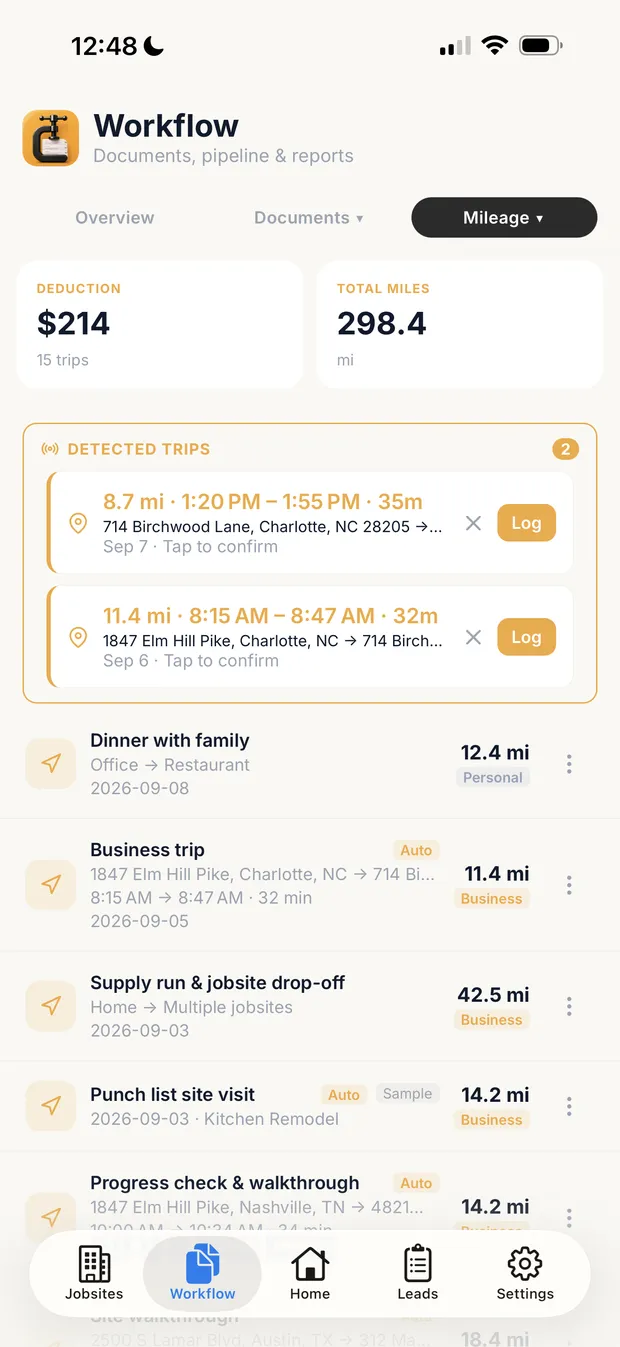
Detected, then confirmed
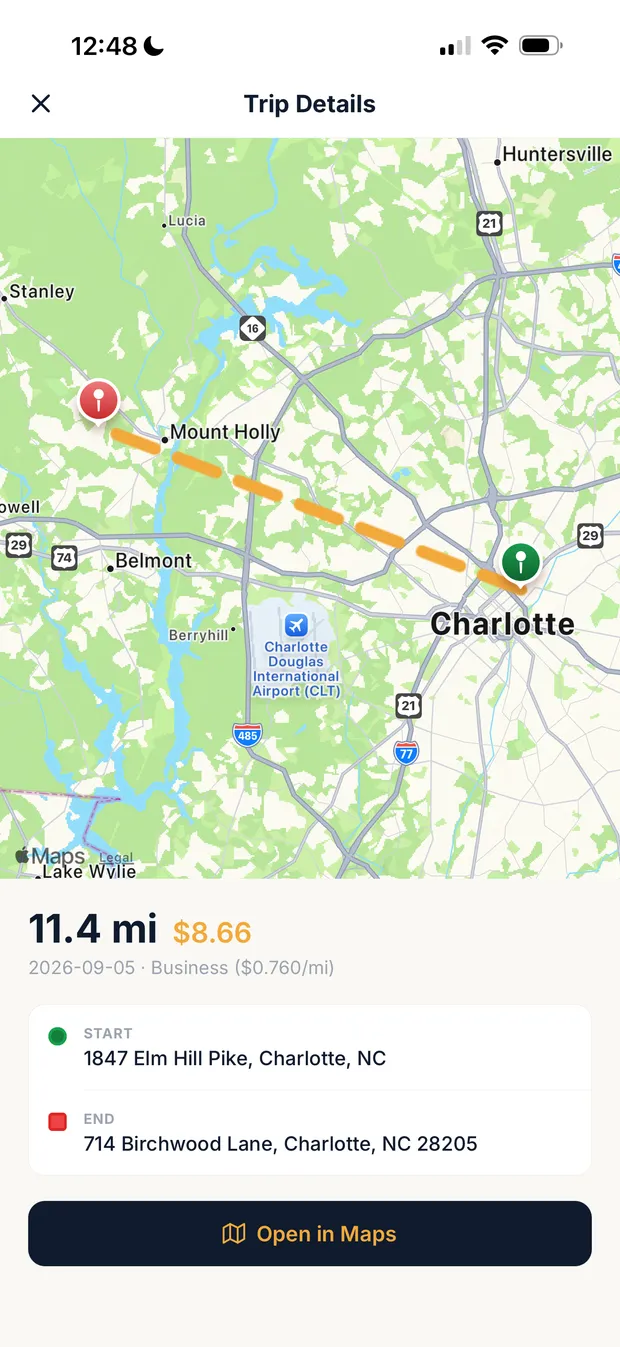
Rate by trip date
Sample data. Detected drives wait for confirmation before they count, a logged trip can sit on the job it belongs to, and each trip carries the IRS rate for its own date.
Claiming Section 179 or bonus on a vehicle ends your use of the standard mileage rate for it. Choosing the rate instead in year one keeps it, but then the later switch to actual costs allows straight-line depreciation only. On 18,000 business miles in 2026, split evenly between the two rate periods, the rate gives $13,365.
The $54,400 is depreciation alone; under actual costs you also deduct the business share of fuel, insurance and repairs, which the rate already includes. The rate keeps paying every year you drive, and it builds in depreciation of 35 cents a mile. A contractor who expects to keep a truck many years and drive it hard should run both over the years they expect to own it. For most, the first-year write-off is larger, and it locks the choice.
Selling the truck turns earlier depreciation back into ordinary income, up to the gain. A trade-in is a sale of the old truck and a separate purchase of the new one; vehicle trades stopped qualifying as like-kind exchanges after 2017.
Your state may not follow the federal amounts.
California
Section 179$25,000 maximum, reduced above $200,000
BonusNot allowed
New Jersey
Section 179$25,000 maximum
BonusNot allowed
New York
Section 179Follows federal for a pickup; the heavy SUV add-back excludes trucks
BonusAdded back, then recovered with regular depreciation
Pennsylvania
Section 179Federal limits, for tax years beginning 2023 or later
BonusNot allowed
What it means
Business use you can prove
Clamp records each drive with its date, distance, start and destination, and the job it belongs to, and marks it business or personal. Your business-use percentage is the sum of those trips, not a guess at year end. Detected trips wait for your review, because what counts as business is your call.
Before you sign for a truck, write three numbers down: the GVWR from the door jamb, the inside length of the bed, and last year's business-use percentage from your log. Those three decide which row of step 4 you are in.
Questions
Can I write off a truck over 6,000 lbs in 2026?
Yes, if it is rated over 6,000 pounds gross vehicle weight, used more than 50% for business, and placed in service by December 31, 2026. With a bed at least 6 feet long inside, Section 179 can expense the business share of its cost, up to your business income; with a shorter bed, Section 179 is capped at $32,000. 100% bonus depreciation can expense the business share with no income limit for a truck acquired after January 19, 2025.
Does a pickup with a 5.5 ft bed qualify for Section 179?
If it is rated over 6,000 pounds GVWR, it qualifies, but the 6-foot cargo area exception does not cover it, so Section 179 on it is generally capped at $32,000 for 2026. The cap limits Section 179 only; 100% bonus depreciation can usually cover the rest of the business share.
Is the 6,000 lb rule curb weight or GVWR?
For trucks and vans the IRS uses the gross vehicle weight rating, the loaded rating on the label in the driver's door jamb, not the curb weight. Exactly 6,000 pounds does not clear it.
Can I use the standard mileage rate after taking Section 179 on my truck?
No. Once you claim Section 179 or bonus depreciation on a vehicle, you can't use the standard mileage rate on it in a later year. Pick the method in the first year.
What happens if business use drops below 50%?
In the first year business use is 50% or less, you add back to income the depreciation you took above what 5-year straight-line would have allowed. On the $68,000 truck in this guide, a drop to 45% in the third year adds $38,080 of ordinary income.
Sources & provenance
- Publication 946, How To Depreciate Property (2025) Internal Revenue Service (official source)
- Rev. Proc. 2025-32, Internal Revenue Bulletin 2025-45 Internal Revenue Service (official source)
- Instructions for Form 4562 (2025) Internal Revenue Service (official source)
- Rev. Proc. 2026-15, Internal Revenue Bulletin 2026-13 Internal Revenue Service (official source)
- Notice 2026-11, Internal Revenue Bulletin 2026-06 Internal Revenue Service (official source)
- Publication 463, Travel, Gift, and Car Expenses (2025) Internal Revenue Service (official source)
- Notice 2026-10, Internal Revenue Bulletin 2026-04 Internal Revenue Service (official source)
- Announcement 2026-11, Internal Revenue Bulletin 2026-29 Internal Revenue Service (official source)
- Instructions for Form 4797 (2025) Internal Revenue Service (official source)
- 2025 Instructions for Form FTB 3885A California Franchise Tax Board (official source)
- GIT-DEP, Gross Income Tax Depreciation Adjustment Worksheet New Jersey Division of Taxation (official source)
- Instructions for Form IT-225 (2025) New York State Department of Taxation and Finance (official source)
- Tax Cuts and Jobs Act and One Big Beautiful Bill Act treatment Pennsylvania Department of Revenue (official source)