Year-End Equipment Purchases 2026: Section 179, Bonus Depreciation and the $2,500 Rule for Tools
Tools and equipment ready to use by December 31 can be written off on your 2026 return. The three rules, five December purchases worked, and what a dollar of equipment actually saves.
The assumptions
This model assumes
- A remodeler filing Schedule C as a sole proprietor, calendar year
- $140,000 of net profit before the December 2026 purchases
- Single filer in the 22% federal bracket, earnings under the Social Security wage base
- Equipment used 100% for the business; the de minimis election made for 2026
- Federal rules; states in step 8. Not tax advice for a specific return
The model, step by step
A purchase is deducted in the year it's placed in service: ready and available for its use in your business. Ordering or paying in December isn't enough. A machine sitting at the dealer, or a trailer that arrives in January, is next year's deduction.
Counts for 2026
Delivered and readyBy December 31, even if first used on a job in January
FinancedYes; the whole cost counts, not only what you paid down
Doesn't count for 2026
Paid, not deliveredOrdered or paid in December, delivered in 2027
A true leaseRent is deducted as you pay it; no Section 179 on the price
Small tools, consumables and big equipment each have their own rule. All three can put the full cost on your 2026 return.
| Rule | Limit |
|---|---|
| De minimisEach item or invoice; an election you make on each year's return | $2,500 each |
| Section 179Equipment you choose; can't exceed business income, wages included; the rest carries forward | $2,560,000 |
| BonusAcquired after January 19, 2025; the whole class unless you elect out; no income limit | 100% |
Blades, bits and other supplies of $200 or less, or that last 12 months or less, are deducted when you use them, or when paid if you've elected the de minimis safe harbor.
The de minimis safe harbor lets you expense any tool that costs $2,500 or less, without depreciation schedules or the Section 179 limits.
Per item or per invoice
Rule$2,500 or less per invoice, or per item when the invoice lists each item's price
SoA $4,200 invoice for a $1,800 kit and a $2,400 saw passes, if both are priced separately
Count everything on the invoice
IncludesDelivery and other charges on the same invoice, shared across the items
WatchDelivery can push a $2,400 saw over $2,500; then use bonus or Section 179
How to elect it
Each yearAttach the de minimis election statement to your return, filed on time
PolicyHave it in place on January 1 and expense these items in your books; without audited financials it needn't be written
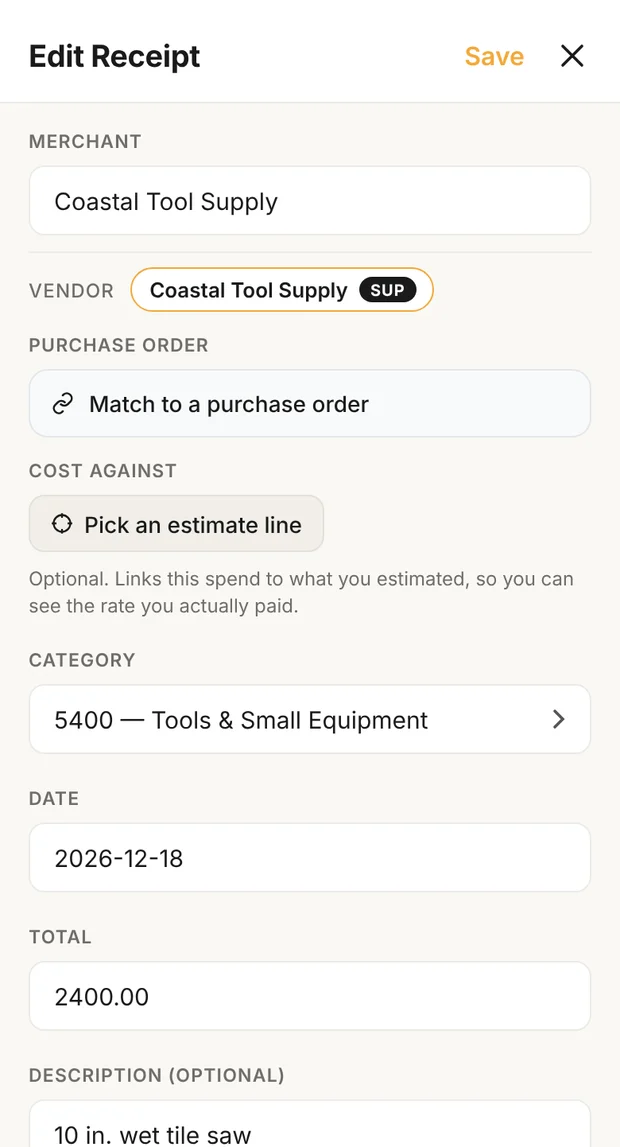
The receipt, dated
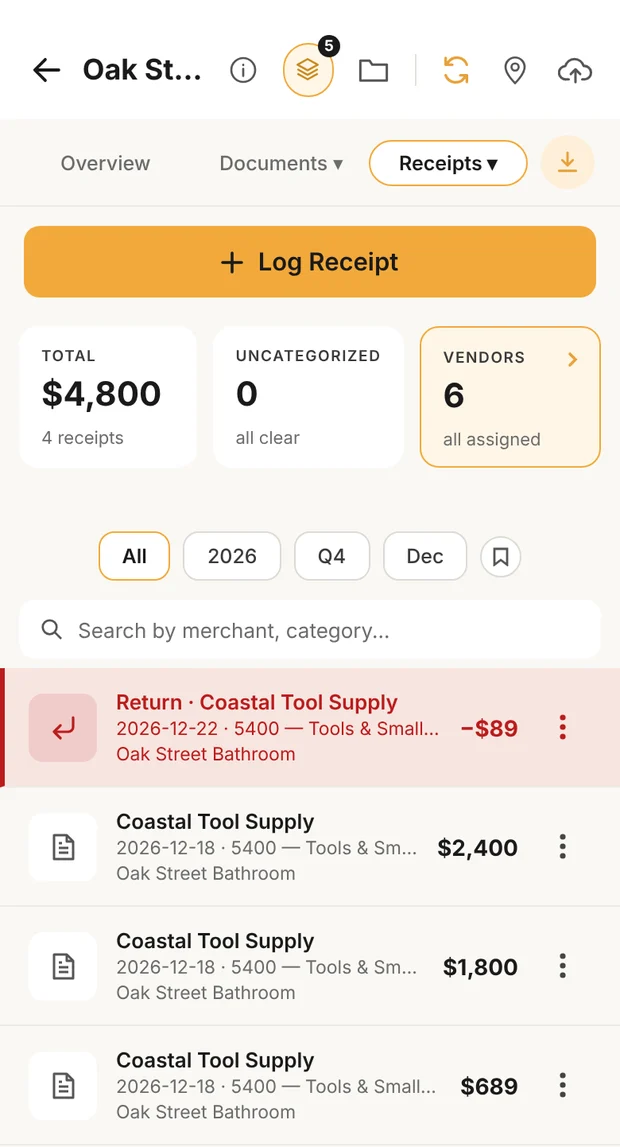
A return as its own entry
December's tool receipts in Clamp: the tile saw with its date and total, and the job's receipts with a returned blade as its own entry. Demo data.
A remodeler on Schedule C with $140,000 of net profit before these buys in December 2026, with the de minimis election made.
| Purchase | Rule | 2026 |
|---|---|---|
| $1,800 tool kitOne invoice, every tool under $2,500 | De minimis | $1,800 |
| $2,400 tile sawIf delivery doesn't push it over $2,500 | De minimis | $2,400 |
| $14,500 used skid steerFinanced, ready December 20; bonus gives the same | Section 179 | $14,500 |
| $9,000 trailerPaid December 15, delivered January 8: a 2027 deduction | Not yet | $0 |
| $600 blades and bitsSupplies, expensed with the election | De minimis | $600 |
A deduction isn't money back. On Schedule C it lowers self-employment tax and income tax, but less of each than the quick math suggests, because two other deductions shrink with it: half of self-employment tax, and the 20% qualified business income deduction.
The $17,936.50 is $19,300 less the $1,363.50 drop in the deductible half of self-employment tax. Without the qualified business income effect the savings are $6,673.03. The quick "22% plus 15.3%" math says $7,199, which overstates it.
Each dollar deducted saves about 30 cents. Buying $10,000 of equipment you don't need, just for the deduction, still costs you about $7,000.
Three rules decide whether the write-off sticks.
Used equipment
QualifiesFor Section 179 and bonus, if you never used it before and didn't buy it from a related party
More than 50% business use
RequiredFor Section 179 on any asset; a tool used mostly for personal projects doesn't qualify
If it dropsFalling to 50% or less in a later year brings part of the Section 179 deduction back into income
Selling it
RecaptureGain up to the depreciation you took is ordinary income, Section 179 and bonus included
ExampleA skid steer expensed at $14,500 and sold for $9,000 adds $9,000 of ordinary income
Bonus depreciation is elected out by class, so the class matters if you want less than a full write-off. Almost everything a remodeler buys is 5-year property.
| Equipment | Years |
|---|---|
| Construction tools and equipmentClass 15.0, Construction: saws, skid steers, compressors | 5 |
| Pickups and work trucksClasses 00.241 and 00.242 | 5 |
| TrailersClass 00.27 | 5 |
| ComputersClass 00.12; not listed property since 2018 | 5 |
| Office furnitureClass 00.11 | 7 |
Several states don't allow the federal write-off, so the same purchase is deducted differently on your state return. Keep a federal and a state depreciation schedule.
California
Section 179$25,000, reduced above $200,000
BonusNot allowed
New Jersey
Section 179$25,000
BonusNot allowed
Pennsylvania
Section 179Federal limits
BonusNot allowed
New York
BonusAdded back, then recovered with regular depreciation
Ohio
BonusGenerally 5/6 added back, then deducted over the next five years
Section 179Only the part above $25,000 is added back, generally 5/6
Illinois
BonusReversed through its own depreciation adjustment
What it means
The invoice that proves the deduction
Clamp keeps every receipt and bill on the job it belongs to, with the vendor, the date and the photo. At year end the accountant package exports any date range, so your preparer gets the December invoices without a shoebox. Clamp doesn't figure depreciation; your preparer does, from those records.
List what you plan to buy before year end. Next to each item write its price per invoice line and the date it will be ready to use. Anything over $2,500 goes to Section 179 or bonus, and anything ready after December 31 goes on next year's list.
Questions
Can I write off tools I buy in December 2026?
Yes, if they're ready to use in your business by December 31. Tools of $2,500 or less per item on the invoice can be expensed under the de minimis safe harbor if you elect it; larger equipment can be expensed with Section 179 or 100% bonus depreciation.
What is the Section 179 limit for 2026?
$2,560,000 for tax years beginning in 2026, reduced dollar for dollar once you place more than $4,090,000 of qualifying property in service. It also can't exceed your business income, including wages; the rest carries forward.
Does equipment ordered in December but delivered in January count for 2026?
No. The deduction goes to the year the equipment is ready and available for use. Paying or ordering in December doesn't count; a trailer delivered January 8, 2027 is a 2027 deduction.
Does Section 179 reduce self-employment tax?
On Schedule C, yes. The deduction lowers net profit, and self-employment tax is figured on net profit. For an S corporation owner, it doesn't reduce payroll taxes on their wages.
Is it worth buying equipment at year end to save taxes?
Only if you need it. Each deducted dollar saves about 30 cents of federal tax for a contractor in the 22% bracket, so $10,000 of equipment you don't need still costs about $7,000.
Sources & provenance
- Rev. Proc. 2025-32, Internal Revenue Bulletin 2025-45 Internal Revenue Service (official source)
- Publication 946, How To Depreciate Property (2025) Internal Revenue Service (official source)
- Notice 2026-11 Internal Revenue Service (official source)
- Instructions for Form 4562 (2025) Internal Revenue Service (official source)
- 26 CFR 1.263(a)-1, the de minimis safe harbor Electronic Code of Federal Regulations (official source)
- Notice 2015-82, Internal Revenue Bulletin 2015-50 Internal Revenue Service (official source)
- Tangible property final regulations Internal Revenue Service (official source)
- 26 CFR 1.162-3, materials and supplies Electronic Code of Federal Regulations (official source)
- Income and expenses FAQ: equipment lease or conditional sale Internal Revenue Service (official source)
- Instructions for Form 4797 (2025) Internal Revenue Service (official source)
- Self-employment tax (Social Security and Medicare taxes) Internal Revenue Service (official source)
- Instructions for Form 8995 (2025) Internal Revenue Service (official source)
- 2025 Instructions for Form FTB 3885A California Franchise Tax Board (official source)
- GIT-DEP, Gross Income Tax Depreciation Adjustment Worksheet New Jersey Division of Taxation (official source)
- Form IT-398, New York State Depreciation Schedule for IRC Section 168(k) Property (2025) New York State Department of Taxation and Finance (official source)
- Tax Cuts and Jobs Act and One Big Beautiful Bill Act treatment Pennsylvania Department of Revenue (official source)
- Income: bonus depreciation Ohio Department of Taxation (official source)
- IL-4562 instructions Illinois Department of Revenue (official source)